ISLAMABAD: An Australian and a Canadian mountain climber died last week in northern Pakistan while attempting to scale K2, the world’s second-highest mountain, officials said Thursday.
The death of Matthew Eakin was announced by the Australian Department of Foreign Affairs and Trade, which expressed its “condolences to his family and friends.” His body was found through drone video on Thursday.
A Pakistani mountaineering official and the Canadian Press said the body of Richard Cartier, who went missing in a separate incident on the same mountain on July 19, had finally also been spotted by a search team on K2. Cartier was 60 and an experienced climber.
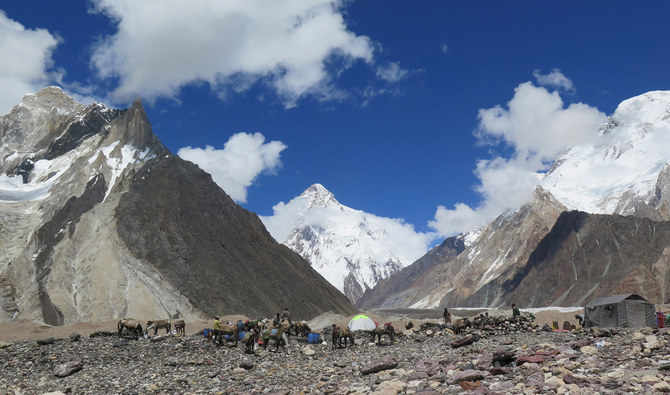
K2, on the Chinese-Pakistani border in the Karakorum Range, has one of the deadliest records, with most climbers dying on the descent, where the slightest mistake can trigger an avalanche and become fatal. Only a few hundred have successfully reached its summit. In contrast, Mount Everest, the world's highest mountain, has been summited more than 9,000 times.
Eakin’s devastated friends posted tributes on social media to honor him, saying his death was a huge loss to the mountaineering community. One friend, Felicity Symons, said about their 23 years of friendship: “I will always see your smile in the clouds. Rest easy my dear friend on the mountains you loved.”
Karrar Haidri, the deputy chief of the Pakistan Alpine Club, which coordinates search and rescue missions with Pakistan's government and military, confirmed the deaths of Eakin and Cartier.
“We extend our condolences to the friends and family members of the Australian and Canadian climbers who died on K2,” Haidri told The Associated Press.
Also last week, a third climber, Ali Akbar Sakki from Afghanistan, died on K2. Sakki suffered a heart attack while trying to scale the summit, Haidri said.
The Canadian Embassy in Islamabad did not immediately respond to a request for comment.
The Dawn, one of Pakistan's English-language newspapers, reported earlier this week that the two climbers had been spotted between Camp 1 and Camp 2 on K2 after they both went missing on July 19 in separate incidents.
K2 is also among the coldest and windiest of climbs. At places along the route, climbers must navigate nearly sheer rock faces rising 80 degrees, while avoiding frequent and unpredictable avalanches.


![]()

Australian, Canadian climbers die on Pakistan's K2
Short Url
https://arab.news/wzz56
Australian, Canadian climbers die on Pakistan's K2
- The two climbers had been spotted between Camp 1 and Camp 2 after they both went missing on July 19
- K2 is among the coldest and windiest of climbs, with only a few hundred successfully reaching its summit
Latest updates




© 2026 SAUDI RESEARCH & PUBLISHING COMPANY, All Rights Reserved And subject to Terms of Use Agreement.