

An old political prisoner warns against new Tunisian constitution

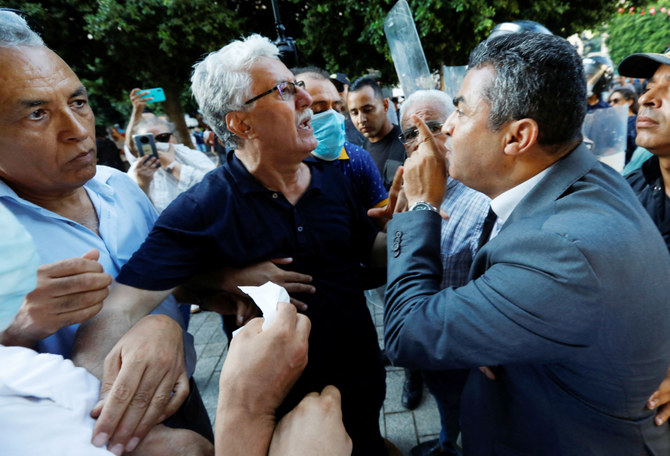
Hamma al-Hammami, a leftist activist and former political prisoner, confronts with police during a protest against the President Kais Saied's upcoming referendum in Tunis, Tunisia July 22, 2022. (REUTERS)
Short Url
Updated 25 July 2022
Follow

An old political prisoner warns against new Tunisian constitution

TUNIS: Hamma Al-Hammami knows the peril Tunisia risks if it slides back into autocracy, as he and opposition parties warn it may do if President Kais Saied passes his draft constitution in a referendum on Monday.
Hammami, a leftist political leader, was repeatedly imprisoned and tortured from 1972 until the 2011 revolution that brought democracy to Tunisia — a moment he experienced from inside an Interior Ministry cell hearing the crowd roar outside.
Now, he says, the struggle for freedom must resume after a decade in which Tunisians could say what they pleased, criticize their leaders and vote in fair elections.
“He is a sultan, not a president,” he said of Saied.
“The struggle for freedom and dignity will start again.”
Saied says his moves since last year to dismiss the parliament, take over government, rule by decree and rewrite the constitution — which his critics call a coup — were necessary to save Tunisia from years of stagnation.
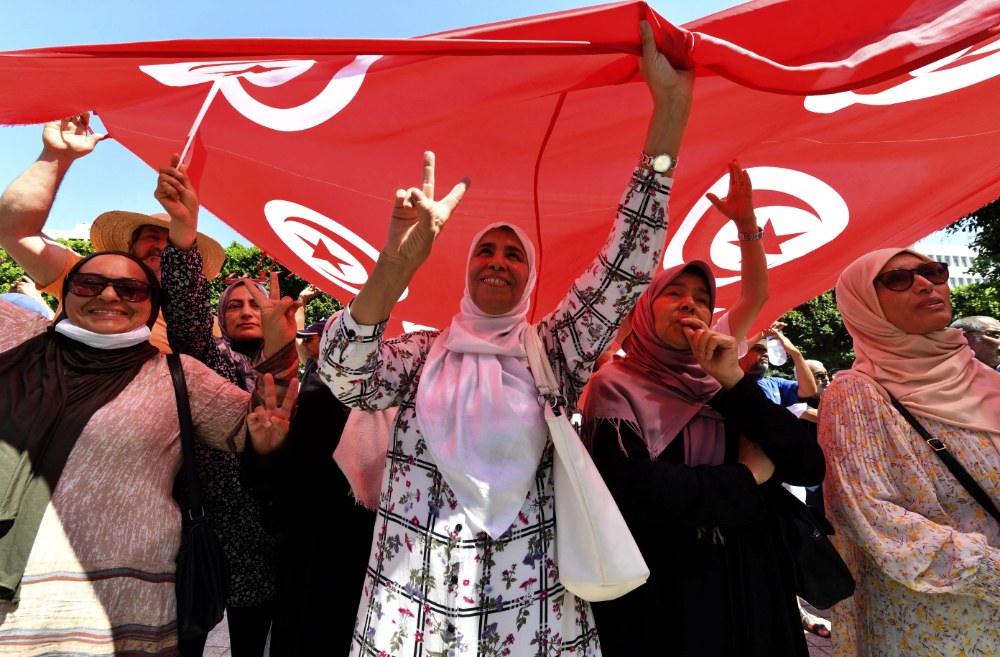


Tunisian protesters raise a flag on July 23, 2022, during a demonstration along Habib Bourguiba avenue in the capital Tunis, against their president and the upcoming July 25 constitutional referendum. (AFP)

While Tunisians have embraced the rights they won in 2011, they have suffered from economic decline, corruption and political in-fighting.
Saied has repeatedly vowed not to become a dictator and has said he will uphold the rights and freedoms secured after the 2011 revolution when autocratic leader Zine Al-Abidine Ben Ali was ousted.
However, his draft constitution brings nearly all powers under the president, removing most checks on his authority. While it guarantees freedoms in one clause, it makes them subject to new laws or undefined security needs in another.
There has been no widespread crackdown on dissent, banning of press or mass arrests of Saied’s opponents, but rights groups have concerns.
Last week Amnesty International warned against what it called an “alarming backsliding on human rights,” while a UN rapporteur on judicial independence also warned this month that Saied’s moves to bring the body overseeing judges under his control has raised concerns over the right to a fair trial.

TORTURE
Now 70, Hammami has been a political activist since his student days when he was arrested in 1972 under Tunisia’s first leader after independence, Habib Bourguiba, for protesting against state control of university organizations.
Accused of conspiring against state security, he was trussed “like a chicken,” beaten repeatedly including on the head and genitals, and burned with cigarettes, for hours, he said.
After a month of solitary confinement, torture and execution threats, including being thrown into an open grave with soil flung onto his body, he was released onto the streets of the capital.
Walking down the central Habib Bourguiba Avenue, where the Interior Ministry is located and where most major protests have taken place, he decided to devote himself to political activism.
Rising in Tunisia’s Communist movement, eventually becoming head of the Workers’ Party, he was imprisoned and tortured during 1974-80.
Though Bourguiba later publicly acknowledged that Hammami had been tortured, the persecution continued after Ben Ali seized power in 1987 as he spent years alternately in prison or in hiding, constantly changing his appearance and location.
When Tunisians rose up in December 2010 and January 2011, outraged by the self-immolation of a street seller, Hammami was again detained and taken to the same Interior Ministry cells.
“I heard the people like waves in the sea,” he said, tears pricking his eyes, of the tens of thousands rushing down Habib Bourguiba Avenue the day Ben Ali fled as Hammami listened from the cells.
The revolution began a new phase of his life. His wife, human rights lawyer Radhia Nasraoui, was feted by foreign countries and he was offered positions in the new democratic governments.
He turned them down and remained a vocal critic of successive governments, particularly of the Islamist Ennahda party that is now also a leading foe of Saied and the new constitution.
On Friday evening Hammami joined a small protest of political figures and civil society organizations against the referendum.
“Shut down Kais Saied,” Hammami chanted with the others, marching down Habib Bourguiba Avenue toward the Interior Ministry where he had so often been imprisoned.
Hours after Hammami told Reuters the struggle for freedom would start again, the police set upon his group of protesters, using pepper spray, sticks and arrests to disperse the demonstration.


Historic decree seeks to end decades of marginalization of Syria’s Kurds

Updated 4 sec ago
Follow

Historic decree seeks to end decades of marginalization of Syria’s Kurds

DAMASCUS/RIYADH: A decree issued by President Ahmad Al-Sharaa on Friday marks a historic end to decades of marginalization of Syria’s Kurdish minority and seeks to open a new chapter based on equality and full citizenship in post-liberation Syria.

The presidential action, officially known as Decree No. 13, affirms that Syrian Kurds are an integral part of the national fabric and that their cultural and linguistic identity constitutes an inseparable element of Syria’s inclusive, diverse, and unified national identity.

Al-Sharaa’s move seeks to address the consequences of outdated policies that distorted social bonds and divided citizens.

The decree for ⁠the first time grants Kurdish Syrians rights, including recognition of Kurdish identity as part of Syria’s national fabric. It designates Kurdish as a national language alongside Arabic and allows schools to teach it.

Al-Sharaa’s decree came after fierce clashes that broke out last week in the northern city of Aleppo, leaving at least 23 people dead, according to Syria’s health ministry, and forced more than 150,000 to flee the two Kurdish-run pockets of the city. The clashes ended ⁠after Kurdish fighters withdrew.

The Syrian government and the Kurdish-led Syrian Democratic Forces (SDF), that controls the country’s northeast, have engaged in months of talks last year to integrate Kurdish-run military and civilian bodies into Syrian state institutions by the end of 2025, but there has been little progress.

The end of an era of exclusion

For more than half a century, Kurds in Syria were subjected to systematic discriminatory policies, most notably following the 1962 census in Hasakah Governorate, which stripped thousands of citizens of their nationality and deprived them of their most basic civil and political rights.

These policies intensified after the now-dissolved Baath Party seized power in 1963, particularly following the 1970 coup led by criminal Hafez al-Assad, entrenching a state of legal and cultural exclusion that persisted for 54 years.

With the outbreak of the Syrian revolution in March 2011, Syrian Kurds actively participated alongside other segments of society. However, the ousted regime exploited certain separatist parties, supplying them with weapons and support in an attempt to sow discord and fragment national unity.

Following victory and liberation, the state moved to correct this course by inviting the Kurdish community to fully integrate into state institutions. This approach was reflected in the signing of the “March 10 Agreement,” which marked an initial milestone on the path toward restoring rights and building a new Syria for all its citizens.

Addressing a sensitive issue through a national approach

Decree No. 13 offers a balanced legal and political response to one of the most sensitive issues in modern Syrian history. It not only restores rights long denied, but also redefines the relationship between the state and its Kurdish citizens, transforming it from one rooted in exclusion to one based on citizenship and partnership.

The decree shifts the Kurdish issue from a framework of conflict to a constitutional and legal context that guarantees meaningful participation without undermining the unity or territorial integrity of the state. It affirms that addressing the legitimate demands of certain segments strengthens, rather than weakens, the state by fostering equal citizenship, respecting cultural diversity, and embracing participatory governance within a single, centralized state.

Core provisions that restore dignity

The decree commits the state to protecting cultural and linguistic diversity, guaranteeing Kurdish citizens the right to preserve their heritage, develop their arts, and promote their mother tongue within the framework of national sovereignty. It recognizes the Kurdish language as a national language and permits its teaching in public and private schools in areas with significant Kurdish populations, either as an elective subject or as part of cultural and educational activities.

It also abolishes all laws and exceptional measures resulting from the 1962 Hasakah census, grants Syrian nationality to citizens of Kurdish origin residing in Syria, including those previously unregistered, and guarantees full equality in rights and duties. In recognition of its national symbolism as a celebration of renewal and fraternity, the decree designates Nowruz Day (21 March) as a paid official holiday throughout the Syrian Arab Republic.

A call for unity and participation

In a speech following the issuance of the decree, President Ahmad al-Sharaa addressed the Kurdish community, urging them not to be drawn into narratives of division and calling on them to return safely to full participation in building a single homeland that embraces all its people. He emphasized that Syria’s future will be built through cooperation and solidarity, not through division or isolation.

The decree presents a pioneering national model for engaging with diversity, grounded not in narrow identities but in inclusive citizenship, justice, and coexistence. The decree lays the foundations for a unified and strong Syria that respects all its components and safeguards its unity, sovereignty, and territorial integrity.