TUNIS: Tunisia’s Islamist movement leader Rached Ghannouchi was allowed to return home after a court hearing on Tuesday in a money laundering investigation that his Ennahda party rejects as a political ploy.
The preliminary hearing before an investigative judge lasted nearly 10 hours and followed warnings from activists that the authorities were contemplating arresting the 81-year-old Ghannouchi to hold in pre-trial detention.
However, a lawyer for Ghannouchi and an Ennahda party official said the judge had released him pending further investigation.
The hearing comes less than a week before President Kais Saied holds a referendum on a new constitution that would greatly expand his powers, a move that Ennahda and many other parties have rejected as illegal.
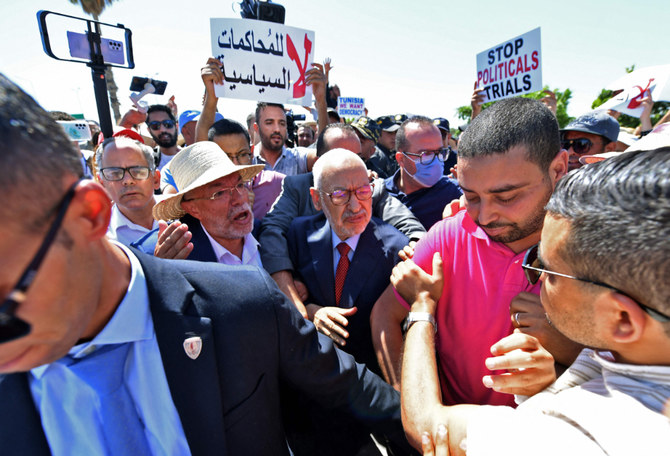
About 200 people gathered in front of the court, chanting “Down with the coup,” referring to Saied’s seizure of powers, and “Ghannouchi, you are not alone.” They raised banners that read “stop political trials” and celebrated after his release.
A judiciary official told Reuters the judge was investigating suspicions of money laundering relating to foreign funds paid to an Ennahda-linked association. Local media have also reported that he would also be investigated for suspected links to terrorism.
The judge has ordered a freeze on the financial assets of Ghannouchi, who is the speaker of the parliament that Saied has dissolved, as well as former prime minister Hamadi Jebali and several other people.
Last week, Ghannouchi told Reuters the investigation into him was politically motivated and said Saied was using the referendum to push Tunisia toward dictatorship.
He said in a statement on Tuesday that “the malicious charges fall within the framework of passing a constitution that enshrines tyranny.”
He added that he had been tried and imprisoned during the tenure of two former presidents, Zine El Abdine Ben Ali and Habib Bourguiba, and was also now “subjected to the worst forms of injustice.”
Ennahda has been a major force in parliament and in nearly every coalition government since the 2011 revolution, working alongside secular parties and moving away from its Islamist roots.
Saied has said his moves since last year, when he closed the parliament and started to rule by decree before rewriting the country’s democratic constitution, were necessary to end years of political stagnation.


![]()

Tunisian judge lets opposition chief go after hearing
Short Url
https://arab.news/vqhdt
Tunisian judge lets opposition chief go after hearing
- The hearing comes less than a week before President Kais Saied holds a referendum on a new constitution that would greatly expand his powers, a move that Ennahda and many other parties have rejected as illegal


Latest updates



Recommended



© 2026 SAUDI RESEARCH & PUBLISHING COMPANY, All Rights Reserved And subject to Terms of Use Agreement.