

UK’s Sunak vows to get tough on China if he becomes PM

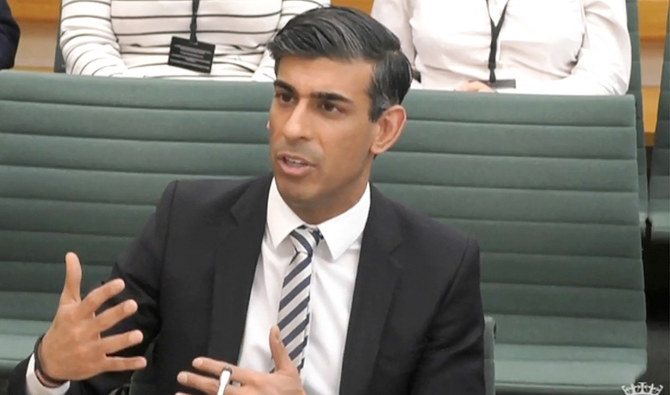
Rishi Sunak. (AFP file photo)
Short Url
Updated 25 July 2022
Follow

UK’s Sunak vows to get tough on China if he becomes PM

  • Sunak’s proposals include the closure of all 30 Confucius Institutes in Britain, preventing the soft-power spread of Chinese influence through culture and language programs

LONDON: Rishi Sunak on Sunday promised to get tough on China if he becomes Britain’s next prime minister, calling the Asian superpower the “number one threat” to domestic and global security.
The former finance minister’s pledge comes after his rival in the final two of the race to lead the ruling Conservative party, Liz Truss, accused him of being weak on China and Russia.
China’s state-run Global Times has previously said Sunak was the only candidate in the contest with “a clear and pragmatic view on developing UK-China ties.”
The Daily Mail, which has come out for Foreign Secretary Truss in the race to succeed Boris Johnson, called that “the endorsement that nobody wanted.”
Sunak’s proposals include the closure of all 30 Confucius Institutes in Britain, preventing the soft-power spread of Chinese influence through culture and language programs.
He also promised to “kick the CCP (Chinese Communist Party) out of our universities” by forcing higher education establishments to disclose foreign funding of more than £50,000 ($60,000) and reviewing research partnerships.
Britain’s domestic spy agency MI5 would be used to help combat Chinese espionage, and he would look to build “NATO-style” international co-operation to tackle Chinese threats in cyberspace.
He would also study the case for banning Chinese acquisitions of key British assets, including strategically sensitive tech firms.
Sunak claimed that China was “stealing our technology and infiltrating our universities” at home, “propping up” Vladimir Putin abroad by buying Russian oil, as well as attempting to bully neighbors including Taiwan.
He hit out at China’s global “belt and road” scheme for “saddling developing countries with insurmountable debt.”
“They torture, detain and indoctrinate their own people, including in Xinjiang and Hong Kong, in contravention of their human rights. And they have continually rigged the global economy in their favor by suppressing their currency,” he added.
“Enough is enough. For too long, politicians in Britain and across the West have rolled out the red carpet and turned a blind eye to China’s nefarious activity and ambitions.
“I will change this on Day 1 as PM.”

Sunak’s tough-talking will doubtless please China hawks in the Tory ranks, who have repeatedly pushed Johnson to stand up more to Beijing.
But it is also a sign of how Sunak is desperately trying to claw back ground on Truss, whom opinion polls have put well ahead in the crucial hunt for votes from the 200,000 grassroots Tory members.
A winner will be announced on September 5.
Truss has similarly urged a tougher approach, calling for the G7 to become an “economic NATO” against Chinese threats and warned Beijing of sanctions if they did not play by international rules.
It aligns both with warnings from MI5 and the FBI about a surge in Chinese commercial espionage in the West.
Yet British government policy when both Sunak and Truss were in Johnson’s cabinet has warned about China before.
In March last year, its integrated review of security, defense and foreign policy called China “the biggest state-based threat to the UK’s economic security.”
Under fierce political pressure from Washington, it banned Chinese technology giant Huawei from involvement in the roll-out of Britain’s 5G network.
Laws have been tightened to make it harder for foreign firms, including those from China, to buy British businesses in sensitive sectors such as defense, energy and transport.
At the same time, London has recognized that China’s power and international assertiveness was here to stay, and called Beijing a “systemic competitor.”
In July last year, Sunak himself called for a more nuanced approach to the debate on China.
“We need a mature and balanced relationship,” he said in his Mansion House speech as chancellor of the exchequer.
“That means being eyes wide open about their increasing international influence and continuing to take a principled stand on issues we judge to contravene our values.”


8 in 10 British Muslims face ‘financial faith penalty’ when seeking home finance, survey finds

Updated 5 sec ago
Follow

8 in 10 British Muslims face ‘financial faith penalty’ when seeking home finance, survey finds

  • Restricted choices plague potential buyers

LONDON: Eight in 10 British Muslims say their home finance choices are restricted because of their faith, according to a new national survey that highlighted what researchers describe as a growing “financial faith penalty” in the UK housing market.

The report, published by Islamic home finance fintech firm Offa, found that 80 percent of Muslim respondents believe their religious beliefs limit their access to suitable home finance, while those who do use Islamic products often face slower decisions, heavier paperwork and poorer customer experiences than in the conventional mortgage market.

Based on surveys of 1,000 British Muslims conducted by Muslim Census, and 2,000 non-Muslims carried out by OnePoll, the research calls on providers, brokers and policymakers to modernize Islamic home finance and improve access to Sharia-compliant products.

Among the 24.3 percent of British Muslims who have used Islamic home finance, just 5 percent said they had received a same-day decision.

Some 62 percent waited up to two weeks, while 33 percent waited more than 15 days, including 16 percent who waited over a month.

Long decision times were cited as the biggest challenge by 28 percent of respondents, followed by excessive paperwork (22.6 percent) and poor customer service (18.9 percent).

Islamic home finance differs from conventional mortgages by avoiding interest and steering investment away from sectors considered harmful to society, including gambling, alcohol, tobacco, arms trading and animal testing.

Sagheer Malik, chief commercial officer and managing director of home finance at Offa, said the findings showed British Muslims were being underserved by outdated systems.

Malik said: “Property is the asset class of choice for many of the UK’s 3.87 million Muslims, both as a route to generational wealth and as a long-term financial foundation, yet our insightful research report reveals that British Muslims are being underserved and deterred by slow, outdated and opaque Islamic home finance provision.

“This is not a niche concern. It goes to the heart of financial fairness and inclusion in modern Britain.”

He added that Muslims deserved Sharia-compliant products that matched mainstream standards on “price, speed and simplicity.”

Despite strong demand, uptake remains low.

Only 12.8 percent of British Muslims surveyed said they currently use Islamic home finance, with a further 11.5 percent having done so in the past. More than three quarters (75.7 percent) have never used it.

Faith plays a central role in financial decisions, with 94.2 percent saying it is important that their financial products align with their ethical or religious beliefs. Yet more than half of those using conventional mortgages said they felt unhappy or uneasy about doing so because of their faith.

The study also found that British Muslims share similar home ownership aspirations to the wider population, with 79.1 percent citing the desire to provide a stable home for their family, while 18.6 percent said building generational wealth was their main motivation. Only 2.2 percent said they did not want to own a home.

The report suggests Islamic finance could appeal beyond Muslim communities. While 64 percent of non-Muslim respondents had never heard of Islamic home finance, 63 percent said they favored its ethical principles once explained.

Younger generations were the most receptive, with 43 percent of Generation Z and 37 percent of millennials saying they would consider using Islamic home finance, compared with just 7 percent of baby boomers. More than three quarters of Gen Z and 72 percent of millennials also said it was important that their finance provider avoided investing in ethically harmful sectors.

Offa said the findings pointed to an opportunity to expand ethical finance in the UK, provided the industry can deliver faster, simpler and more transparent services.