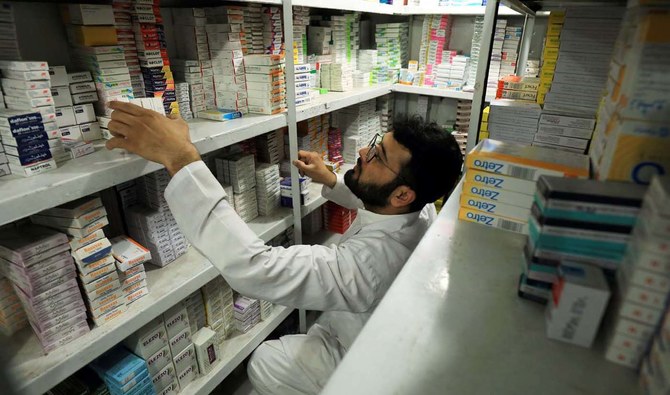

ISLAMABAD: Pakistani health officials on Friday said there was no shortage of drugs in the South Asian country after pharmacists and pharmaceutical manufacturers said around 60 essential medicines, including those for psychiatric illnesses, tuberculosis, neurological disorders and cancer, were no longer available in the market.
The main reason for the disruption in manufacturing and the subsequent disappearance of medicines is an exponential increase in raw material costs and the free fall of the Pakistani currency. Around 95 percent of raw materials for drug manufacturing are imported, according to the pharmaceutical industry.
With no increase in the retail price of medicines, there have been reports of drug shortages in markets across Pakistan over the last few months, which the Drug Regulatory Authority of Pakistan (DRAP) denied.
“We have not received any report about the shortage of life-saving drugs in the market,” Akhtar Abbas, an additional director at DRAP, told Arab News.
“When we receive any report of shortage, we issue NOC (no-objection certificate) on priority for the import of those medicines if it is not manufactured locally and we even provide import NOCs to patients for those medicines, which usually are not imported on a commercial basis due to low usage.”
Abbas said the authority acted immediately to ensure the uninterrupted supply of medicines, whenever there was a shortage reported in the market. He, however, said a few medicines were not very common and were only available at major pharmacies.
However, Osama Javed, a pharmacist in Islamabad, said there was a shortage of medicines over the last few months.
“Some medicines related to psychiatric illness, epilepsy and cancer as well as pain killers are not available for the last two to three months,” he said.
He said whenever the pharmacy contacted suppliers, they replied that the drugs were short as manufacturers were not producing them.
Qazi Mansoor Dilawar, chairperson of the Pakistan Pharmaceutical Manufacturers’ Association (PPMA), said the medicines were short due to a production cost higher than the selling price, which in Pakistan is legally fixed by the government.
“Around 60 medicines are short, including tuberculosis, epilepsy, anti-depressants, childcare syrups, panadol and cancer medicines,” he told Arab News.
The PPMA chief said production cost had gone up because of the rupee’s depreciation, expensive raw materials and a 10-time increase in freight charges due to the COVID-19 pandemic.
The Pakistani currency has depreciated by 40.69 percent, or Rs66.05, from Rs162.3247 on July 23, 2021 to Rs228.37 on July 22, 2022, according to the central bank data.
“This shortage will not stop here and it will increase in the future due to price disparity,” Dilawar said, adding the solution to it was the removal of price cap so that prices could be adjusted to the market value, like other commodities.
Asked about possible hoarding by industry players, Dilawar said there was no question of it, nor of profit as the real issue was the cost of production, which had exceeded the retail price.
“Pharmaceutical industry is already in danger and we are trying to save the industry, so how can we hold products when we are already shutting down our production units,” he said.
As the government had not increased prices, therefore it was not sustainable for the industry to keep on manufacturing medicines, the PPMA chief said.
“If a medicine costs Rs100 to manufacture, then how can we sell it for Rs75,” he asked.
Dilawar said the government had also not released Rs40 billion ($175 million) in refundable sales tax, which had caused a shortage of working capital for the import of raw materials.
“We contacted the finance ministry regarding refunds, but only a few have gotten it so far and a majority of manufacturers still haven’t gotten their refunds,” he added.
The PPMA chief said his association had taken up the matter of price disparity with DRAP, but not heard back yet.
“Now again we have prepared a comprehensive presentation which will be given to DRAP officials very soon,” he said. “But price increase is a complex mechanism that needs the approval of the prime minister and the cabinet, which is time-consuming and the industry needs immediate action for its survival.”
Sajid Hussain Shah, a spokesperson for the Pakistani health ministry, said the government was continuously monitoring the situation and in touch with DRAP on the matter.
“The government is ensuring the availability of life-saving medicines and there is no acute shortage reported so far,” he told Arab News.
Shah said even if a medicine or two were in short supply, drugs of similar compounds manufactured by another company were always available as a replacement.
About the price increase, he said the issue would be resolved after considering interests of all stakeholders.
“The government has to consider public interest as well along with demands of pharmaceutical firms,” Shah added.