Twitter report reveals top three trends in Saudi Arabia

Short Url
Updated 25 July 2022
Follow

Twitter report reveals top three trends in Saudi Arabia

  • Saudi society has in recent years undergone significant changes, such as women being allowed to drive and cinemas opening

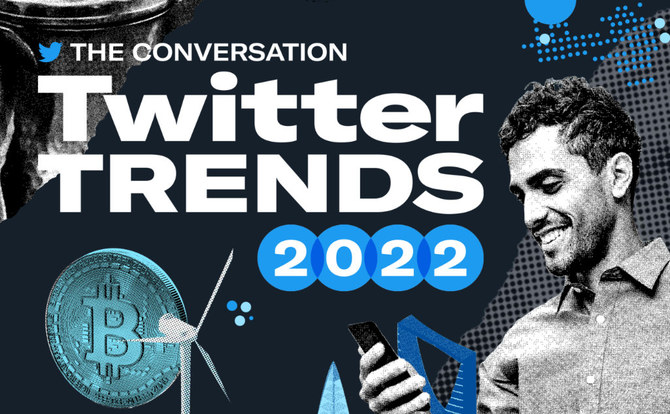
DUBAI: A recent Twitter report has revealed the top three trends in Saudi Arabia based on an analysis of billions of tweets from the last two years.

Saudi society has in recent years undergone significant changes, such as women being allowed to drive and cinemas opening.

The first trend — identity in transit — captures the transformation of the Kingdom and its effect on Saudis’ self-identity.

There have been increased conversations on Twitter about women working, driving, general economic progress, and embracing smart cities.

For example, conversations around pride concerning smart cities and NEOM grew by 172 percent, while those around chasing the Saudi dream grew by 161 percent.

More than 50 percent of all conversations around identity were related to relationships and family, indicating the shifting gender dynamics in the Kingdom.

“People on Twitter actively drive the conversations that shape today’s culture, acting as leaders, not followers. Their friends and family are more likely to look to them for recommendations, from where to go and who to listen to, all the way to what to buy,” Walid Issa, head of research at Twitter MENA, told Arab News.

The second trend focuses on the spending habits of Saudis, with people preferring to spend wisely rather than freely. This approach was evident in their search for online deals and discount codes. Conversations related to offers, competitions, and discounts grew by over 49 percent year-on-year.

Saudis are also keen on being more involved in the digital economy, particularly cryptocurrencies, with conversations around these seeing a 595 percent year-on-year increase.

Twitter advised brands to be the “financially smart choice for consumers.” Keeping these trends in mind would help brands to “connect with their audiences in a space where they are leaned-in and receptive,” said Issa.

The third trend, eco-innovation, saw sustainability and technology merge to become something Saudis cared deeply about, especially when it came to topics of national identity and pride such as smart cities, smart cars, large rail construction, and alternative energy projects.

For people in the Kingdom, sustainability is less about the environment and more about Saudi investments in sustainable innovation, according to Twitter.

The trend was corroborated by a year-on-year increase in conversations around tech (49 percent), electric cars (55 percent), and smart cities (180 percent).

Brands can stand out by embracing sustainability and technology and highlighting the initiatives that have a strong local impact, according to the report.

Issa said: “The results (of the report) are a reflection of what is happening in Saudi Arabia and an indication of the national sentiment, which is crucial for brands to gauge regardless of industry.”


Study finds nearly half of UK news stories on Muslims show signs of bias

Updated 09 March 2026
Follow

Study finds nearly half of UK news stories on Muslims show signs of bias

  • Centre for Media Monitoring finds 20,000 out of 40,913 articles from 30 major news outlets contain bias and 70% link Muslims to negative behaviors or themes
  • Findings reveal ‘deeply concerning evidence of structural bias’ in portrayal of Muslims by UK press and point to ‘systemic problem’ within the media, says center’s director

LONDON: Nearly half of news articles published in the UK in 2025 that referenced Muslims or Islam contained some degree of bias, according to a report issued on Monday by the Centre for Media Monitoring. It also found that about 70 percent of stories linked Muslims to negative behaviors or themes.

The nonprofit organization, which tracks the ways in which Muslims and Islam are portrayed in the media, examined 40,913 articles from 30 major news outlets and found that about 20,000 showed some form of bias.

The study looked at “structural patterns” in coverage that “shape public narratives” about Muslims amid rising hostility toward the community.

“As the largest study of its kind ever conducted in the UK, this report presents deeply concerning evidence of structural bias in how Muslims are portrayed in the UK press,” said Rizwana Hamid, the director of the organization.

It found that 70 percent of the articles it reviewed highlighted negative aspects related to Muslims, though not all of the stories were biased in themselves. The wider patterns were also troubling: 44 percent of the coverage omitted key context, 17 percent relied on generalizations, and 13 percent included outright misrepresentation.

Taken together, the monitoring center said, the findings amounted to evidence of an “information integrity crisis” that distorts public understanding, and “a deeply concerning trend” in reporting on Muslims.

The research points to a “systemic problem within our media ecosystem,” Hamid said.

“When entire communities are repeatedly framed through lenses of suspicion or threat, it inevitably shapes public attitudes, political debate and the everyday lives of British Muslims,” she added.

News brands targeting right-wing audiences were more likely to produce biased coverage, the report found.

The Spectator magazine and GB News were identified as having the highest proportion of “very biased” articles, and as the “worst across all five bias categories”: negative framing, generalizations, misrepresentation, lack of context, and problematic headlines.

Other outlets highlighted for displaying high levels of biased content about Muslims included The Telegraph, The Jewish Chronicle, Daily Express, The Sun, Daily Mail and The Times.

In contrast, the BBC, other broadcasters and left-leaning outlets recorded the lowest rates of bias in the study.

The research comes as British Muslims report rising levels of discrimination. Official figures published in October revealed that religious hate crimes against Muslims rose by 19 percent in the year to March 2025 compared with the previous 12 months.