

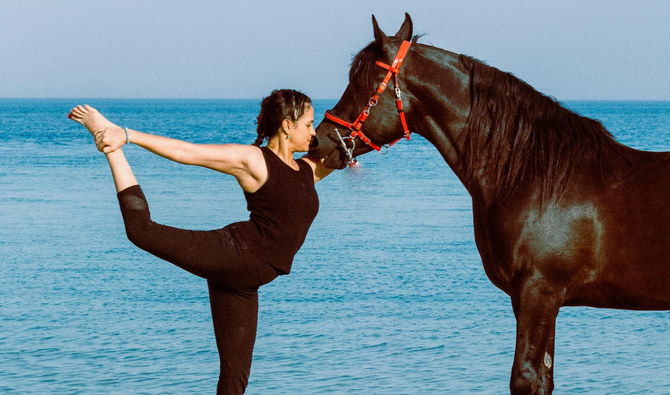
Saudi yoga instructor practices yoga with horses

Dana Al-Gosaibi practicing horse yoga in Alkhobar beach. (Supplied)
Short Url
Updated 22 July 2022
Follow

Saudi yoga instructor practices yoga with horses

  • Al-Gosaibi, who started yoga 15 years ago to overcome her mood swings and depression, said that she changed her life dramatically by practicing yoga

RIYADH: Saudi yoga instructor Dana Al-Gosaibi has stepped outside of the norm to practice horse yoga. 

Yoga is about combining different physical poses with breathing exercises to meditate or relax, but Al-Gosaibi takes things a step further with horse yoga. 

“It’s not about practicing yoga around horses but about the connection between us and the horses, as they feel the energy and they are curious,” Al-Gosaibi told Arab News.

Al-Gosaibi, who started yoga 15 years ago to overcome her mood swings and depression, said that she changed her life dramatically by practicing yoga. 

“I wanted to be more aware of my physical and mental body, and I changed my food habits and my sleep pattern, so yoga became a big part of my life,” she said.

The passionate yogi has accrued 2,000 hours of practicing yoga and has certificates in Iyengar and Ashtanga yoga. As an equestrian, Al-Gosaibi chose to combine horsemanship and yoga — with powerful results.  

“People misunderstand that we do yoga on the horse’s back, but it’s not just about that. We do yoga around horses. The horse will feel you instantly. Most of us, as horse riders, don’t have ground-level contact with the horse, and we forget to be on the ground around it and let it get close to us, smell us, and hug us. So, when you practice horse yoga, the horse changes, calms, and bonds with you,” she said. 
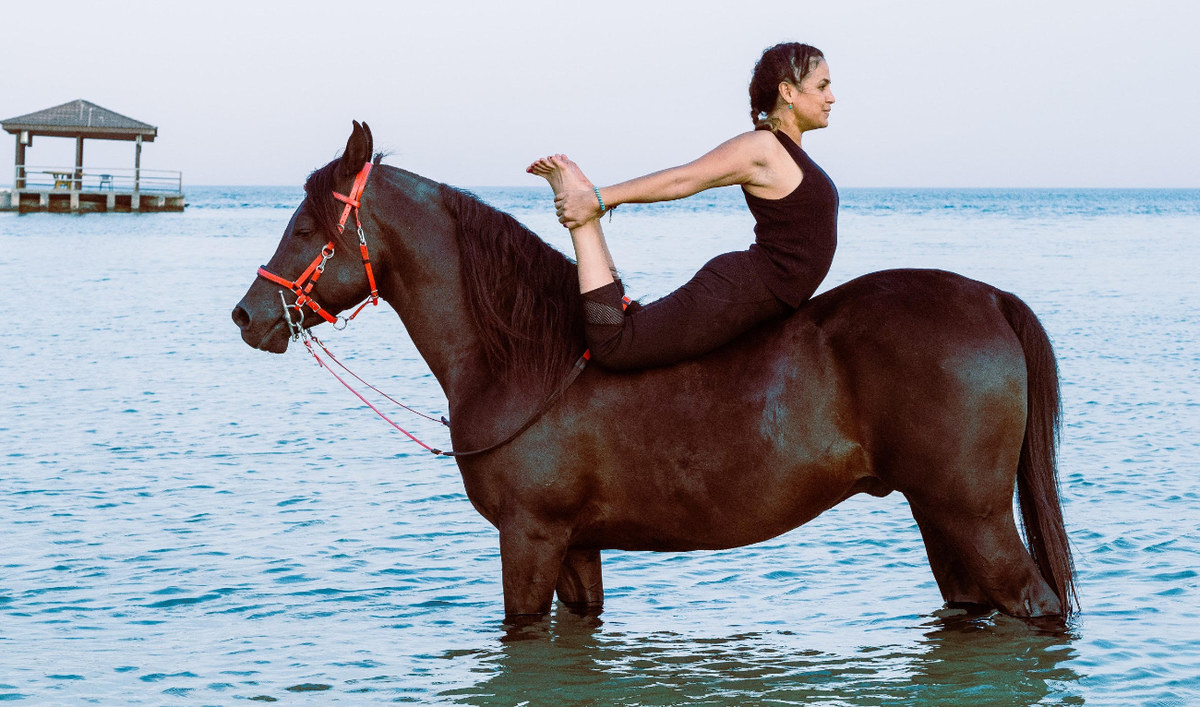
Al-Gosaibi gives horse-guided private empowerment sessions, which focuses on the client’s problem. “What happens is the horse does more of the work in the session, and mostly the participants leave with tears because they didn’t expect the interaction of horses,” she said. 

She discovered horse yoga during the pandemic while in lockdown.  

“During quarantine, I was around four untamed horses, so my project was to train them, so I spent a lot of time with them and started doing yoga around them,” she said. 

“I noticed their behavior had changed around me. In particular, there was an untamed mare where it wouldn’t let me get close to it, but while doing yoga it started to approach me, and then our relationship developed and we bonded.” 

Al-Gosaibi said that yoga is a big part of meditation and helps to achieve focus.

“Yoga is a philosophy, not a religion, and everyone can practice it. I advise people to read more about it before even trying it.”


Threat to Kingdom’s security is ‘red line’ that will be ‘addressed and neutralized,’ Saudi envoy says

Updated 14 January 2026
Follow

Threat to Kingdom’s security is ‘red line’ that will be ‘addressed and neutralized,’ Saudi envoy says

  • Abdulaziz Alwasil tells UN Security Council the situation in southern Yemen is ‘a just cause with social and historic dimensions’ that can only be resolved through dialogue
  • Recent military activity in the south was unilateral, resulting in an escalation that harms the interests of Yemeni people and undermines efforts to address issues in the south, he said

NEW YORK CITY: Any attempt to threaten Saudi Arabia’s national security is a “red line” and will be met with decisive action, the Kingdom’s ambassador to the UN told the Security Council on Wednesday.

Speaking during a meeting of the council to discuss Yemen, Abdulaziz Alwasil said the situation in the south of the country is “a just cause with social and historic dimensions” that can only be resolved through dialogue.

“We stress that any attempt to threaten our national security is a red line, and we will not hesitate to take the necessary actions and steps to address it and neutralize it,” he added.

Alwasil reaffirmed Saudi Arabia’s support for Yemeni President Rashad Al-Alimi, the Presidential Leadership Council, and the Yemeni government in their efforts to achieve security, stability, development and peace while preserving national unity.

He said military activity by Southern Transitional Council forces in Hadramout and Al-Mahra on Dec. 2, 2025, was unilateral, did not have the approval of the Presidential Leadership Council, and was not carried out in coordination with the Coalition to Restore Legitimacy in Yemen.

It had resulted in an unjustified escalation that harmed the interests of the Yemeni people, undermined efforts to address the issues in the south, and ran counter to the coalition’s objectives, Alwasil added.

The Kingdom, working with its coalition partners, the Presidential Leadership Council and the Yemeni government, had moved to contain the situation by dispatching a military force to coordinate arrangements with the Southern Transitional Council in Aden, he said.

The aim was to ensure the return of the southern council’s forces to their previous positions outside of Hadramout and Al-Mahra, and the handover of camps to legitimate government forces and local authorities in line with agreed procedures, Alwasil added.

He expressed regret over the military operations that took place in Hadramout and Al-Mahra, close to Saudi Arabia’s southern border, which he said posed a direct threat to the Kingdom’s national security, as well as the security of Yemen and regional stability. Such steps were extremely dangerous, he added, and contradicted the principles on which the Coalition to Restore Legitimacy in Yemen had been founded.

Alwasil welcomed a prisoner and detainee exchange agreement signed in Muscat on Dec. 23, which he described as an important humanitarian measure to alleviate suffering and build confidence.

He praised Oman for hosting and sponsoring the consultations and supporting negotiations, and commended the efforts of UN’s special envoy for Yemen, Hans Grundberg, the International Committee of the Red Cross and all others that has played a part.

Regarding the political efforts to resolve the crisis, Alwasil said Saudi Arabia welcomed President Al-Alimi’s call for an inclusive conference in Riyadh to bring together all stakeholders to discuss just solutions to the situation in southern Yemen.

Preparations for the conference have begun, he added, in cooperation with the Yemeni government and southern representatives, reflecting the close ties between the two countries and their shared interests in stabilizing Yemen.

He urged all southern stakeholders to participate actively and constructively in the talks, to help find comprehensive and just solutions that meet the legitimate aspirations of the people of southern Yemen.

Alwasil called on all Yemeni forces and stakeholders to cooperate and intensify their efforts to reach a lasting political settlement that would ensure security and stability.

He described the southern issue as “a just cause with social and historic dimensions,” adding that “the only way to address it is through dialogue that leads to a comprehensive political solution” based on nationally and internationally agreed terms of reference.