UK government introduces legal reforms to protect journalists and free speech

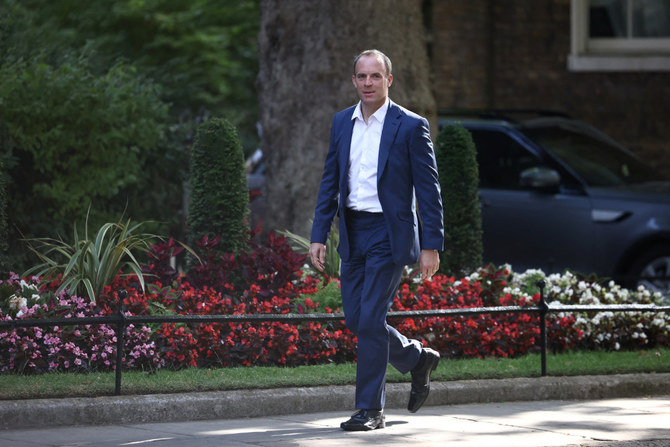
British Deputy PM Dominic Raab, seen outside Downing Street in London on July 19, 2022, is proposing that courts be granted new powers to protect journalists from being muzzled by the rich. (REUTERS)
Short Url
Updated 21 July 2022
Follow

UK government introduces legal reforms to protect journalists and free speech

  • Courts will have the power to decide whether a case has been brought by a wealthy claimant in an attempt to silence criticism or discourage investigations and should be thrown out immediately
  • Such cases, dubbed Strategic Litigation Against Public Participation, are expensive to defend, designed to intimidate and have been employed by Russian oligarchs to target the media

LONDON: The UK government announced on Wednesday a proposal that would grant courts in England and Wales the authority to dismiss cases involving so-called Strategic Litigation Against Public Participation (SLAPP).

According to the government website, SLAPPs are lawsuits intended to censor, intimidate, and silence reporters and publishers by burdening them with the cost of a legal defense until they abandon their criticism.

The proposals, which were set out by Deputy Prime Minister Dominic Raab, include “a new mechanism to allow courts to throw out baseless claims quicker, and a cap on costs to prevent the mega-rich, such as Russian oligarchs, from using expensive litigation as a weapon to silence their critics.”

Courts would be granted new powers designed to protect free speech by employing a three-stage test that would firstly assess whether the case involves journalistic activity that is in the public interest; for example an investigation into financial misconduct by a company or individual. It would then examine whether there is evidence of abuse of process, and finally consider whether the case has any realistic prospect of success.

Anyone targeted by a suspected SLAPP would be able to apply to the court to consider it for early dismissal.

The plans to crack down on SLAPPs were announced in March after the UK government was accused of not doing enough to protect journalists and media organizations from Russian oligarchs close to President Vladimir Putin, who have repeatedly used expensive litigation in UK courts to silence criticisms and discourage investigations into their affairs.

“We won’t let those bankrolling Putin exploit the UK’s legal jurisdiction to muzzle their critics,” Raab said. “So today I’m announcing reforms to uphold freedom of speech, end the abuse of our justice system, and defend those who bravely shine a light on corruption.”

Michelle Stanistreet, general secretary of the National Union of Journalists, said the reforms represent “a significant step in tackling the deployment of SLAPPs and other forms of ‘lawfare’ designed to stymie journalistic investigations.

“Abuse of the law by the sly and mighty, who deeply resent the legitimate work of the media in calling them to account, is a scourge which must be eradicated.”

Dawn Alford, executive director of the Society of Editors, also welcomed the proposals and said a mechanism that will “allow the courts to throw out meritless cases more quickly and a cap on costs are essential protections that should deter the wealthy from using the threat of expensive litigation to silence their critics, and should allow journalists and others the ability to fulfill their roles as the public’s watchdog without bullying or intimidation.”


Bondi Beach attack hero says wanted to protect ‘innocent people’

Updated 30 December 2025
Follow

Bondi Beach attack hero says wanted to protect ‘innocent people’

DUBAI: Bondi Beach shooting hero Ahmed Al Ahmed recalled the moment he ran toward one of the attackers and wrenched his shotgun away, saying the only thing he had in mind was to stop the assailant from “killing more innocent people.” 

Al-Ahmad’s heroism was widely acclaimed in Australia when he tackled and disarmed gunman Sajid Akram who fired at Jewish people attending a Hanukkah event on December 14, killing 15 people and wounding dozens.

“My target was just to take the gun from him, and to stop him from killing a human being’s life and not killing innocent people,” he told CBS News in an interview on Monday.

“I know I saved lots, but I feel sorry for the lost.”

In footage viewed by millions of people, Al Ahmed was seen ducking between parked cars as the shooting unfolded, then wresting a gun from one of the assailants.

He was shot several times in the shoulder as a result and underwent several rounds of surgery.

“I jumped in his back, hit him and … hold him with my right hand and start to say a word like, you know, to warn him, ‘Drop your gun, stop doing what you’re doing’,” Al Ahmed said. 

“I don’t want to see people killed in front of me, I don’t want to see blood, I don’t want to hear his gun, I don’t want to see people screaming and begging, asking for help,” Al Ahmed told the television network.

“That’s my soul asked me to do that, and everything in my heart, and my brain, everything just worked, you know, to manage and to save the people’s life,” he said.

Al Ahmed was at the beach getting a cup of coffee when the shooting occurred.

He is a father of two who emigrated to Australia from Syria in 2007, and works as a fruit seller.  

Local media reported that the Australian government has fast-tracked and granted a number of visas for Al Ahmed’s family following his act of bravery.

“Ahmed has shown the courage and values we want in Australia,” Home Affairs Minister Tony Burke said in a statement.

One of the gunmen, Sajid Akram, 50, was shot and killed by police during the attack. An Indian national, he entered Australia on a visa in 1998.

His 24-year-old son Naveed, an Australian-born citizen, remains in custody on charges including terrorism and 15 murders, as well as committing a “terrorist act” and planting a bomb with intent to harm.

(with AFP)