UN slams killings, rights abuses under Afghanistan's Taliban 

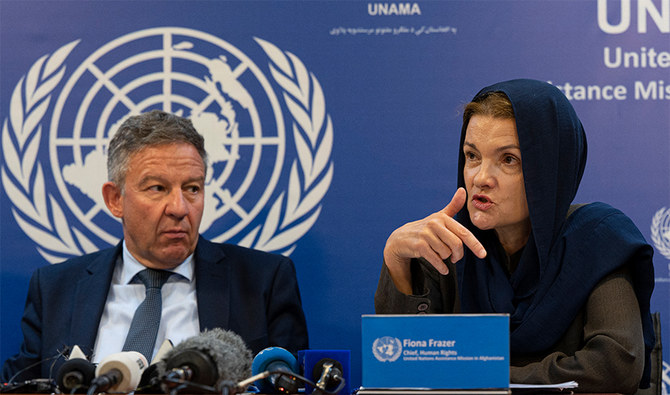
Fiona Frazer, Chief Human right United Nations assistance Mission in Afghanistan (R) speaks next to Markus Potzel, acting head of (UNAMA) United Nations Assistance Mission in Afghanistan during a press conference in Kabul on July 20, 2022. (AFP)
Short Url
Updated 20 July 2022
Follow

UN slams killings, rights abuses under Afghanistan's Taliban 

  • UN report added that the erosion of women’s rights has been one of the most notable aspects 
  • Report said as many as 700 people have been killed and 1,400 wounded since mid-August 2021 

ISLAMABAD: Hundreds of people have been killed in Afghanistan since the Taliban overran the country nearly a year ago, even though security on the whole has improved since then, the United Nations said in a report Wednesday.
In its report, the United Nations Assistance Mission in Afghanistan also highlighted the poor situation of women and girls since the Taliban takeover and how they have been stripped of many of their human rights under Afghanistan's current rulers.
“It is beyond time for all Afghans to be able to live in peace and rebuild their lives after 20 years of armed conflict. Our monitoring reveals that despite the improved security situation since 15 August, the people of Afghanistan, in particular women and girls, are deprived of the full enjoyment of their human rights,” said Markus Potzel, deputy special representative of the Secretary-General for Afghanistan.
The report said as many as 700 people have been killed and 1,400 wounded since mid-August 2021, when the Taliban overran the Afghan capital of Kabul as the United States and NATO were in the final weeks of their withdrawal from the country.
The majority of those casualties were linked to attacks by the Islamic State group's affiliate in the country, a bitter rival of the Taliban which has targeted ethnic and religious minority communities in places where they go to school, worship and go about their daily lives.
Afghanistan has seen persistent bombings and other attacks on civilians, often targeting the mainly Shiite Muslim ethnic Hazara minority. Most of the attacks have been claimed by the Islamic State group’s affiliate in the country.
After their takeover, the Taliban quickly started enforcing a sharply tougher line, harking back to similar radical measures when the Taliban last ruled the country, from 1996 to 2001.
They issued edicts requiring women to cover their faces except for their eyes in public, including women presenters on TV, and banned girls from attending school past the sixth grade.
The U.N. report added that the erosion of women’s rights has been one of the most notable aspects of the de facto administration to date. Since August, women and girls have progressively had their rights to fully participate in education, the workplace and other aspects of public and daily life restricted and in many cases completely taken away.
The decision not to allow girls to return to secondary school means that a generation of girls will not complete their full 12 years of basic education, the U.N. said.
“The education and participation of women and girls in public life is fundamental to any modern society. The relegation of women and girls to the home denies Afghanistan the benefit of the significant contributions they have to offer. Education for all is not only a basic human right, it is the key to progress and development of a nation,” said Potzel, the U.N. envoy.
During the previous Taliban rule in Afghanistan, they subjected women to overwhelming restrictions, banning them from education and participation in public life and requiring them to wear the all-encompassing burqa. 


In rare overlap, Chinese Muslims observe Ramadan with Lunar New Year

Updated 6 sec ago
Follow

In rare overlap, Chinese Muslims observe Ramadan with Lunar New Year

  • Lunar New Year started on Feb. 17 and is celebrated for another two weeks
  • Chinese Indonesians make up about 3 percent of the Indonesian population

JAKARTA: Every year, on the first day of Lunar New Year, Febriani visits relatives and gathers for a feast with her Chinese Muslim family, part of a long-standing tradition honoring their ethnic heritage.

But this year, as Thursday marks the beginning of Ramadan, she is celebrating two important occasions within the same week, in a rare overlap that last took place in 1995.

“I’m very happy and grateful that Lunar New Year and Ramadan are celebrated so closely. I observe both every year, so it’s truly special,” she told Arab News.

Widely observed across Asia, the Lunar New Year or Chinese New Year festival is believed to date back to the 14th century B.C., to the times of the Shang Dynasty, China’s earliest ruling dynasty, when people celebrated good harvests.

In 2026, it started on Feb. 17 and is celebrated for another two weeks. For many, celebrations typically involve elaborate feasts, giving children pocket money in red envelopes, and watching dragon dance parades.

In Indonesia, Chinese-descent citizens make up an estimated 3 percent of the country’s Muslim-majority population of more than 280 million. While most are either Buddhists or Christians, a small minority professes Islam.

For 25-year-old Febriani, both Lunar New Year and Ramadan are equally meaningful.

“The two celebrations teach us to strengthen bonds, to share with one another, and to become closer to family,” she said.

“They are both important to me because they happen only once every year and they’re always an occasion to gather with the extended family. It is also a chance to self-reflect and strengthen relationships with your loved ones.”

For Naga Kunadi, whose family lives in Central Java’s Cepu district, Chinese New Year is all about embracing his ethnic identity.

Earlier in the week, his family was busy preparing for the new year’s feast, which was a fusion of Chinese and Indonesian dishes, such as claypot tofu, meatball soup and shumai, or steamed dumplings.

“To celebrate Chinese New Year, we prepared halal Chinese food at home. It’s also a way to introduce to my children the traditions from our Chinese side, but there’s a bit of a fusion because my wife is Javanese,” Kunadi told Arab News.

Kunadi, an Islamic teacher at the Lautze Mosque in Jakarta, sees both Chinese New Year and Ramadan as opportunities to teach important life values for his two children. 

Upholding Chinese New Year traditions with his family is for him a way of preserving his ethnic heritage.

“We want to preserve cultural values as long as it does not clash with our religion,” he said.

“If we leave our culture behind, we might lose our identity, so this is something I want to teach my children.”

The fasting month of Ramadan, on the other hand, gives him a chance to teach and practice honesty.

“I want to focus on the religious and moral aspects during the holy month of Ramadan, when we practice honesty on a personal level,” Kunadi said.

“There’s always an opportunity to eat or snack in secret without anybody knowing, but we train ourselves not to do that. For me, Ramadan is a time for everyone to put honesty into practice, including myself and my children.”