

Global index puts Pakistani passport at world's fourth weakest for international travel

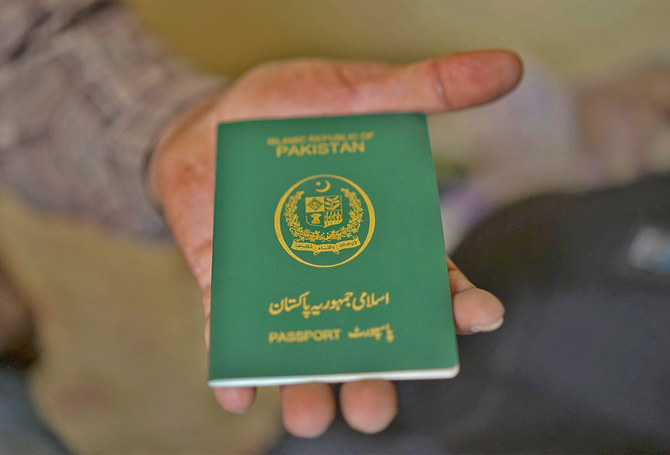
The image shows a man holding a Pakistani passport in Bangkok, Thailand, on November 3, 2018. (AFP)
Short Url
Updated 20 July 2022
Follow

Global index puts Pakistani passport at world's fourth weakest for international travel

  • Pakistani passport holders enjoy visa-free access to only 32 destinations worldwide
  • Only three other countries, Syria, Iraq and Afghanistan, rank lower than Pakistan

ISLAMABAD: Pakistan’s passport maintained its rank as the fourth weakest for international travel, according to a global index report published this week that grades travel documents on the basis of international mobility enjoyed by holders.

The Henley Passport Index ranks visa-free access of 199 passports to 227 travel destinations across the world. The global index has exclusive access to data from the International Air Transport Authority (IATA), which maintains the world’s largest and most accurate travel information.  

As per the index’s report for the third quarter of 2022, Pakistan retained its position at number 109 in the list, the fourth worst in the index, with visa-free access to only 32 destinations across the world. Pakistan also ranked 109th on the index in the last report published by the global index in the second quarter of 2022.  

Only three other countries’ passports rank lower than Pakistan, Syria (110), Iraq (111) and Afghanistan (112). Pakistan’s eastern neighbor India has been placed at number 87, with visa-free access to 60 destinations.  

Pakistan enjoyed its highest ranking on the index in 2006 when it was 79 on the index. The country’s position gradually fell over the years until it dropped to its lowest ranking of 113 in 2021.  

Japan, Singapore and South Korea are placed at number one on the index, with visa-free access to 193 destinations across the world.


Pakistan strikes $4 billion deal to sell weapons to Libyan force, officials say

Updated 5 sec ago
Follow

Pakistan strikes $4 billion deal to sell weapons to Libyan force, officials say

  • Pakistan’s defense industry spans aircraft, vehicles, and naval construction
  • The deal, spread over two-and-a-half years, includes JF-17 jets, officials say

KARACHI: Pakistan has reached a deal worth over $4 billion to sell military equipment to the Libyan National Army, four Pakistani officials said, despite a UN arms embargo ​on the fractured North African country.

The deal, one of Pakistan’s largest-ever weapons sales, was finalized after a meeting last week between Pakistan military chief Field Marshal Asim Munir and Saddam Khalifa Haftar, deputy commander-in-chief of the LNA, in the eastern Libyan city of Benghazi, said the four officials.

The officials, all involved in defense matters, declined to be identified because of the sensitivity of the deal.

Pakistan’s foreign ministry, defense ministry and military did not respond to requests for comment.

Any arms agreement with the LNA is likely to face scrutiny given Libya’s long-running instability following a 2011 NATO-backed uprising that toppled Muammar Qaddafi and split the country between rival authorities.

A copy of the deal before it was finalized that was ‌seen by Reuters listed ‌the purchase of 16 JF-17 fighter jets, a multi-role combat aircraft that has ‌been ⁠jointly ​developed by Pakistan ‌and China, and 12 Super Mushak trainer aircraft, used for basic pilot training.

One of the Pakistani officials confirmed the list was accurate while a second official said the arms on the list were all part of the deal but could not provide exact numbers.

One of the Pakistani officials said the deal included the sale of equipment for land, sea and air, spread over 2-1/2 years, adding it could also include the JF-17 fighter jets. Two of the officials said the deal was valued at more than $4 billion, while the other two said it amounted to $4.6 billion.

The LNA’s official media channel reported on Sunday that ⁠the faction had entered a defense cooperation pact with Pakistan, which included weapons sales, joint training and military manufacturing, without providing details.

“We announce the launch of a ‌new phase of strategic military cooperation with Pakistan,” Haftar said in remarks broadcast ‍on Sunday by Al-Hadath television.

Authorities in Benghazi also did ‍not immediately respond to a request for comment.

The UN-recognized Government of National Unity, led by Prime Minister Abdulhamid Dbeibah, controls ‍much of western Libya, while Haftar’s LNA controls the east and south, including major oilfields, and does not recognize the western government’s authority.

ARMS EMBARGO

Libya has been subject to a UN arms embargo since 2011, requiring approval from the UN for transfers of weapons and related material.

A panel of experts said in a December 2024 report to the UN that the arms embargo on Libya remained “ineffective.” The panel said some foreign ​states had become increasingly open about providing military training and assistance to forces in both eastern and western Libya despite the restrictions.

It was not immediately clear whether Pakistan or Libya had applied for ⁠any exemptions to the UN embargo.

Three of the Pakistani officials said the deal had not broken any UN weapons embargo.

One of the officials said Pakistan is not the only one to make deals with Libya; another said there are no sanctions on Haftar; and a third said Benghazi authorities are witnessing better relations with Western governments, given rising fuel exports.

PAKISTAN EYEING MARKETS

Pakistan has been seeking to expand defense exports, drawing on decades of counterinsurgency experience and a domestic defense industry that spans aircraft production and overhaul, armored vehicles, munitions and naval construction.
Islamabad has cited its Air Force’s performance in clashes with India in May.

“Our recent war with India demonstrated our advanced capabilities to the world,” military chief Munir said in remarks broadcast by Al-Hadath on Sunday.

Pakistan markets the Chinese co-developed JF-17 as a lower-cost multi-role fighter and has positioned itself as a supplier able to offer aircraft, training and maintenance outside Western supply chains.

Pakistan has also been deepening security ties with Gulf partners, signing a Strategic Mutual Defense Agreement ‌with Saudi Arabia in September 2025 and holding senior-level defense talks with Qatar.

The Libya deal would expand Pakistan’s footprint in North Africa as regional and international powers compete for influence over Libya’s fragmented security institutions and oil-backed economy.
