WASHINGTON: Federal prosecutors called their first witness to the stand Tuesday and began building their case that former Trump adviser Steve Bannon willfully ignored a congressional subpoena in open defiance of the US government.
Bannon, a longtime adviser and strategist for former President Donald Trump, was brought to trial on a pair of federal charges for criminal contempt of Congress after refusing for months to cooperate with the House committee investigating the US Capitol insurrection on Jan. 6, 2021.
Under questioning Tuesday from Assistant US Attorney Amanda Vaughn, Kristin Amerling, the chief counsel for the Jan. 6 committee, went through a detailed explanation of the committee’s role, the Bannon subpoena and why the panel felt it was important to compel his testimony. Amerling said Bannon’s public statements leading up to the riot “suggested he might have some advanced knowledge of the events of Jan. 6.”
Amerling said there were multiple indications that Bannon “might have had some discussions with individuals in the White House, including the president.” The day’s session ended with Amerling being questioned by the prosecution. The trial was scheduled to resume Wednesday morning.
In her opening statement, Vaughn told jurors that the subpoena issued to Bannon by the committee investigating the aftermath of the 2020 presidential election and the events leading up to the Capitol insurrection “wasn’t optional. It wasn’t a request, and it wasn’t an invitation. It was mandatory.” She added: “The defendant’s failure to comply was deliberate. It wasn’t an accident, it wasn’t a mistake. It was a choice.”
Bannon’s lawyers argued that the charges against him were politically motivated and that Bannon was engaged in good-faith negotiations with the congressional committee when he was charged.
“No one ignored the subpoena,” defense lawyer Evan Corcoran told the jury.
In reality, Corcoran said, one of Bannon’s previous lawyers, Robert Costello, contacted an attorney for the House committee to express some of Bannon’s concerns about testifying.
“They did what two lawyers do. They negotiated,” Corcoran said, adding that Bannon and his legal team believed “the dates of the subpoena were not fixed; they were flexible.”
An unofficial adviser to Trump at the time of the Capitol attack, Bannon was charged with defying a subpoena that sought his records and testimony. He was indicted in November on two counts of criminal contempt of Congress, one month after the Justice Department received a congressional referral. Upon conviction, each count carries a minimum of 30 days of jail and as long as a year behind bars.
US District Judge Carl Nichols, a Trump appointee, had previously ruled that major elements of Bannon’s planned defense were irrelevant and could not be introduced in court. He ruled last week that Bannon could not claim he believed he was covered by executive privilege or that he was acting on the advice of his lawyers.
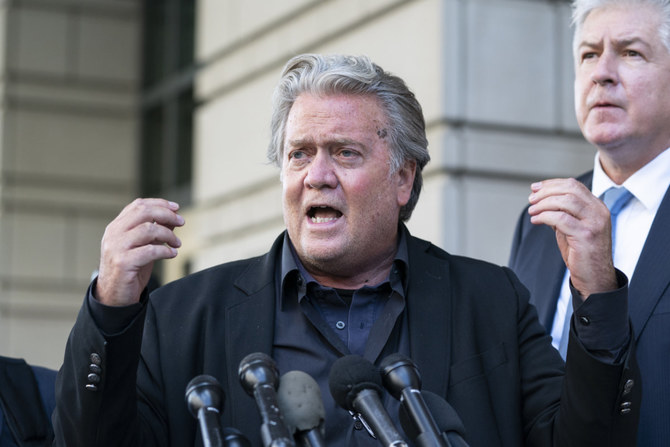
Outside the courthouse, Bannon launched into an extended rant against the committee chairman, Democratic Rep. Bennie Thompson of Mississippi, and the committee hearing, calling it “a show trial.” He also repeated the discredited claim that Trump won the 2020 election and called President Joe Biden illegitimate. But he did not criticize his trial or Nichols.
Bannon, 68, was one of the most prominent of the Trump-allied holdouts refusing to testify before the committee. He had argued that his testimony was protected by Trump’s claim of executive privilege, which allows presidents to withhold confidential information from the courts and the legislative branch.
Trump has repeatedly asserted executive privilege — even though he’s not a current president — to try to block witness testimony and the release of White House documents. The Supreme Court in January ruled against Trump’s efforts to stop the National Archives from cooperating with the committee after a lower court judge — Tanya S. Chutkan — noted, in part, “Presidents are not kings.”


![]()

Former Trump adviser Bannon acted as if ‘above the law,’ say prosecutors
Short Url
https://arab.news/6su8n
Former Trump adviser Bannon acted as if ‘above the law,’ say prosecutors
- Bannon was brought to trial for criminal contempt of Congress after refusing for months to cooperate with the House committee investigating the US Capitol insurrection on Jan. 6, 2021


Latest updates





© 2026 SAUDI RESEARCH & PUBLISHING COMPANY, All Rights Reserved And subject to Terms of Use Agreement.