

Yemen demands international pressure on Houthis to honor truce

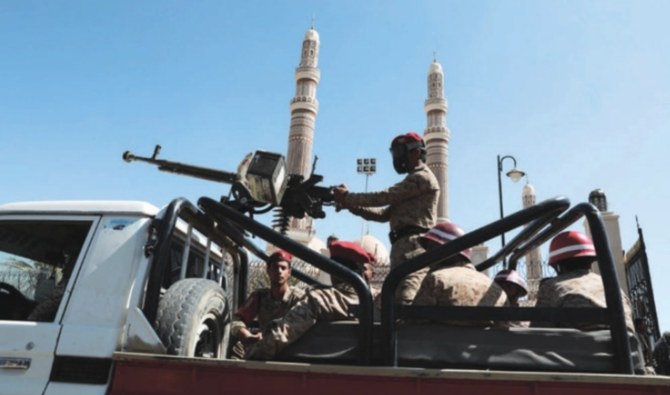
The internationally recognized government in Yemen has reiterated its determination to achieve enduring peace in Yemen and strengthen the UN-brokered truce. (Reuters/File Photo)
Short Url
Updated 16 July 2022
Follow

Yemen demands international pressure on Houthis to honor truce

  • The Yemeni leader said that military, economic and humanitarian assistance from the Saudi-led coalition and the UAE have so far prevented the country from falling apart

AL-MUKALLA: The internationally recognized government in Yemen has reiterated its determination to achieve enduring peace in Yemen and strengthen the UN-brokered truce, calling upon the international community to demand that the Houthis implement the truce and end their siege on the city of Taiz.

The government issued a statement to that effect after a meeting between Chairman of Yemen’s Presidential Leadership Council Rashad Al-Alimi, US Secretary of State Antony Blinken, and US Special Envoy for Yemen Tim Lenderking in Jeddah on Saturday.

Al-Alimi told the American officials that the world, particularly the US, should put more pressure on the Iran-backed Houthis to fully honor the truce, and to open roads in Taiz.

He stressed that his government was committed to a true, “just and comprehensive” peace based on United Nations’ resolutions.

The Yemeni leader said that military, economic and humanitarian assistance from the Saudi-led coalition and the UAE have so far prevented the country from falling apart, the official news agency SABA reported.

“I welcome the government’s bold leadership on the truce. We must see meaningful Houthi action to allow access to Taiz, Yemen,” Blinken tweeted after the meeting. He also thanked the Yemeni leader for respecting the truce.

Under the two-month truce brokered by the UN, which came into effect on April 2 and was renewed for a further two months in June, the Yemeni government ceased hostilities, facilitated the departure of commercial flights from Sanaa airport, allowed passengers with Houthi-issued passports to leave the country, eased restrictions on Hodeidah port, and agreed to a UN proposal on opening roads in Taiz.

Despite the government’s show of good faith, the Houthis rejected the proposal of the UN’s Special Envoy to Yemen Hans Grundberg that they should open a main road and several small roads around Taiz, instead unilaterally opening one dilapidated road.

Also on Saturday, the Yemeni government welcomed a joint statement from Saudi Arabia and the US issued after US President Joe Biden’s meeting with Saudi officials in Jeddah that supported strengthening and extending the truce and turning it into a lasting peace deal to end the war in Yemen.

“The government highly values the two countries’ affirmation of their full support for the Presidential Leadership Council, its role and commitment to the truce, and the steps that contributed to improving the lives of Yemenis throughout the country, including facilitating the import of fuel and the resumption of flights from Sanaa,” the government said in a statement.

The US and Saudi Arabia also called for the Houthis to join peace talks to end the war, and for the removal of any obstructions to the distribution of aid.

Local officials in Taiz said that without international pressure on the Houthis to end their siege of the city, the truce would remain in jeopardy.

“Opening roads in Taiz is the cornerstone and proves the credibility of the Houthis, as well as the international community,” Abdul Kareem Shaiban, head of the government’s delegation at the talks on Taiz in Amman, told Arab News.

Separately, Yemen’s official news agency said on Saturday that Prime Minister Maeen Abdul Malik Saeed is in good health after undergoing surgery in Germany, adding that he would return home soon to resume his duties.


What will the new Israeli measures change in the West Bank?

A Palestinian policeman directs the traffic in Hebron in the Israeli-occupied West Bank, February 9, 2026. (REUTERS)
Updated 7 sec ago
Follow

What will the new Israeli measures change in the West Bank?

  • The measures expand Israeli control over two major religious sites in the southern West Bank: Rachel’s Tomb near Bethlehem and the Cave of the Patriarchs in Hebron, both holy to Jews, Christians and Muslims
  • More than 500,000 Israeli settlers live among three million Palestinians in the West Bank

RAMALLAH, Palestinian Territories: New Israeli measures for the occupied West Bank, announced over the weekend, are expected to accelerate the territory’s annexation, ease land purchases by settlers and push Palestinians into increasingly isolated enclaves.
The full text of the latest decisions remains classified, but some details were disclosed in a statement. While it was unclear when the new rules would take effect, they do not require further approval.
Below are key changes that are expected to reshape the West Bank.

- Easy land purchases by settlers? -

Far-right Finance Minister Bezalel Smotrich, a member of the security cabinet who himself lives in a settlement, said the moves would make it easy for settlers to purchase land in the West Bank, occupied by Israel since 1967.
Until now, land acquisitions for settlers were typically carried out through intermediary companies.
The new measures repeal a decades-old law that barred Jews from directly purchasing land in the West Bank.
“This will allow Jews to purchase land in Judea and Samaria exactly as they do in Tel Aviv or Jerusalem,” Smotrich said.
Under the new rules, Israelis or companies registered in their name will no longer require a special permit from the state to complete land transactions.
Peace Now, an Israeli anti-settlement watchdog, said the permit system had been intended “to prevent forgeries and to curb settlers’ real-estate initiatives that contradict government policy.”
More than 500,000 Israeli settlers live among three million Palestinians in the West Bank.
Members of Netanyahu’s coalition like Smotrich or fellow far-right National Security Minister Itamar Ben Gvir are ardent supporters of the settlement movement, and have long advocated annexing the West Bank.
“Smotrich, Ben Gvir and the rest of them have been telling us that this is their policy,” Palestinian political scientist Ali Jarbawi told AFP.
“Now it has come to fruition.”
The current Israeli government has fast-tracked settlement expansion, approving a record 52 settlements in 2025.

- Palestinians to live in enclaves? -

The measures will also increase Israel’s control in parts of the West Bank where the Ramallah-based Palestinian Authority exercises power.
Under the Oslo Accords of the 1990s, the West Bank was divided into areas A, B, and C — under Palestinian, mixed and Israeli governance respectively.
According to Smotrich, the new measures will extend greater Israeli authority into A and B “with regard to water offenses, damage to archaeological sites, and environmental hazards that pollute the entire region.”
Palestinian experts warn the initiatives would displace Palestinians living near archaeological sites, landfills or springs, with Jarbawi saying Israel wants “to drive Palestinians into small pieces of land, basically, their major cities, enclaves.”
Yonatan Mizrachi of Peace Now said the steps would further weaken the Palestinian Authority — established under the Oslo Accords as an interim governing body pending the creation of a Palestinian state — accusing Israel of “advancing annexation.”

- More Israeli control over religious sites? -

The measures expand Israeli control over two major religious sites in the southern West Bank: Rachel’s Tomb near Bethlehem and the Cave of the Patriarchs in Hebron, both holy to Jews, Christians and Muslims.
In Hebron, the West Bank’s largest Palestinian city, municipal bylaws will be amended to transfer building-permit authority in areas around the Cave of the Patriarchs, known to Muslims as the Ibrahimi Mosque, to COGAT, Israel’s military body overseeing civilian affairs in the Palestinian territories.
Asma Al-Sharbati, Hebron’s deputy mayor, called the move “the most dangerous ongoing Israeli trend,” adding settlement expansion was happening at a “rapid pace.”
Rachel’s Tomb, currently administered by the Bethlehem municipality, will similarly be placed under a newly created Israeli authority.