SUVA: Pacific island leaders have agreed to take a united approach as the United States and China vie for influence in the region, and to push developed nations for bolder action on climate change, which they say is the biggest threat they face.
A communique to be released on the final day of the Pacific Islands Forum meeting in Suva will show the leaders agree to consult each other before entering into security arrangements, forum secretary general Henry Puna told reporters.
The approach taken by China, which asked 10 out of 18 forum members to endorse a pre-prepared security and trade deal in May, without time to consult, was rejected by forum leaders this week, he said.
“The region did not accept that approach,” he said at a press conference on Thursday.
The biggest member, Australia, provides aid and policing throughout the region but was excluded from China’s proposal, as were several nations that have ties with Taiwan.
This week the United States said it would triple funding to the Pacific islands under a fisheries deal, amid concern over China’s security ambitions for the region and a decade of rising Chinese investment.
Puna said Pacific islands “can’t afford to be enemies with anyone.”
“There are opportunities to be had... however certain issues like security, it does have regional impacts, and that is the issue that leaders have asked each other to share and dialogue with each other so everybody knows what is happening,” he said.
In an interview with The Guardian on Thursday, Solomon Islands Prime Minister Manasseh Sogavare said a security deal struck with China in May, prompting concern from the US, Australia and New Zealand, would not allow a Chinese military base in his country because he didn’t want his country to become a target.
“The reason is regionalism. The moment we establish a foreign military base, we immediately become an enemy,” he said.
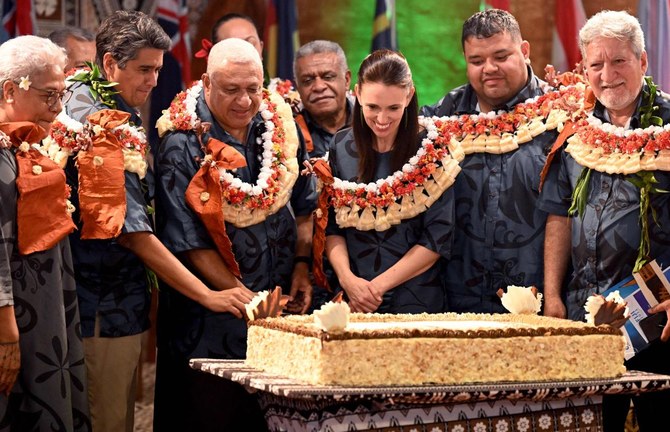
Forum chairman and Fiji Prime Minister Frank Bainimarama said the region was facing complex challenges and leaders recognized they had strength in numbers.
“Unity was our overriding focus,” he said.
An agreement was signed to resolve a rift with Micronesian nations, as leaders committed to keep talking with Kiribati, which withdrew from the forum this week.
Agreement was also reached on climate action, nuclear issues and fisheries, he said, ahead of the communique being released.
The forum will call for the United Nations General Assembly to seek an advisory opinion from the International Court of Justice on climate change, as a tactic to boost commitments.
“Australia’s new position on climate change was particularly well-received, and that is reflected in the communique,” Australia’s Prime Minister Anthony Albanese told reporters.
Bainimarama said Fiji urged developed countries including Australia to phase out coal and fossil fuels, and step up financing for the “loss and damage” caused by climate change in small island countries.


![]()

Pacific islands leaders commit to regional unity in face of superpower rivalry
Short Url
https://arab.news/52k7p
Pacific islands leaders commit to regional unity in face of superpower rivalry
- Leaders agree to consult each other before entering into security arrangements
- Agreement was also reached on climate action, nuclear issues and fisheries


Latest updates


Recommended


© 2026 SAUDI RESEARCH & PUBLISHING COMPANY, All Rights Reserved And subject to Terms of Use Agreement.