China eyes security pact in Pacific Island summit

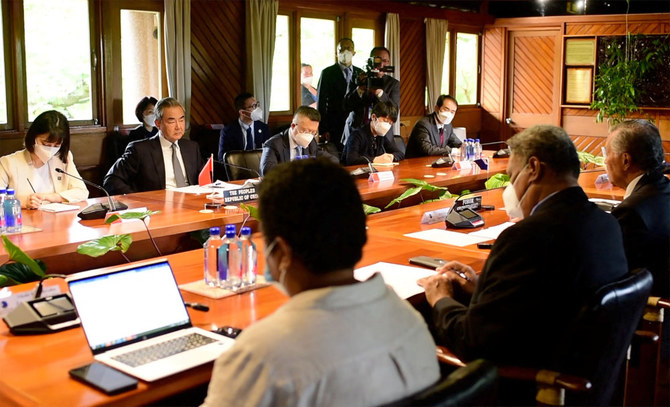
This handout photo taken by the Pacific Islands Forum on May 29, 2022 shows Secretary-General of the Pacific Islands Forum Henry Puna (R) holding a meeting with Chinese Foreign Minister Wang Yi (2nd L) in Fiji's capital city of Suva. (AFP)
Short Url
Updated 30 May 2022
Follow

China eyes security pact in Pacific Island summit

  • The virtual summit is expected to discuss leaked proposals for China to radically increase its involvement in the security, economy and politics of the South Pacific

SUVA, Fiji: Chinese Foreign Minister Wang Yi holds talks with leaders and top officials from ten Pacific Island states Monday, part of a regional diplomatic blitz that has stirred deep Western concern.
The virtual summit is expected to discuss leaked proposals for China to radically increase its involvement in the security, economy and politics of the South Pacific.
Wang is in the Fijian capital Suva, where he will co-host a virtual meeting with regional foreign ministers — many of whom are also leaders of the small island states.
On the table is a secret deal — obtained by AFP — that would see China train local police, become involved in cybersecurity, expand political ties, conduct sensitive marine mapping and gain greater access to natural resources on land and in the water.
As an enticement, Beijing is offering millions of dollars in financial assistance, the prospect of a China-Pacific Islands free trade agreement and access to China’s vast market of 1.4 billion people.
Only Pacific nations that recognize China over Taiwan will attend today’s summit, including those Wang has already visited on his regional whistle-stop — Solomon Islands, Kiribati, Samoa and Fiji.
The proposal comes as Beijing jostles with Washington and its allies over influence in the strategically vital Pacific.
Analysts say the deal is unlikely to be unanimously approved by Pacific Island leaders today.
A recent security deal between the Solomon Islands and China caused deep unease in a region that is usually more concerned by climate change than superpower politics.
“The Solomons came off as an outlier, there wasn’t a rush of interest,” said Richard Herr, an academic at the University of Tasmania who has decades of experience working in the Pacific Islands.
The region will be hesitant about “being dragged into geostrategic competition,” he said.
There has already been some pushback to Beijing’s latest proposal, including from the President of the Federated States of Micronesia, David Panuelo, who warned other Pacific leaders it could cause “the fracturing of regional peace, security, and stability.”
The president of Palau, a Pacific nation that maintains diplomatic ties with Taiwan, told the ABC Monday that the region “should be concerned” about the proposed deals.
Western powers have bristled against the deals, with the US State Department warning the Pacific to be wary of “shadowy, vague deals with little transparency” with China.
Australia joined the United States in urging South Pacific nations to spurn China’s attempts to expand its security reach deep into the region, with the country’s new foreign minister warning of the “consequences” of such deals.
But many Pacific nations are also keen to maintain amicable ties with China, balancing relations between Beijing and Washington or playing each off against the other.
So it is far from clear what Pacific Island leaders will tell Wang Monday or in a series of closed-door meetings around the South Pacific.
“It’s hard to believe that the Chinese foreign minister will come to the region and be told to go home,” said Herr.
“It could be an embarrassment. Every Chinese diplomat in the region will be working on that.”
Wang said Sunday that Beijing was willing to work with other major powers in the Pacific region to help island nations develop.
“China is willing to carry out more tripartite cooperation with other countries, especially countries with traditional influence in the region,” he said when he met with Pacific Islands Forum Secretary General Henry Puna.
He described his Pacific tour as “a trip of peace, friendship and cooperation,” according to a statement by the Chinese foreign ministry.
Wang is expected to remain in Fiji’s capital until at least Tuesday, meeting with the country’s leaders and hosting the second China-Pacific Island Countries Foreign Ministers’ meeting.
The Chinese foreign minister will visit Vanuatu, Papua New Guinea and Tonga — just months after the island nation was devastated by a deadly earthquake and tsunami — to round out his tour.


US and Mideast countries seek Kyiv’s drone expertise as Russia-Ukraine talks put on ice

Updated 06 March 2026
Follow

US and Mideast countries seek Kyiv’s drone expertise as Russia-Ukraine talks put on ice

KYIV, Ukraine: The United States and its allies in the Middle East are seeking Ukraine's expertise in countering Iran's Shahed drones, according to Ukrainian President Volodymyr Zelenskyy.

Various countries, including the United States, have approached Ukraine for help in defending against the Iranian drones, Zelenskyy said late Wednesday. He said he has spoken in recent days with the leaders of the United Arab Emirates, Qatar, Bahrain, Jordan and Kuwait about possible cooperation.

Russia has fired tens of thousands of Shaheds at Ukraine since it invaded its neighbor just over four years ago, launching a swarm of more than 800 drones and decoys in its biggest nighttime barrage. Iran has responded to joint U.S.-Israeli strikes by launching the same type of drones at countries in the Middle East.

Ukrainian assistance in countering Iranian drones will be provided only if it does not weaken Ukraine's own defenses, and if it adds leverage to Kyiv's diplomatic efforts to stop the Russian invasion, according to the Ukrainian leader.

"We help to defend from war those who help us, Ukraine, bring a just end to the war" with Russia, Zelenskyy said. Later Thursday, Zelenskyy said he had received a U.S. request for support to defend against the drones in the Middle East and had given the order for equipment to be provided along with Ukrainian experts without providing further details.

"Ukraine helps partners who help our security and the protection of our people's lives," he added in a social media post.

Trump, in an interview Thursday with Reuters, said, "Certainly I'll take, you know, any assistance from any country."

Ukraine has battle-tested drone defenses

Ukraine has pioneered the development of cut-price drone killers that cost as little as $1,000, rewriting the air defense rule book and making other countries take notice.

European countries got a wake-up call last September on the changed nature of air defense when Poland scrambled multimillion-dollar military assets, including F-35 and F-16 fighter jets and Black Hawk helicopters, in response to airspace violations by cheap drones.

Ukrainian manufacturers have developed low-cost interceptor drones specifically designed to hunt and destroy Shaheds, and its rapidly expanding drone industry is producing excess capacity.

Zelenskyy announced earlier this year that Ukraine would begin exporting the battle-tested systems.

The European Union's top diplomat, Kaja Kallas, said before chairing a meeting of EU and Gulf foreign ministers via video link Thursday that the talks would look at how Ukraine's experience can help countries counter Iranian drones.

Middle East war delays Russia-Ukraine talks

The Iran war, now in its sixth day, has drawn international attention away from Europe's biggest conflict since World War II, and forced the postponement of a new round of U. S-brokered talks between Russia and Ukraine planned for this week, Zelenskyy said.

Western governments and analysts say the Russia-Ukraine war has killed hundreds of thousands of people, while there is no sign that yearlong U.S.-led peace efforts will stop the fighting any time soon.

"Right now, because of the situation around Iran, there are not yet the necessary signals for a trilateral meeting," Zelenskyy said. "But as soon as the security situation and the overall political context allow us to resume that trilateral diplomatic work, it will be done."

Zelenskyy thanked the United States for the return from Russia on Thursday of 200 Ukrainian prisoners of war. Russia's Defense Ministry also said it received the same number of prisoners from Ukraine and thanked the U.S. and United Arab Emirates for mediating.

Prisoner swaps have been one of the few tangible results of the talks. Vladimir Medinsky, a Russian negotiator, said on social media that a total of 500 prisoners from each side would be exchanged between Thursday and Friday.

Oleksandr Merezhko, the head of Ukraine's parliamentary foreign affairs committee, said Russian President Vladimir Putin is trying to drag out the negotiations so that he can press on with Russia's invasion while escaping further U.S. sanctions.

He urged the U.S. administration to look at the Russia-Ukraine war and the war in the Middle East as linked.

"In reality, Russia and Iran are close allies that act in concert — Iran supplies weapons and Russia helps Iran develop its defense industry. These are interconnected conflicts," Merezhko told The Associated Press.

Ukraine's army has recently pushed back Russian forces at some points along the roughly 1,250-kilometer (750-mile) front line, according to the Institute for the Study of War.

Localized Ukrainian counterattacks liberated more territory than Ukrainian forces lost in the last two weeks of February, the Washington-based think tank said this week, estimating the recovered land at about 257 square kilometers (100 square miles) since Jan. 1.