Pacific islands leaders commit to regional unity in face of superpower rivalry

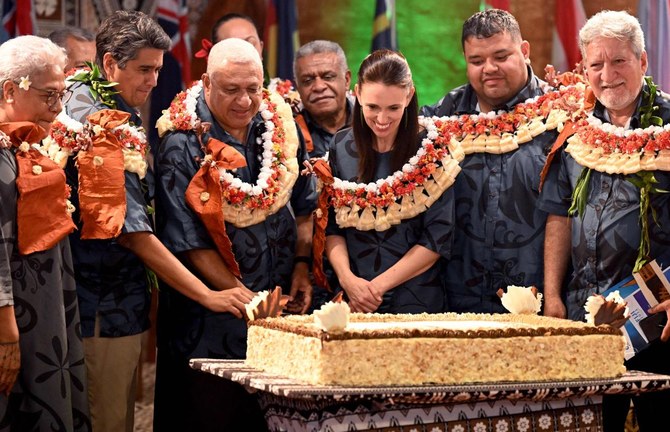
Leaders cut a cake after the launch of the 2050 Strategy during the Pacific Islands Forum in Suva on July 14, 2022. (AFP)
Short Url
Updated 14 July 2022
Follow

Pacific islands leaders commit to regional unity in face of superpower rivalry

  • Leaders agree to consult each other before entering into security arrangements
  • Agreement was also reached on climate action, nuclear issues and fisheries

SUVA: Pacific island leaders have agreed to take a united approach as the United States and China vie for influence in the region, and to push developed nations for bolder action on climate change, which they say is the biggest threat they face.
A communique to be released on the final day of the Pacific Islands Forum meeting in Suva will show the leaders agree to consult each other before entering into security arrangements, forum secretary general Henry Puna told reporters.
The approach taken by China, which asked 10 out of 18 forum members to endorse a pre-prepared security and trade deal in May, without time to consult, was rejected by forum leaders this week, he said.
“The region did not accept that approach,” he said at a press conference on Thursday.
The biggest member, Australia, provides aid and policing throughout the region but was excluded from China’s proposal, as were several nations that have ties with Taiwan.
This week the United States said it would triple funding to the Pacific islands under a fisheries deal, amid concern over China’s security ambitions for the region and a decade of rising Chinese investment.
Puna said Pacific islands “can’t afford to be enemies with anyone.”
“There are opportunities to be had... however certain issues like security, it does have regional impacts, and that is the issue that leaders have asked each other to share and dialogue with each other so everybody knows what is happening,” he said.
In an interview with The Guardian on Thursday, Solomon Islands Prime Minister Manasseh Sogavare said a security deal struck with China in May, prompting concern from the US, Australia and New Zealand, would not allow a Chinese military base in his country because he didn’t want his country to become a target.
“The reason is regionalism. The moment we establish a foreign military base, we immediately become an enemy,” he said.
Forum chairman and Fiji Prime Minister Frank Bainimarama said the region was facing complex challenges and leaders recognized they had strength in numbers.
“Unity was our overriding focus,” he said.
An agreement was signed to resolve a rift with Micronesian nations, as leaders committed to keep talking with Kiribati, which withdrew from the forum this week.
Agreement was also reached on climate action, nuclear issues and fisheries, he said, ahead of the communique being released.
The forum will call for the United Nations General Assembly to seek an advisory opinion from the International Court of Justice on climate change, as a tactic to boost commitments.
“Australia’s new position on climate change was particularly well-received, and that is reflected in the communique,” Australia’s Prime Minister Anthony Albanese told reporters.
Bainimarama said Fiji urged developed countries including Australia to phase out coal and fossil fuels, and step up financing for the “loss and damage” caused by climate change in small island countries.


In Bangladesh’s mangrove forest, villagers brave tigers to collect rare honey

Updated 58 min 55 sec ago
Follow

In Bangladesh’s mangrove forest, villagers brave tigers to collect rare honey

  • Honey is gathered from wild bee colonies deep in the Sundarbans
  • Producers made a debut at the biggest food fair in Jeddah this month

DHAKA: When the harvest begins, Mizanur Rahman gathers a few hundred men and sets out into the mangrove forest along the Bay of Bengal, where for months they climb trees to collect by hand a wild natural honey whose unique properties are only starting to attract global attention.

The honey is collected from wild bee colonies deep within the Sundarbans, the world’s largest mangrove reserve spanning parts of India and southwestern Bangladesh.

“Honey collection from this forest is mostly done in the Bangladesh part,” Rahman said. “All plants, trees, and the overall environment of this forest are natural. There is no human touch.”

Sundarban honey comes from an ecosystem where trees grow and bloom naturally, without the use of fertilizers or pesticides. Its collectors, known as mawalis, begin work in March for about three and a half months.

Rahman estimates there are about 4,000 mawalis in the local community. To enter the forest, they require special passes from the forest department.

“It’s a very risky job for the people who enter the forest,” he told Arab News. “It’s the only honey in the world where collectors risk their lives in the den of the mighty Bengal tiger to gather it. Sometimes, they also face the danger of poisonous snake bites.”

During the season, his team reaches up to 1,200 members who together manage to collect about 400 tons of honey.

“One hundred small boats start sailing together, each carrying eight to 10 people,” Rahman said. “Despite the dangers, it is a matter of pride to be part of these challenging tasks.”

Collected from a humid environment, Sundarban honey is thinner than other types. Its greenish-amber shade comes from the nectar of mangrove flowers, and the taste is less sweet than most commercial honeys, with a subtle citrus-like tanginess. The scent is mild.

Being raw and unprocessed, the honey retains more enzymes, antioxidants, and pollen.

“Some people can feel acidity similar to orange juice,” Rahman said. “It has a unique taste. If someone tastes this honey once, she or he will definitely love to taste it again and again.”

Well known locally in Bangladesh and parts of eastern India, where it has been harvested and consumed for generations, Sundarban honey is only starting to gain attention in organic and specialty food markets.

Earlier this month, it debuted at AgroFood Jeddah, Saudi Arabia’s leading international exhibition for the agriculture, food, and agritech industries.

The organic honey from the Sundarbans received an encouraging reception, according to Mohammed Saleh Uddin Bhuyan, chief category officer at Ghorer Bazar, one of the companies participating in the expo.

“We have been receiving good responses from the local buyers,” he said. “Saudi Arabia is a very promising market for us.”

Bangladeshi authorities recognize the honey’s export potential but also the fact that production still needs to be standardized to enter global markets.

Mahmudul Hasan, director of Bangladesh’s Export Promotion Bureau, told Arab News that there are plans to promote the organic practices behind the honey during future food fairs in the Gulf region.

“There is huge export potential for our mangrove honey in the Gulf countries, as Arab consumers are fond of honey. They just need to be assured of the quality in the production process,” he said.

“Our mangrove honey is undoubtedly an organic product. It has unique value, but the world is not very aware of it yet.”