

Sri Lanka protests continue despite curfew, heavy troop deployment

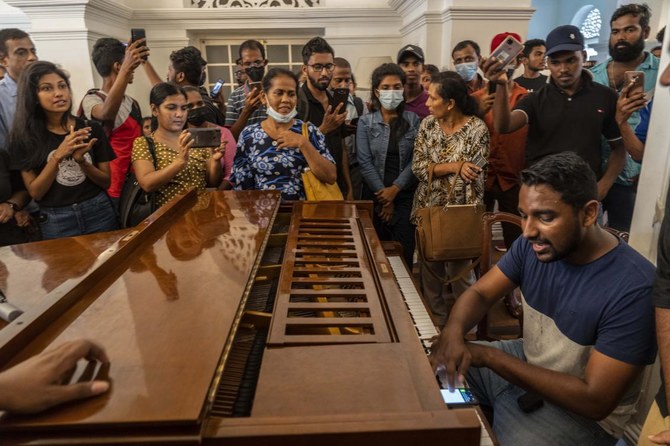
Demonstrations came to a head last weekend when hundreds of thousands of people took over government buildings in Colombo, including the prime minister’s official residence, above. (AP)
Short Url
Updated 14 July 2022
Follow

Sri Lanka protests continue despite curfew, heavy troop deployment

  • President Gotabaya Rajapaksa fled on Wednesday to escape a popular uprising
  • Appointment of PM Ranil Wickremesinghe as acting president triggers more rallies

COLOMBO: Protesters remained on the streets of Colombo on Thursday, despite a curfew and heavy troop deployment, saying they will not stop rallying until Prime Minister Ranil Wickremesinghe quits.

Wickremesinghe was appointed the acting president on Wednesday, hours after President Gotabaya Rajapaksa fled to Maldives to escape a popular uprising over the role his family — Sri Lanka’s most influential political dynasty — played in the country’s worst economic meltdown in memory.

Thousands of demonstrators stormed parliament and government buildings over the weekend and continued to occupy them after the president’s escape.

Rajapaksa’s decision to make his ally Wickremesinghe the acting president triggered more protests, prompting the prime minister to declare a state of emergency and impose a curfew in the capital and surrounding areas.

“We will not stop the protests until the Prime Minister Ranil Wickremesinghe resigns from his premiership,” Senaka Perera, a prominent lawyer representing protesters, told Arab News.

For months, people have been struggling with daily power cuts and shortages of basic commodities such as fuel, food and medicines, as foreign currency reserves have run out, making Sri Lanka unable to pay for imports. Protests flared up in Colombo in March and have grown since, spreading across the country.

Wickremesinghe was appointed prime minister after Rajapaksa’s elder brother, Mahinda, was forced to resign when demonstrations turned deadly in May. A senior opposition lawmaker, he has been prime minister six times, but has never completed his term.

“We were successful in ousting the president and the former prime minister Mahinda Rajapaksa, and now our target is to clear this man from office,” Perera said. “We are all focused on our goals, and we will never move from the site until we achieve them.”

People remained at protest sites despite an army announcement on Thursday that troops would “exercise their force, if the situation deems necessary.”

About 5,000 protesters gathered in the Galle Face Green park in Colombo, as they agreed to abandon government buildings. Perera said the number was expected to grow to 20,000 over the weekend.

Sri Lanka’s parliament is expected to name a new full-time president on July 20, if Rajapaksa files his official resignation letter.

The main opposition alliance, Samagi Jana Balawegaya, has nominated its leader Sajith Premadasa for the post.

Premadasa is the son of Ranasinghe Premadasa, who served as the country’s president from 1989 to 1993. He contested the presidential election in 2019, but lost to Rajapaksa.


Modi ally proposes social media ban for India’s teens as global debate grows

Updated 3 sec ago
Follow

Modi ally proposes social media ban for India’s teens as global debate grows

  • India is the world’s second-biggest smartphone market with 750 million devices and a billion Internet users
  • South Asian nation is a key growth market for social media apps and does not set a minimum age for access
NEW DELHI: An ally of Indian Prime Minister Narendra Modi has proposed a bill to ban social media for children, as the world’s biggest market for Meta and YouTube joins a global debate on the impact of social media on young people’s health and safety.
“Not only are our children becoming addicted to social media, but India is also one of the world’s largest producers of data for foreign platforms,” lawmaker L.S.K. Devarayalu said on Friday.
“Based on this data, these companies are creating advanced AI systems, effectively turning Indian users into unpaid data providers, while the ‌strategic and economic ‌benefits are reaped elsewhere,” he said.
Australia last ‌month ⁠became the ‌first country to ban social media for children under 16, blocking access in a move welcomed by many parents and child advocates but criticized by major technology companies and free-speech advocates. France’s National Assembly this week backed legislation to ban children under 15 from social media, while Britain, Denmark and Greece are studying the issue.
Facebook operator Meta, YouTube-parent Alphabet and X did ⁠not respond on Saturday to emails seeking comment on the Indian legislation. Meta has ‌said it backs laws for parental oversight but ‍that “governments considering bans should be careful ‍not to push teens toward less safe, unregulated sites.”
India’s IT ministry ‍did not respond to a request for comment.
India, the world’s second-biggest smartphone market with 750 million devices and a billion Internet users, is a key growth market for social media apps and does not set a minimum age for access.
Devarayalu’s 15-page Social Media (Age Restrictions and Online Safety) Bill, which is not public but was seen by Reuters, says ⁠no one under 16 “shall be permitted to create, maintain, or hold” a social media account and those found to have one should have them disabled.
“We are asking that the entire onus of ensuring users’ age be placed on the social media platforms,” Devarayalu said.
The government’s chief economic adviser attracted attention on Thursday by saying India should draft policies on age-based access limits to tackle “digital addiction.”
Devarayalu’s legislation is a private member’s bill — not proposed to parliament by a federal minister — but such bills often trigger debates in parliament and influence lawmaking.
He is from the ‌Telugu Desam Party, which governs the southern state Andhra Pradesh and is vital to Modi’s coalition government.