

Lebanon telecoms mark-up threatens migrants’ link to jobs and safety

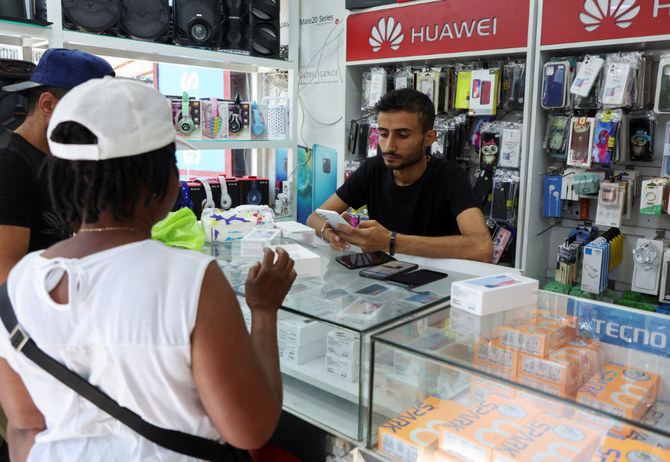
A vendor assists customers inside a mobile shop in Dora, Lebanon July 9, 2022. (REUTERS)
Short Url
Updated 12 July 2022
Follow

Lebanon telecoms mark-up threatens migrants’ link to jobs and safety

  • Lebanon hosts an estimated 250,000 migrant workers primarily from sub-Saharan Africa and Southeast Asia, according to the UN

BEIRUT: Kenyan cleaner Noel Musanga survived Lebanon’s economic meltdown, waves of COVID-19 and Beirut’s port blast. But when her internet provider announced rates would double, she feared her last lifeline to family and work would snap.
The freelance migrant worker already barely earned enough to survive. Now, the higher telecoms bill means she will have to ration her calls to relatives and potential employers.
“It will be like (being) in a deep hole,” Musanga said in her ground-floor apartment in the densely populated Burj Hammoud neighborhood on the edge of Beirut.
Lebanon hosts an estimated 250,000 migrant workers primarily from sub-Saharan Africa and Southeast Asia, according to the UN.

HIGHLIGHT

Lebanon’s three-year financial downturn has only added to their woes, with employers abandoning domestic migrant workers in the streets as their monthly wages — between $150 and $400 — became too expensive

Their residence is usually subject to “kafala,” a sponsorship system that rights groups say gives employers excessive control over workers’ lives.
Lebanon’s three-year financial downturn has only added to their woes, with employers abandoning domestic migrant workers in the streets as their monthly wages — between $150 and $400 — became too expensive.
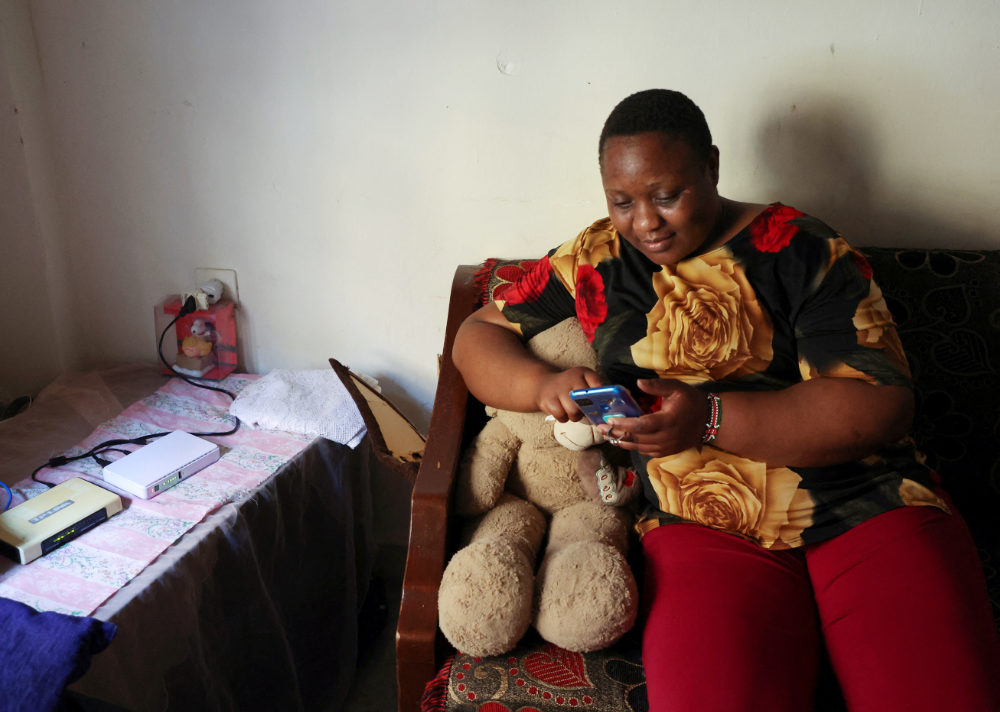


Kenyan migrant worker, Noel Musanga, uses her mobile phone during an interview with Reuters, in her apartment in Burj Hammoud, Lebanon July 1, 2022. (REUTERS)

Some went freelance, living on their own and taking on cleaning or nannying work to pay the bills.
But that has become harder by the day. Lebanon’s currency has lost 95 percent of its value while food and public transportation costs have risen roughly elevenfold. The internet is the next big challenge.
Until this month, Lebanon’s telecoms sector had continued to use the government’s old peg of 1,500 Lebanese pounds to the dollar to charge for phone calls, broadband and mobile internet.
With slim revenues, the state struggled to import enough fuel to run telecoms transmitter stations, leading to cuts in coverage throughout 2021.
To reverse that trend, Lebanon’s Cabinet said telecoms tariffs would be calculated based on the much weaker flexible currency rate set by the government’s Sayrafa platform.
Using the government’s formula, that would cause up to fourfold increases in customers’ bills.
Musanga, who also volunteers as a migrant rights advocate, said that mark-up will be life-changing for vulnerable workers. They would have to choose between paying for a home connection or a mobile one, which they would likely use less to conserve data packages.
It could also present a higher risk for workers seeking to escape abusive employers.
“All the time, I’m on the phone receiving complaints from the girls on contract who are in trouble ... So, I have to have the internet to reach them and solve all these problems,” Musanga said.
The higher cost of living all around also meant migrant workers had almost nothing left to send in remittances to their relatives back home.
“Now in Lebanon if you are here, you are wasting your time, wasting your energy ... Because everything is expensive, and you’ll have nothing to save for yourself or send to your family. So it’s better to go home,” she said.

Druze: the great survivors
How the world's most secretive faithhas endured for a thousand years

Enter


keywords

Sudan hospital welcomes first patients after war forced it shut

Women walk outside Bahri Teaching Hospital after it resumed services in the Sudanese capital Khartoum on January 18, 2026. (AFP)
Updated 5 sec ago
Follow

Sudan hospital welcomes first patients after war forced it shut

  • The Bahri Teaching Hospital, which, before the conflict, treated around 800 patients a day in its emergency department, was repeatedly attacked and looted

KHARTOUM: At a freshly renovated hospital in Khartoum, the medical team is beaming: Nearly three years after it was wrecked and looted in the early days of Sudan’s war, the facility has welcomed its first patients.
The Bahri Teaching Hospital in the capital’s north was stormed by the paramilitary Rapid Support Forces in April 2023, soon after fighting broke out between the RSF and Sudan’s army.
Bahri remained a war zone until an army counteroffensive pushed through Khartoum last year, recapturing the area from the RSF in March.

FASTFACT

Around 40 of Khartoum’s 120 hospitals, shut during the war, have resumed operations, according to the Sudan Doctors’ Network, a local medical group.

“We never thought the hospital would reopen,” said Dr. Ali Mohammed Ali, delighted to be back in his old surgical ward.
“It was completely destroyed; there was nothing left,” he said. “We had to start from scratch.”
Ali fled north from Khartoum in the early days of the war, working in a makeshift medical camp with “no gloves, no instruments, and no disinfectant.”
According to the World Health Organization, the conflict has forced the shutdown of more than two-thirds of Sudan’s health facilities and caused a world record number of deaths from attacks on health care infrastructure.
Tens of thousands of people have been killed across Sudan since the war began, while 11 million have been left displaced, triggering the world’s largest hunger crisis.
But with the RSF now driven out of Khartoum, Sudan’s government is gradually returning, and the devastated city is starting to rebuild.
Around 40 of Khartoum’s 120 hospitals, shut during the war, have resumed operations, according to the Sudan Doctors’ Network, a local medical group.
The Bahri Teaching Hospital, which, before the conflict, treated around 800 patients a day in its emergency department, was repeatedly attacked and looted.
“All the equipment was stolen,” said director Galal Mostafa, adding that about 70 percent of its buildings were damaged and the power system was destroyed.
“We were fortunate to receive two transformers just days ago,” said Salah Al-Hajj, the hospital’s chief executive.
During the first five days of fighting, Al-Hajj — an affable man with a sharp grey moustache — was trapped inside one wing of the hospital.
“We couldn’t leave because of the heavy gunfire,” he said, saying that anyone “who stepped outside risked being detained and beaten” by the RSF.
Patients were rushed to 
safety in dangerous transfers to hospitals away from the fighting across the Nile.
“Vehicles had to take very complicated routes to evacuate patients safely, avoiding shells and bullets,” Al-Hajj said. On April 15, 2023, as the first shots rang out in the capital, RSF fighters seized Ali on his way into surgery.
They held him for two weeks at Soba, an RSF-run detention center in southern Khartoum whose former inmates have shared testimony of torture and inhumane conditions.
“When I was released, the country was in ruins,” he said.
Hospitals were “destroyed, streets devastated, and homes looted. There was nothing left.”
Almost three years on, taxis now drop patients at the hospital’s entrance, while new ambulances sit parked in a courtyard that until recently was strewn with rubble and overgrown weeds.
Inside, refurbished corridors smell of fresh paint.
The renovations and new equipment were funded by the Sudanese American Physicians Association and Islamic Relief USA at a cost of more than $2 million, according to the association.
Services have resumed in newly fitted emergency, surgical, obstetrics, and gynaecology rooms.
Doctors, nurses, and administrators hustle through the halls, the administrators fretting over covering salaries and running costs.
“Now it’s much better than before the war,” said Hassan Alsahir, a 25-year-old intern in the emergency department.
“It wasn’t this clean before, and we were short on beds — sometimes patients had to sleep on the floor.”
On its first day reopened, the hospital received a patient from the Kordofan region — the war’s current major battleground — for urgent surgery.
“The operation went well,” said Ali.