

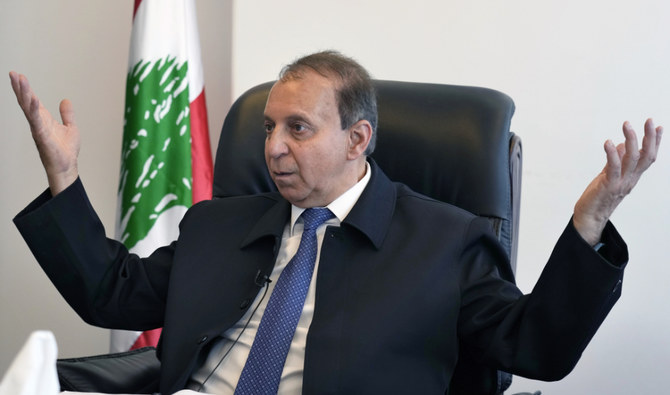

BEIRUT: Lebanon has decided to formally negotiate refugee repatriation with Syria, a minister in the caretaker government said on Thursday.
The Minister of Displaced Affairs Issam Sharaf El-Din said he would visit Damascus after the Eid Al-Adha holiday, making him the first Lebanese minister to visit the Syrian capital in an official capacity since 2011.
Sharaf El-Din will discuss the plan to repatriate Syrian refugees in stages and “secure the executive mechanisms” for their return.
He confirmed he had an official mandate from President Michel Aoun and caretaker Prime Minister Najib Mikati for the Syrian refugee issue.
BACKGROUND
International organizations were trying to obstruct this issue by threatening to not help refugees if they returned to their country, said Minister of Displaced Affairs Issam Sharaf El-Din.
According to Sharaf El-Din, the plan stipulated “the repatriation of 15,000 refugees per month” because Lebanon believed the war in Syria had ended and the country was safe. “Lebanon will not accept the non-return of Syrian refugees to their country.”
Lebanon, which is already in crisis, says Syrian refugees are a heavy burden on basic services and infrastructure.
According to Lebanese protesters, the refugees shared “our bread, which has turned into a rare commodity, and people are scrambling to get it in the past days.”
Lebanese ministers have previously visited Damascus and met Syrian officials, despite the suspension of Syria's Arab League membership, but they have been keen to stress the visits were personal.
The Syrian minister of energy visited Lebanon more than once in the context of signing a contract for the passage of Egyptian gas and Jordanian electricity to Lebanon through Syria.
On Thursday, Sharaf El-Din confirmed that Lebanon dealt with the Syrian state in particular because it was the second party directly concerned with the refugee issue regardless of the UNHCR’s opinion.
He also said the Syrian state was very cooperative in the matter.
Those who wanted to return but had judicial rulings against them or any specific legal circumstances would have their cases dealt with or deported to third countries, he added.
International organizations were trying to obstruct this issue by threatening to not help refugees if they returned to their country, said Sharaf El-Din.
The UNHCR estimates there are fewer than 1 million refugees in Lebanon, while Lebanon estimates their number to be 1.5 million.
The door to repatriation was opened two years ago by submitting the names of refugees who wished to return to their villages and cities to Syrian authorities.
Those wishing to return had to obtain the approval of Syrian authorities. But the process later stopped as many refugees did not get approval because authorities wanted to secure an adequate infrastructure for living.
A source in the Lebanese government told Arab News: “The process is continuing on two fronts. Minister Sharaf El-Din takes charge of the side related to the Syrian authorities and holds an official cover from the Lebanese side, and Prime Minister Mikati takes over the side related to international institutions.
“So far, Lebanon has not received any answer from the UNHCR. There are thorny issues, including those related to Syrian dissidents, and these issues must be dealt with calmly to reach the implementation stage.”
MP Razi Al-Hajj, from the Lebanese Forces party, criticized the “populism and contradictory agendas” in addressing the issue of Syrian and Palestinian refugees in Lebanon.
He told a press conference on Thursday: “Why, until now, are there no unified figures in the executive authority institutions about the number of refugees? What about the classification of these refugees between displaced people and workers? And why has this legal classification been ignored until now?
“The current Lebanese government and the governments that preceded it ignored signing a cooperation protocol with the UNHCR. If they fear that this protocol will turn Lebanon into a country of asylum, a basic cooperation protocol can define rights, duties, and repatriation policy for refugees.
“A proposal to establish temporary border shelters inside Syria, under the auspices of the United Nations, was rejected in the past. Was the rejection intended to maintain easy smuggling and open borders for Hezbollah as well?"
He asked why the government, through the Ministry of Foreign Affairs, had not requested the International Support Group for Lebanon to put the issue of repatriation of Syrian refugees on the agenda of UN Security Council sessions, and why it had not requested that Lebanon be an observer member of the Geneva process, given its “inability to tolerate” these burdens.
He said Lebanon had submitted a belated request to be an observer member of the Astana process, which ended in “catastrophic failure.”


