

Turkey’s Erdogan, Serbia’s Vucic agree to broker Bosnia crisis talks

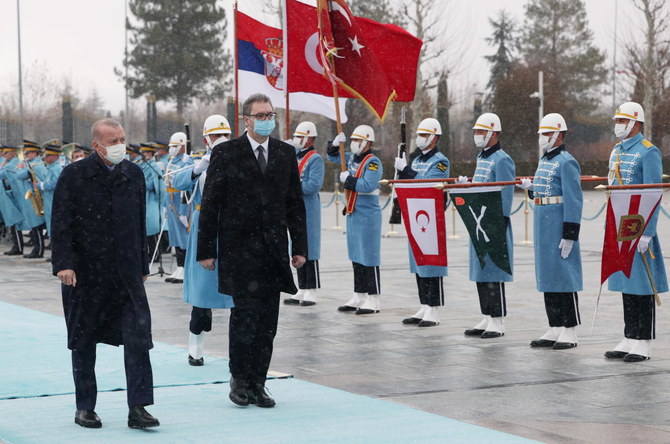
Turkish President Recep Tayyip Erdogan and Serbian President Aleksandar Vucic review a guard of honor, during a welcome ceremony, in Ankara, Turkey, Jan. 18, 2022. (Reuters)
Short Url
Updated 19 January 2022
Follow

Turkey’s Erdogan, Serbia’s Vucic agree to broker Bosnia crisis talks

  • Erdogan said Serbs, Croats and Bosniaks alike should refrain from steps that endanger Bosnia’s territorial integrity
  • Erdogan said, earlier, that Albanian Prime Minister Edi Rama and Bosnian Serb leader Milorad Dodik had voiced support for his mediation offer

ANKARA: Turkish President Tayyip Erdogan said he and Serbian counterpart Aleksandar Vucic agreed on Tuesday to broker crisis talks involving all parties in Bosnia after elections in Serbia in April.

The crisis flared after nationalist lawmakers in post-war Bosnia’s semi-autonomous Serb entity passed a non-binding motion last year to start pulling the region out of the country’s armed forces, tax system and judiciary — a move long backed by Bosnian Serb leader Milorad Dodik.

Turkey, which has deep-rooted historical ties in the Balkans, has criticized the move as “wrong, dangerous” and has offered to mediate in the crisis, which has raised fears of a relapse into ethnic conflict in Bosnia.

After a calamitous 1992-95 ethnic war that killed 100,000 people, Bosnia was split into two widely autonomous regions — a Serb Republic (RS) and a Federation dominated by Bosniaks and Croats, overlaid by a loose central government.

Addressing reporters along with Vucic after talks in Ankara, Erdogan said Serbs, Croats and Bosniaks alike should refrain from steps that endanger Bosnia’s territorial integrity and that all should act “with a sense of responsibility.”

“After these (Serbian) elections, we want to bring together the leaders of these three groups and to have a meeting with them. With this meeting, let us take steps to ensure Bosnia’s territorial integrity,” he said.

“We want to convene the three leaders — of Bosniaks, Croats, and Serbs — and accomplish this. We agreed on this,” Erdogan said, adding the talks could be held in Istanbul or Belgrade.

Mainly Muslim Turkey backed the late Bosniak Muslim wartime leader Alija Izebegovic and has forged good relations with Bosnia’s post-war, inter-ethnic Bosniak-Serb-Croat presidency.

Earlier, Erdogan was quoted by local media as saying Albanian Prime Minister Edi Rama, Dodik and other regional officials had voiced support for his mediation offer, and that Ankara would intensify its diplomacy to resolve the crisis.

Vucic told the news conference that Serbia was committed to Bosnia as an intact state and that the preservation of peace and stability in the Balkans was paramount, along “with respect for differences.”

Vucic called on Dodik last week to return to national institutions that the Serb Republic has boycotted since mid-2021 over a law criminalizing the denial of genocide.

International war crimes court judgments have branded the 1995 massacre of 8,000 Bosniak men and boys in Srebrenica by Bosnian Serb forces as genocide, something nationalist Serbs deny.

Serbia was the patron of wartime Bosnian Serb separatists and remains close to Bosnia’s post-war Serb entity, sharing a border with it.

Dodik’s secessionist rhetoric has spurred Serb nationalist rallies and incidents in towns across the Serb Republic.

Earlier this month, the United States imposed new sanctions on Dodik for alleged corruption and threatening Bosnia’s stability and territorial integrity. The European Union also said last week the Bosnian Serb leadership faced EU sanctions and a loss of aid should it continue to incite tensions.

Shamima Begum’s case revived after top European court’s intervention

Shamima Begum left east London aged 15 and traveled to Daesh-held territory in Syria in 2015. (File/AFP)
Updated 11 sec ago
Follow

Shamima Begum’s case revived after top European court’s intervention

  • European Court of Human Rights challenges British govt’s citizenship deprivation order
  • Begum, 26, left London as a teenager to marry a Daesh fighter, with concerns she was trafficked

LONDON: The longtime appeal by Shamima Begum to return to the UK has been revived after the European Court of Human Rights challenged the British government’s block on her return.

The 26-year-old, who left east London aged 15 and traveled to Daesh-held territory in Syria in 2015, had her British citizenship stripped by the then home secretary, Sajid Javid, The Times reported.

The Strasbourg court’s intervention means the UK must now consider if it acted unlawfully under the framework of the European Convention of Human Rights in stripping her citizenship in 2019.

Begum traveled with two friends to Syria. There, she became a child bride to Dutch national Yago Riedijk and had three children who all died as infants.

The court is examining whether the 2019 decision breached the ECHR’s Article Four, which prohibits slavery, servitude and forced labor.

As part of the examination, it could be found that the UK failed in its duty to identify Begum as a potential victim of trafficking and protect her from harm.

Begum’s journey to Syria made national headlines in the UK. The Times newspaper later discovered her whereabouts at a prison camp in Syria operated by Kurdish security forces, where she remains today.

In stripping her citizenship, Javid said the decision was “conducive to the public good.”

He also argued she was eligible for Bangladeshi nationality through her parents, to avoid rendering her stateless.

However, Bangladesh has said repeatedly that Begum is not a citizen of the country.

Begum’s lawyers, from the firm Birnberg Peirce, filed a submission to the Strasbourg court which argued that the UK failed to ask fundamental questions before stripping her citizenship, including concerns over child trafficking.

Gareth Peirce said the UK could now confront previously ignored questions as a result of the court’s intervention, providing “an unprecedented opportunity.”

She added: “It is impossible to dispute that a 15-year-old British child was lured and deceived for the purposes of sexual exploitation.

“It is equally impossible not to acknowledge the catalogue of failures to protect a child known to be at risk.”

The Strasbourg court’s move meant that it was “impossible now not to have real hope of a resolution,” she said, adding that the Begum case raised profound questions about the UK’s responsibility to victims of grooming and trafficking.

Despite years of litigation, Begum has failed to overturn the citizenship deprivation order. She has stated her desire to return to Britain.

In 2020, the Special Immigration Appeals Commission found that conditions in the camp where she is held, Al-Roj, were inhuman and degrading, but that national security considerations prevented any change to her case.

Later, the Supreme Court ruled that Begum was ineligible to return to Britain to take part in the appeal against her citizenship deprivation.

The Strasbourg court could reject appeals by Begum’s lawyers after considering the UK Home Office’s response to its questions.

If the latest appeal is upheld, however, ministers would have to “take account” of the court’s judgment. The court’s rulings are technically binding but lack an enforcement mechanism.

The Strasbourg court is now set to consider written submissions from both sides before deciding whether the case should proceed to a full hearing. A final judgment could take many months.

A Home Office spokesman said: “The government will always protect the UK and its citizens. That is why Shamima Begum — who posed a national security threat — had her British citizenship revoked and is unable to return to the UK.

“We will robustly defend any decision made to protect our national security.”

Maya Foa, CEO of Reprieve, a charity that has campaigned for the return of women and children from Syria, said: “This case only reached the European court because successive UK governments failed to take simple steps to resolve a common problem.

“While our security allies have all been bringing their people home, Britain has been burying its head in the sand. Casting British men, women and children into a legal black hole is a negligent policy that betrays a lack of faith in our justice system.”