

Sri Lankan PM offers to resign after mass protests in Colombo

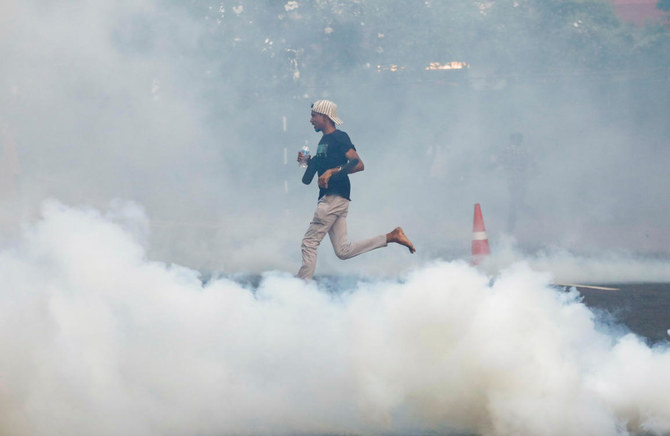
Police used tear gas and water cannons to disperse demonstrators near the presidential residence during anti-government protest. (REUTERS)
Short Url
Updated 09 July 2022
Follow

Sri Lankan PM offers to resign after mass protests in Colombo

  • Protesters had stormed Sri Lankan president’s home and office in capital on Saturday
  • PM willing to step down for a unity government, his office said

COLOMBO: Sri Lanka’s Prime Minister Ranil Wickremesinghe said on Saturday he is willing to step down and allow an all-party government to take over after thousands of protesters descended on the capital Colombo in one of the largest anti-government marches in the crisis-hit country this year.

The bankrupt country of 22 million people is facing its worst economic crisis in memory and has been unable to pay for essential imports for months due to a severe dollar crunch caused by economic mismanagement and the aftermath of the COVID-19 pandemic on its tourism-dependent economy.

Struggling under extreme shortages of petrol, food and medicines, which forced schools to shut and led to record inflation that reached 54.6 percent in June, Sri Lankans from across the country marched to Colombo on Saturday, demanding the resignation of President Gotabaya Rajapaksa.

The mass protests, which saw hundreds storm into the president’s house and nearby office in Colombo, prompted Wickremesinghe to call for an emergency meeting of political party leaders, as they urged him and Rajapaksa to resign immediately.

Wickremesinghe, who took over in May, said he is willing to give up his premiership.

“To ensure the continuation of the government including the safety of all citizens I accept the best recommendation of the party leaders today, to make way for an all-party government,” Wickremesinghe said on Twitter.

“To facilitate this I will resign as prime minister.”

Wickremesinghe’s resignation will only take place after an all-party government is formed and parliament secures a majority, a statement issued by his office said, and he is expected to stay in office until then.  

Though Sri Lankans have been holding protests outside of the president’s office since March, Saturday’s protests are one of the biggest demonstrations yet, as tens of thousands took to the streets to express their anger over Rajapaksa, the leader they hold responsible for the island nation’s economic meltdown.

Protesters had come from other parts of the country and abroad, marching into the government district in the capital and breaking police barricades, while shouting slogans against the president, such as “Gota go home.” Hundreds of people eventually breached parts of the presidential complex, with footage on social media showing people inside as they waved flags and milled about on the grounds.

“We came here to participate in the protest,” Mohammed Hussain Mohammed Manasique, a Sri Lankan who was working in Kuwait and flew into Colombo on Friday, told Arab News.

“Our families are suffering here without proper food, transport and education.”


NATO wants ‘automated’ defenses along borders with Russia: German general

Updated 24 January 2026
Follow

NATO wants ‘automated’ defenses along borders with Russia: German general

  • That zone would act as a defensive buffer before any enemy forces advanced into “a sort of hot zone,” said Lowin
  • The AI-guided system would reinforce existing NATO weapons and deployed forces, the general said

FRANKFURT: NATO is moving to boost its defenses along European borders with Russia by creating an AI-assisted “automated zone” not reliant on human ground forces, a German general said in comments published Saturday.
That zone would act as a defensive buffer before any enemy forces advanced into “a sort of hot zone” where traditional combat could happen, said General Thomas Lowin, NATO’s deputy chief of staff for operations.
He was speaking to the German Sunday newspaper Welt am Sonntag.
The automated area would have sensors to detect enemy forces and activate defenses such as drones, semi-autonomous combat vehicles, land-based robots, as well as automatic air defenses and anti-missile systems, Lowin said.
He added, however, that any decision to use lethal weapons would “always be under human responsibility.”
The sensors — located “on the ground, in space, in cyberspace and in the air” — would cover an area of several thousand kilometers (miles) and detect enemy movements or deployment of weapons, and inform “all NATO countries in real time,” he said.
The AI-guided system would reinforce existing NATO weapons and deployed forces, the general said.
The German newspaper reported that there were test programs in Poland and Romania trying out the proposed capabilities, and all of NATO should be working to make the system operational by the end of 2027.
NATO’s European members are stepping up preparedness out of concern that Russia — whose economy is on a war footing because of its conflict in Ukraine — could seek to further expand, into EU territory.
Poland is about to sign a contract for “the biggest anti-drone system in Europe,” its defense minister, Wladyslaw Kosiniak-Kamysz, told the Gazeta Wyborcza daily.
Kosiniak-Kamysz did not say how much the deal, involving “different types of weaponry,” would cost, nor which consortium would ink the contract at the end of January.
He said it was being made to respond to “an urgent operational demand.”