

Urban flooding hits Pakistan’s largest city as deadly monsoon rains lash South Asia

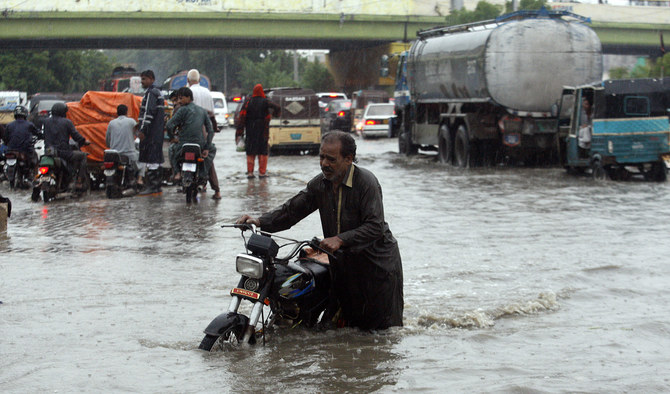
A Pakistani man push his bike through a flooded road after a heavy rainfall in Karachi, Pakistan, on July 8, 2022. (AP)
Short Url
Updated 25 September 2022
Follow

Urban flooding hits Pakistan’s largest city as deadly monsoon rains lash South Asia

  • Monsoon rains have already killed 116 people in Pakistan
  • Karachi Administrator Murtaza Wahab says city's drains working at 'packed capacity'

KARACHI: The main roads of Pakistan’s largest city, Karachi, were under water on Saturday, with many parts of the metropolis hit by power outages, as heavy monsoon rains continued to lash the region. 

The rains, which began with the onset of monsoon season in South Asia in mid-June, have already killed 116 people in Pakistan, with nearly half the deaths taking place in the country’s south and southwest.


People wade through a flooded road in a business district after a heavy rainfall in Karachi, Pakistan, on July 9, 2022. (AP)

Karachi, the capital of the southern Sindh province and Pakistan’s financial and economic hub, suffers from urban flooding each year, with people dying from drowning and electrocution, as the city’s clogged drains fail to empty water from the streets.

While local media channels showed rescue services using lifeboats to evacuate women and children, netizens said there has been little assistance from the local administration, as they shared video footage from impassable streets in the main parts of the city. 


“All roads are flooded,” Wasif Shakil, a Karachi-based journalist, told Arab News. “There’s no government in the city, we are living on our own here in Karachi.”

Karachi Administrator Murtaza Wahab, who was sharing live updates on his Twitter account, said pumping stations have been used to remove the water, as drains were working at “packed capacity.” In some areas the pumps could not work as electricity had been cut off — an issue that he said was being resolved with the use of power generators.

The Pakistan Meteorological Department (PMD) has warned of more isolated falls and thunderstorms during the upcoming Eid Al-Adha holidays as monsoon currents continue to penetrate the region.


Pakistan, China to sign multiple MoUs at major agriculture investment conference today

Updated 18 January 2026
Follow

Pakistan, China to sign multiple MoUs at major agriculture investment conference today

  • Hundreds of Chinese and Pakistani firms to attend Islamabad event
  • Conference seen as part of expanding CPEC ties into agriculture, trade

KARACHI: Islamabad and Beijing are set to sign multiple memorandums of understanding (MoUs) to boost agricultural investment and cooperation at a major conference taking place in the capital today, Monday, with hundreds of Chinese and Pakistani companies expected to participate.

The conference is being billed by Pakistan’s Ministry of National Food Security and Research as a platform for deepening bilateral agricultural ties and supporting broader economic engagement between the two countries.

“Multiple memorandums of understanding will be signed at the Pakistan–China Agricultural Conference,” the Ministry of National Food Security said in a statement. “115 Chinese and 165 Pakistani companies will participate.”

The conference reflects a growing emphasis on expanding Pakistan-China economic cooperation beyond the transport and energy foundations of the flagship China-Pakistan Economic Corridor (CPEC) into agriculture, industry and technology.

Under its first phase launched in 2015, CPEC, a core component of China’s Belt and Road Initiative, focused primarily on transportation infrastructure, energy generation and connectivity projects linking western China to the Arabian Sea via Pakistan. That phase included motorways, power plants and the development of the Gwadar Port in the country's southwest, aimed at helping Pakistan address chronic power shortages and enhance transport connectivity.

In recent years, both governments have formally moved toward a “CPEC 2.0” phase aimed at diversifying the corridor’s impact into areas such as special economic zones, innovation, digital cooperation and agriculture. Second-phase discussions have highlighted Pakistan’s goal of modernizing its agricultural sector, attracting Chinese technology and investment, and boosting export potential, with high-level talks taking place between planning officials and investors in Beijing.

Agri-sector cooperation has also seen practical collaboration, with joint initiatives examining technology transfer, export protocols and value-chain development, including partnerships in livestock, mechanization and horticulture.

Organizers say the Islamabad conference will bring together government policymakers, private sector investors, industry associations and multinational agribusiness firms from both nations. Discussions will center on investment opportunities, technology adoption, export expansion and building linkages with global buyers within the framework of Pakistan-China economic cooperation.