

Pakistan PM expresses sorrow as Japan ex-PM Abe fatally shot during election campaign

A man looks at a television broadcast showing news about the attack on former Japanese prime minister Shinzo Abe earlier in the day, along a street of Tokyo, Japan, on July 8, 2022. (AFP)
Short Url
Updated 08 July 2022
Follow

Pakistan PM expresses sorrow as Japan ex-PM Abe fatally shot during election campaign

  • This is the first assassination of a sitting or former Japanese premier since 1930s
  • Abe served two terms as prime minister, stepping down in 2020 citing ill health

ISLAMABAD: Pakistani Prime Minister Shehbaz Sharif paid tribute to Shinzo Abe, Japan’s longest-serving prime minister, for improving ties between Islamabad and Tokyo, after the leader was fatally shot while campaigning for a parliamentary election.

Abe died on Friday after being shot while campaigning for a parliamentary election, public broadcaster NHK said.

A man opened fire on Abe, 67, from behind with an apparently homemade gun as he spoke at a drab traffic island in the western city of Nara, Japanese media showed earlier.

It was the first assassination of a sitting or former Japanese premier since the days of prewar militarism in the 1930s.

“I extend my profound condolences over the sad demise of former Japanese Prime Minister Shinzo Abe,” Sharif said on Twitter. “He made invaluable contributions to the Pakistan-Japan relationship. Our prayers are with bereaved family. At this difficult time, we stand in solidarity with the people of Japan.”

Speaking before Abe’s death was announced, Prime Minister Fumio Kishida condemned the shooting in the “strongest terms” while Japanese people and world leaders expressed shock at the violence in a country in which political violence is rare and guns are tightly controlled.

“This attack is an act of brutality that happened during the elections — the very foundation of our democracy — and is absolutely unforgivable,” said Kishida, struggling to keep his emotions in check.

A fire department official had told Reuters Abe appeared to be in a state of cardiac arrest when airlifted to hospital.

Police said a 41-year-old man suspected of carrying out the shooting had been arrested. NHK quoted the suspect, identified as Tetsuya Yamagami, as telling police he was dissatisfied with Abe and wanted to kill him.
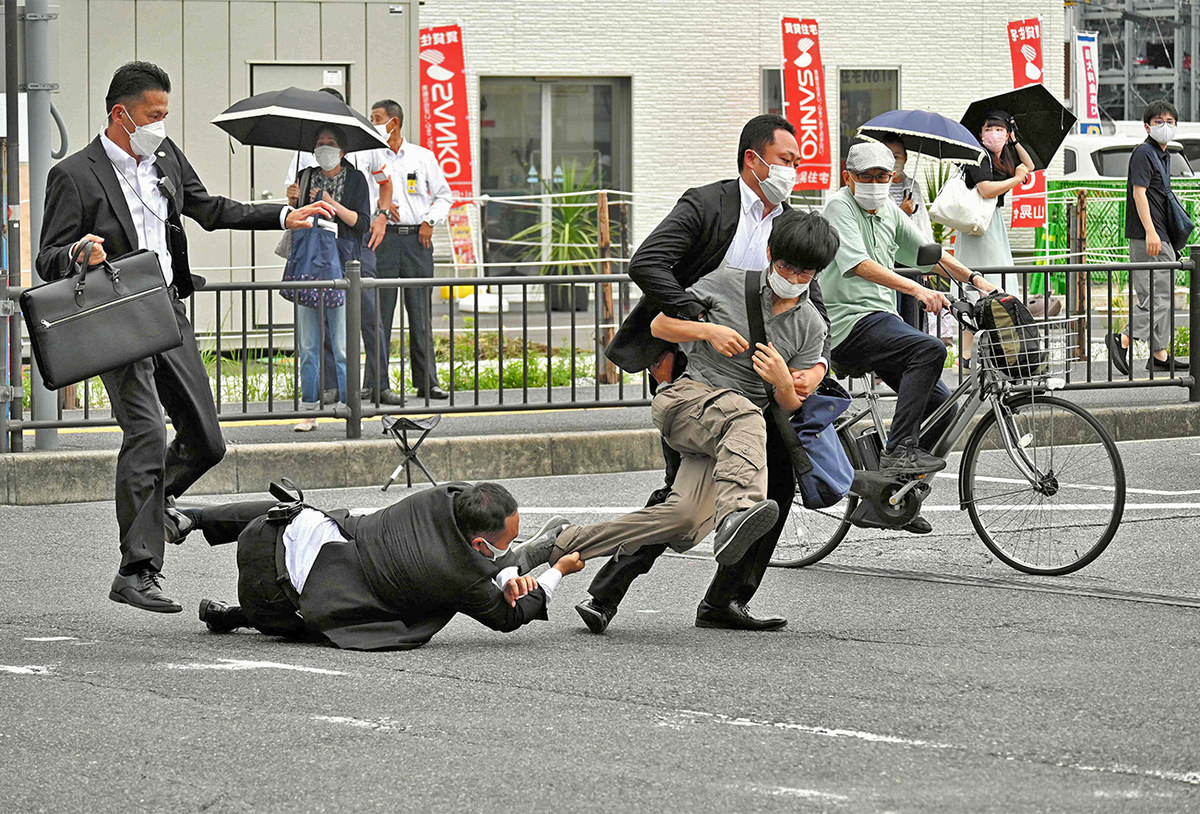


This image received from the Asahi Shimbun newspaper shows a man (centre R) suspected of shooting former Japanese prime minister Shinzo Abe being tackled to the ground by police at Yamato Saidaiji Station in the city of Nara, Japan, on July 8, 2022. (Photo courtesy: ASAHI SHIMBUN / AFP)

Abe was making a campaign speech outside a train station when two shots rang out at about 11:30 a.m. (0230 GMT). Security officials were then seen tackling a man in a grey T-shirt and beige trousers.

“There was a loud bang and then smoke,” businessman Makoto Ichikawa, who was at the scene, told Reuters, adding that the gun was the size of a television camera.

“The first shot, no one knew what was going on, but after the second shot, what looked like special police tackled him.”

Earlier, Kyodo news service published a photograph of Abe lying face-up on the street by a guardrail, blood on his white shirt. People were crowded around him, one administering heart massage.
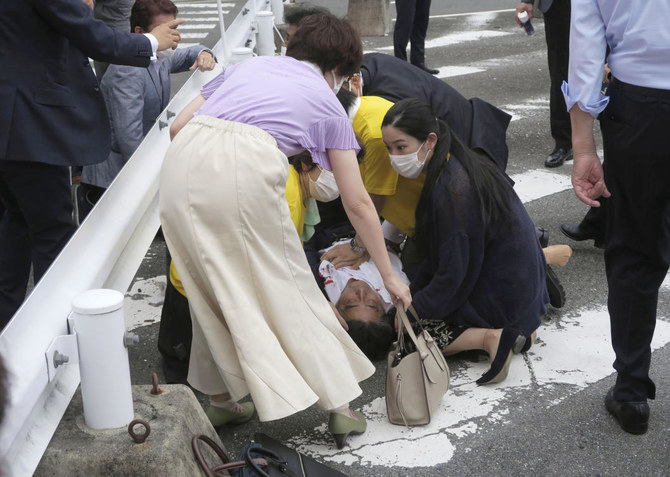


Japan’s former Prime Minister Shinzo Abe, center, falls on the ground in Nara, western on July 8, 2022 after apparently being shot. (Kyodo News via AP)

Nara emergency services said he had been wounded on the right side of his neck and left clavicle. His brother, Defense Minister Nobuo Kishi, had said Abe was getting blood transfusions.

NHK showed live footage of Abe’s wife, Akie, on her way by train to the hospital where he was being treated.

Airo Hino, political science professor at Waseda University, said such a shooting was unprecedented in Japan. “There has never been anything like this,” he said.

Senior Japanese politicians are accompanied by armed security agents but often get close to the public, especially during political campaigns when they make roadside speeches and shake hands with passersby.

In 2007, the mayor of Nagasaki was shot and killed by a yakuza gangster. The head of the Japan Socialist Party was assassinated during a speech in 1960 by a right-wing youth with a samurai short sword. A few other prominent postwar politicians were attacked but not injured.

Police said the suspected shooter was a resident of Nara. Media said he had served in Japan’s military for three years until 2005. Defense Minister Kishi declined to comment on that.

Abe served two terms as prime minister, stepping down in 2020 citing ill health. But he has remained a dominant presence over the ruling Liberal Democratic Party (LDP), controlling one of its major factions.

Kishida, Abe’s protege, had been hoping to use the election to emerge from Abe’s shadow and define his premiership, analysts have said. Kishida suspended his election campaign after the shooting. All main political parties condemned the attack.


‘Look ahead or look up?’: Pakistan’s police face new challenge as militants take to drone warfare

Updated 14 January 2026
Follow

‘Look ahead or look up?’: Pakistan’s police face new challenge as militants take to drone warfare

  • Officials say militants are using weapons and equipment left behind after allied forces withdrew from Afghanistan
  • Police in northwest Pakistan say electronic jammers have helped repel more than 300 drone attacks since mid-2025

BANNU, Pakistan: On a quiet morning last July, Constable Hazrat Ali had just finished his prayers at the Miryan police station in Pakistan’s volatile northwest when the shouting began.

His colleagues in Bannu district spotted a small speck in the sky. Before Ali could take cover, an explosion tore through the compound behind him. It was not a mortar or a suicide vest, but an improvised explosive dropped from a drone.

“Now should we look ahead or look up [to sky]?” said Ali, who was wounded again in a second drone strike during an operation against militants last month. He still carries shrapnel scars on his back, hand and foot, physical reminders of how the battlefield has shifted upward.

For police in the northwestern Khyber Pakhtunkhwa (KP) province, the fight against militancy has become a three-dimensional conflict. Pakistani officials say armed groups, including the Tehreek-e-Taliban Pakistan (TTP), are increasingly deploying commercial drones modified to drop explosives, alongside other weapons they say were acquired after the US military withdrawal from neighboring Afghanistan.

Security analysts say the trend mirrors a wider global pattern, where low-cost, commercially available drones are being repurposed by non-state actors from the Middle East to Eastern Europe, challenging traditional policing and counterinsurgency tactics.

The escalation comes as militant violence has surged across Pakistan. Islamabad-based Pakistan Institute for Conflict and Security Studies (PICSS) reported a 73 percent rise in combat-related deaths in 2025, with fatalities climbing to 3,387 from 1,950 a year earlier. Militants have increasingly shifted operations from northern tribal belts to southern KP districts such as Bannu, Lakki Marwat and Dera Ismail Khan.

“Bannu is an important town of southern KP, and we are feeling the heat,” said Sajjad Khan, the region’s police chief. “There has been an enormous increase in the number of incidents of terrorism… It is a mix of local militants and Afghan militants.”

In 2025 alone, Bannu police recorded 134 attacks on stations, checkpoints and personnel. At least 27 police officers were killed, while authorities say 53 militants died in the clashes. Many assaults involved coordinated, multi-pronged attacks using heavy weapons.

Drones have also added a new layer of danger. What began as reconnaissance tools have been weaponized with improvised devices that rely on gravity rather than guidance systems.

“Earlier, they used to drop [explosives] in bottles. After that, they started cutting pipes for this purpose,” said Jamshed Khan, head of the regional bomb disposal unit. “Now we have encountered a new type: a pistol hand grenade.”

When dropped from above, he explained, a metal pin ignites the charge on impact.

Deputy Superintendent of Police Raza Khan, who narrowly survived a drone strike during construction at a checkpoint, described devices packed with nails, bullets and metal fragments.

“They attach a shuttlecock-like piece on top. When they drop it from a height, its direction remains straight toward the ground,” he said.

TARGETING CIVILIANS

Officials say militants’ rapid adoption of drone technology has been fueled by access to equipment on informal markets, while police procurement remains slower.

“It is easy for militants to get such things,” Sajjad Khan said. “And for us, I mean, we have to go through certain process and procedures as per rules.”

That imbalance began to shift in mid-2025, when authorities deployed electronic anti-drone systems in the region. Before that, officers relied on snipers or improvised nets strung over police compounds.

“Initially, when we did not have that anti-drone system, their strikes were effective,” the police chief said, adding that more than 300 attempted drone attacks have since been repelled or electronically disrupted. “That was a decisive moment.”

Police say militants have also targeted civilians, killing nine people in drone attacks this year, often in communities accused of cooperating with authorities. Several police stations suffered structural damage.

Bannu’s location as a gateway between Pakistan and Afghanistan has made it a security flashpoint since colonial times. But officials say the aerial dimension of the conflict has placed unprecedented strain on local forces.

For constables like Hazrat Ali, new technology offers some protection, but resolve remains central.

“Nowadays, they have ammunition and all kinds of the most modern weapons. They also have large drones,” he said. “When we fight them, we fight with our courage and determination.”