



MAKKAH: As this year’s Hajj pilgrims make their way to Makkah, the providers of Zamzam are welcoming them with the water that springs from a well in the Grand Mosque, 21 meters east of the Kaaba.
Zamzam has an ancient history that goes back thousands of years to the era of Al-Khalil Ibrahim and his son Ismail.
The Zamazima (providers of Zamzam water) and their services have a long and distinguished history.
Hassan Abu Al-Faraj, the managing director and member of the board of directors at the Zamazima Co., told Arab News: “When the divine command was given to the Prophet of God Ibrahim, peace be upon him, to go to Makkah and leave his wife Hajar and his son Ismail, peace be upon him, in an uncultivated valley near the Sacred Mosque, he bid them farewell, left and did not turn back despite the repeated calls of his wife Hajar.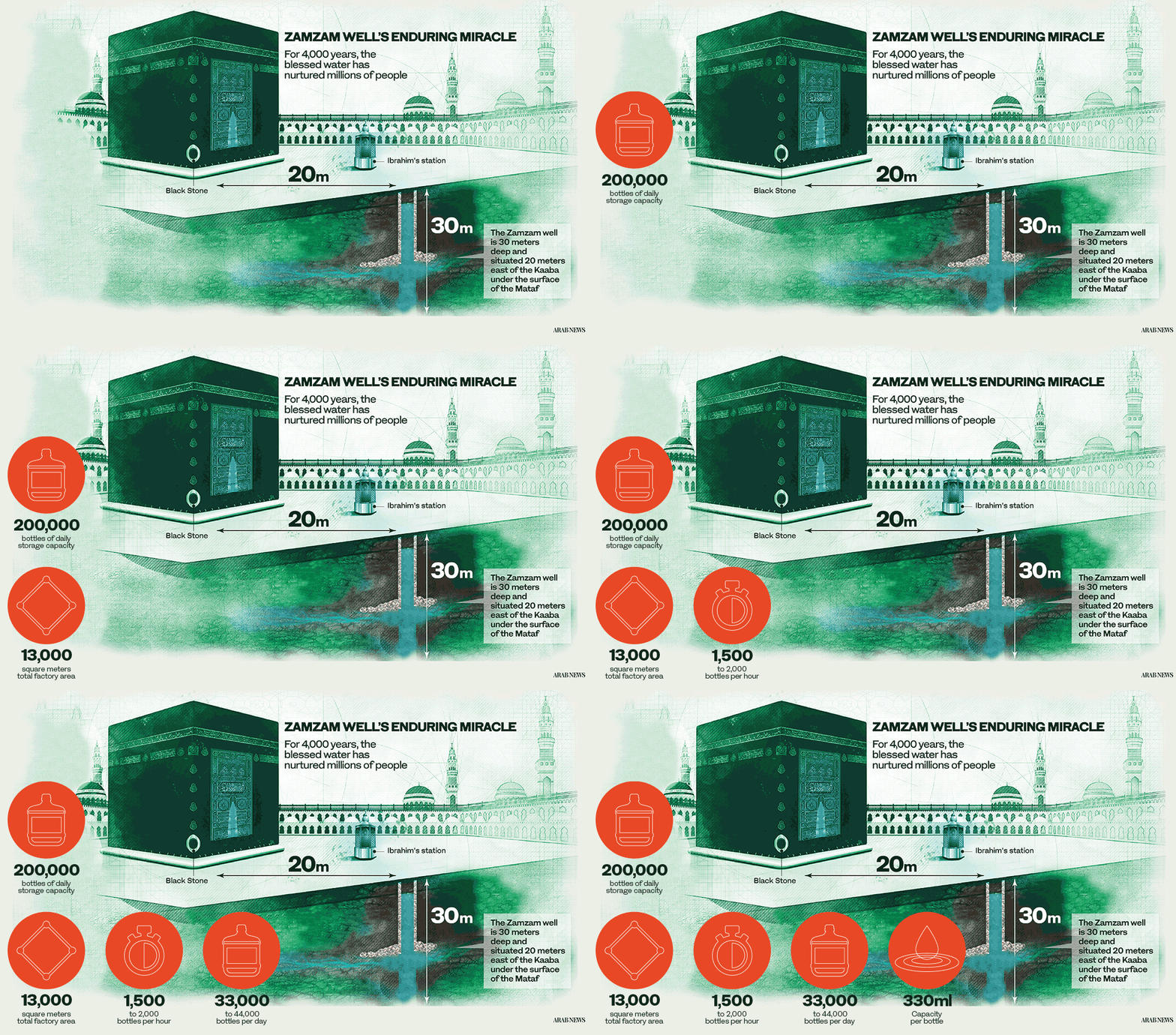
“He answered by saying: ‘I did this by God's command.’ After the water ran out and the child began to cry, his mother could no longer bear to see him crying, so she shunned him so she wouldn’t hear his cries. She headed toward Al-Safa and climbed the mountain, then went toward Al-Marwa and climbed the mountain as well. She walked from Safa to Marwa seven times and, during her seventh quest in Marwa, she heard a voice and said: ‘Help if you have any goodness (in your heart).’
“So the man, who was said to be Gabriel, hit the site of the well with his foot and water emerged from the ground. Hajar surrounded the sand and piled it up to preserve the water and uttered as she piled up the sand, ‘Zam zam, zam zam,’ which means ‘gather’ in the Syriac language. That is the meaning behind the name.
“In 1403 A.H. (1983), the Unified Zamazima Office, known as the Zamazima Co. now, was established to undertake the task of providing water to pilgrims coming from outside the Kingdom, providing Zamzam water at the guidance centers at the entrances to Makkah and in their residences throughout their stay in Makkah.
“Zamzam water is also distributed to pilgrims during their departure at the Tafweej centers at the exits of Makkah so that Zamzam water is the first and last thing pilgrims drink (from) the moment they enter and leave Makkah.”
In 2010, a project with an estimated cost of SR700 million ($186.6 million) was launched to automatically fill bottles and purify the water.

A picture taken on July 29, 2020 shows a pilgrim receiving water at the Grand Mosque complex in Makkah, at the start of the annual Muslim Hajj pilgrimage. (AFP/File Photo)
It consists of several buildings, including one for air compressors, a warehouse with unprocessed water containers, a building for production lines, and a warehouse for the processed bottles with a daily storage capacity of 200,000 bottles.
The factory’s total area exceeds 13,000 square meters. The building also has backup generators with a capacity of 10 megawatts and works with a system that controls and monitors all phases of the project, from pumping water from the well to the last stages of filling.
The production capacity of the automatic filling line for the Zamzam water bottling center ranges from 1,500 to 2,000 bottles per hour, with a daily quantity ranging from 33,000 to 44,000 bottles.
“During this year’s Hajj season, the Zamazima Co. prepared its operational plan, including working to provide Zamzam water to pilgrims from the moment of their arrival in Makkah until their departure through several main axes that are consistent with the Kingdom’s Vision 2030 and the full care and great attention given by our wise government for pilgrims, to perform their rituals at ease and safely,” Al-Faraj told Arab News.
“Among the most prominent developments is the cancellation of the distribution of 20 liter Zamzam water bottles that were placed in refrigerators in the pilgrims’ residences and replacing them with bottles of 330 ml capacity to make them more accessible to pilgrims.
“The first program of the plan included working on preparing sites to distribute Zamzam water to pilgrims at guidance centers at Makkah’s entrances from Jeddah and Madinah. Each pilgrim receives two refrigerated bottles straight from cooling rooms and special sites. Supervisors and employees were also recruited to distribute bottles of Zamzam water to pilgrims during their arrival at the guidance center so that Zamzam water is the first thing that pilgrims drink.”
The second program sees the distribution of three 330 ml bottles to pilgrim accommodation daily through a digital channel that facilitates their delivery and confirms their receipt. There is also an internal and field control center to follow up and ensure the arrival of Zamzam water for pilgrims to their residence daily, from the moment of their arrival at their accommodation until they leave.
According to Islamic belief, Zamzam is a miraculously-generated source of water from God, which began thousands of years ago when Abraham's infant son Ishmael was thirsty and crying for water when it discovered a well by kicking the ground. (AFP/File Photo)
The under-secretary-general for services and field affairs and environmental protection investigation, Mohammed bin Musleh Al-Jabri, told Arab News that the General Presidency for the Affairs of the Two Holy Mosques worked through its service system to help visitors perform their rituals with ease and that one of those blessed services was the provision of Zamzam water.
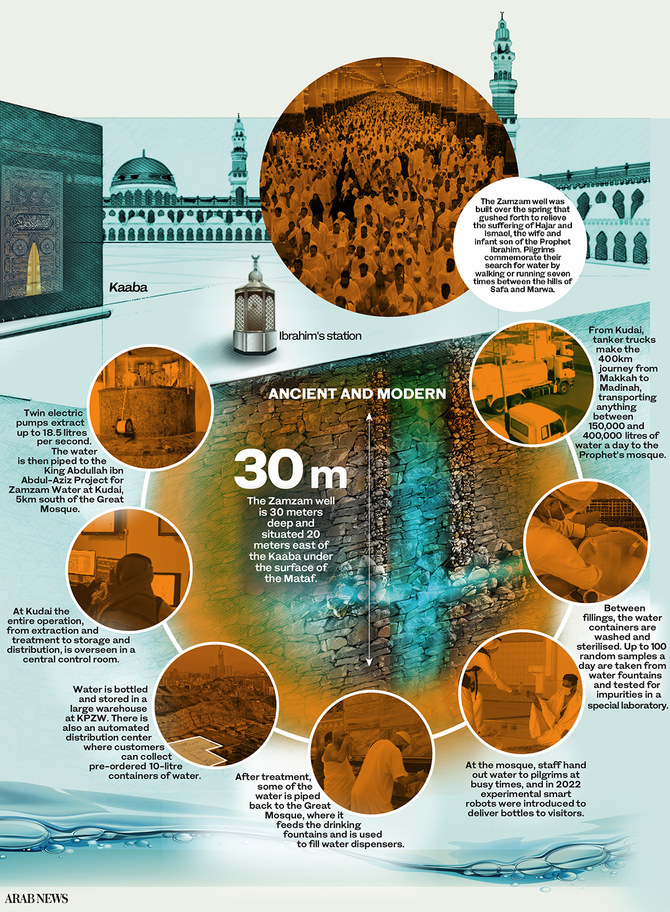
The presidency ensures the water’s purity and its access to pilgrims and visitors in the easiest way, by drawing it from the well of Zamzam, purifying it, and distributing it automatically through the latest international technology to protect the water from pollution.
Its journey, from the well of Zamzam to the pilgrims of the Grand Mosque and the Prophet’s Mosque, passes through several stages.

keywords


