
RIYADH: Saudi Arabian Military Industries unveiled a slate of new subsidiaries and industrial projects at the World Defense Show in Riyadh, reinforcing its push to localize more than 50 percent of the Kingdom’s defense spending by 2030 in line with Saudi Vision 2030.
Under the patronage of Saudi Defense Minister and Chairman of SAMI Prince Khalid bin Salman, the company announced the launch of SAMI Land Co., SAMI Autonomous Co., the SAMI Land Industrial Complex, and the HEET indigenous vehicle program.
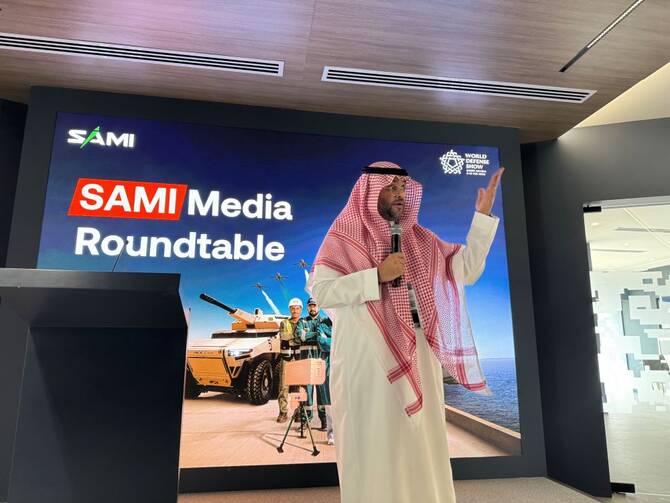
“We know that there is a huge demand in the land forces and most of the land systems users,” said Wael Al-Sarhan, SAMI’s chief communication officer, speaking to Arab News. “That’s why it’s one of the first companies that we worked on to spin off as an independent company.
“Today, the first need is to equip the land forces, defense, and security forces with local MRO (maintenance, repair, and overhaul) services (based) on their need and on their current systems that they have,” he added.
“The second is to see the needs across all of the land forces and start working accordingly upon the demand. We think that land forces will contribute significantly … (to) localization.”
The General Authority for Military Industries announced that the localization rate of military spending in Saudi Arabia reached 24.89 percent by the end of 2024, underscoring continued progress toward the Kingdom’s goal of exceeding 50 percent by 2030.
“The goal is to reach 50 percent,” Al-Sarhan stated. “We know that land is a very important domain and there is a lot of interest from the different end users.”
The SAMI Land announcement includes a 1 million-square-meter site, an 82,000-square-meter advanced manufacturing facility equipped with Industry 4.0 technologies and robotics, and a partnership with Zamil Industrial to develop the SAMI Land Industrial Complex.
In parallel, SAMI announced the HEET program, a fully indigenous fire-support vehicle initiative. The program includes the HEET 8x8 vehicle fitted with a 105 mm turret, designed and engineered by teams at the SAMI Land Industrial Complex, with full intellectual property ownership retained by SAMI.
SAMI also announced the launch of SAMI Autonomous Co. “SAMI Autonomous is focused on the autonomous systems from design, services, manufacturing, and MRO, of course, working with the whole of the supply chain and the ecosystem,” Al-Sarhan stated.
During the World Defense Show, SAMI signed over 12 memoranda of understanding, with additional agreements expected before the event concludes.
“The last point that we announced during the visit was something most of the ecosystem was waiting for, especially the SMEs, which is RUKN,” he said.
RUKN is SAMI’s fully automated local content and supplier-engagement platform aimed at small and medium-sized enterprises.
“RUKN means ‘cornerstone,’ and it is our local content program,” Al-Sarhan said. “On our website, you can register as an SME, and you will find local content and partnership opportunities from different companies.”
“This is something that the SME companies have been waiting for, and we’re happy to announce that RUKN is fully automated and it’s available for the supplier, future partner of SAMI,” the CCO added.
SAMI’s presence at this year’s World Defense Show marks its largest participation to date, with more than 60 products on display and heavy visitor traffic at its pavilion.
Founded in 2017 and operational since 2018 under the Public Investment Fund, SAMI is undergoing a broader transformation, Al-Sarhan said, citing a new board, leadership and management structure.
“This year is very unique as we are going through a transformation as a group, starting from a new board, a new leadership led by His Royal Highness Prince Khalid bin Salman as a chairman of the board,” he said. “We have a new management, a new CEO since February last year, Eng. Thamer AlMuhid, who is an expert in the industry, led several companies before, and he’s leading this transformation.”
With ambitions to rank among the world’s top 25 defense companies by 2030, SAMI continues to position itself as a central pillar of Saudi Arabia’s rapidly expanding defense ecosystem, using global platforms such as the World Defense Show to showcase local capability, industrial scale and long-term strategic intent.
The World Defense Show brought together global experts in military and defense to showcase the latest naval, air, and security technologies.