

France repatriates 35 children, 16 mothers from Syria camps

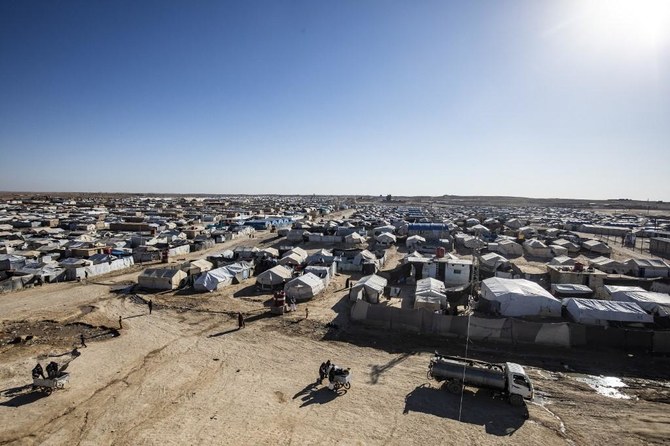
Above, the Kurdish-run Al-Hol camp which holds relatives of suspected Daesh group fighters in Syria’s northeastern Hasakeh governorate. (AFP file photo)
Short Url
Updated 05 July 2022
Follow

France repatriates 35 children, 16 mothers from Syria camps

  • The French government had long refused mass repatriations of the hundreds of French children detained in Kurdish-controlled camps, dealing with them on a case-by-case basis

PARIS: France repatriated 35 children and 16 mothers from camps in Syria holding family members of suspected Daesh terrorists on Tuesday in the largest such operation by Paris after pressure from campaigners.

The French government had long refused mass repatriations of the hundreds of French children detained in Kurdish-controlled camps, dealing with them on a case-by-case basis that rights groups criticized as deliberately slow.

“France has today undertaken the return to the country of 35 French minors who were in camps in northeast Syria. This operation also includes the return of 16 mothers from these same camps,” a statement from the Foreign Ministry said.

It added that the minors were handed over to child protection services while the mothers would face judicial proceedings that lawyers expect to lead to their prosecution for terror offenses.

One of the women was 37-year-old Emilie Konig, a Muslim convert from northwest France who became a notorious recruiter for the group and urged supporters in the West to carry out attacks, a security source told AFP.

Family members of the returnees said that French officials had entered the sprawling and squalid Roj camp on Monday to select orphans and women with medical problems for the flight home.

“It’s a 180-degree turn from the French government to repatriate women as well. It gives us hope, but there are still a lot of children over there,” the aunt of one of the repatriated women told AFP, asking not to be named.

Western countries have faced a dilemma over how to handle their citizens detained in Syria since the end of military operations against the Daesh group there in 2019.

Thousands of extremists in Europe decided to join the group as fighters, often bringing their wives and children to live in the “caliphate” declared in territory conquered in Iraq and Syria.

Until now, France had prioritized its security over welfare concerns for the detained, pointing to a series of attacks by Daesh militants, including the November 2015 assaults on Paris that left 130 people dead.

In a 2019 poll by Odoxa-Dentsu Consulting, seven out of 10 people surveyed were opposed to bringing back the children of jihadists to France.

Before Tuesday’s operation, Paris had repatriated 126 children since 2016.

The decision to return 51 people in a single operation points to a change in policy that came after Germany and Belgium announced that they would bring back all of their minors from Syria.

Around 150 remain in Syria, lawyers and campaigners said on Tuesday.

“Our country has isolated itself more and more by choosing inhumanity and irresponsibility, unlike Germany, Belgium and many other European countries,” the French campaign group Collective for United Families said in a statement on Tuesday.

A UN watchdog also increased  the pressure in February when it said that France had violated the rights of children by leaving them for years in inhuman and life-threatening conditions.

The president of the Seine-Saint-Denis region northeast of Paris, where many previous returnees have been housed, said it was important to make a distinction between Daesh fighters and children, many of whom are orphans.

“Whenever this issue becomes a news story, I’m aware of the fantasies that it can create,” Stephane Troussel told AFP recently. “The images of children indoctrinated by Daesh, weapons in their hands, are deeply ingrained.”

But “the children are not guilty. They are above all the victims of the deadly excesses of their parents and what they need more than anything is an opportunity to rebuild themselves if we want them to rejoin society,” he added.

A statement from France’s anti-terror prosecutor’s office said the mothers repatriated on Tuesday were aged between 22 and 39 and had been taken into custody.

In addition to Konig, there is also a mother-of-four with colon cancer whose mother, Pascale Descamps, went on hunger strike to campaign for her return on humanitarian grounds.

She left France in 2015 with her husband and three children. He was killed in combat, leading her to re-marry another Daesh extremist, who also died.

One of the minors, who is nearly 18, was also detained because “evidence exists likely to prove his association with a terrorist organization,” the statement from anti-terror prosecutors added.

Daesh declared a caliphate in 2014 in territory stretching across Iraq and Syria, but was progressively beaten back by a coalition of Western-backed local forces, losing its last territory in March 2019.


Iranian strikes kill two in UAE, injure eight in Qatar as regional conflict escalates

Updated 01 March 2026
Follow

Iranian strikes kill two in UAE, injure eight in Qatar as regional conflict escalates

  • UAE defense ministry said Iran fired 137 missiles and 209 drones at the territory
  • Qatar intercepted most of the 65 missiles and 12 drones launched by Iran, said officials

ABU DHABI: Explosions rocked cities across the Gulf on Saturday, killing two people in Abu Dhabi, while smoke and flames rose from Dubai landmark The Palm as Iran launched waves of attacks in retaliation for US and Israeli strikes.

The attacks hit airports in Abu Dhabi, Dubai and Kuwait, as well as Gulf military bases and residential areas, raising fears of a wider conflict and rattling a region long seen as a haven of peace and security.

Across the UAE, Iran fired 137 missiles and 209 drones at the territory, the country’s defense ministry said, as projectiles streaked across the skies of every Gulf state but Oman, a mediator in the recent US-Iran talks.

The UAE defense ministry said most of the missiles and drones were intercepted but at Abu Dhabi’s Zayed International Airport officials said at least one person was killed and seven wounded in an “incident.”

Earlier, falling debris killed a Pakistani civilian in Abu Dhabi, the United Arab Emirates’ capital, officials said.

At Dubai International Airport four people were injured according to airport authorities and four others were also hurt at the luxury Palm development.

In Qatar, officials said Iran launched 65 missiles and 12 drones toward the Gulf state, most of which were intercepted, but eight people were injured in the salvos, with one of them in critical condition.

“We are scared of what the future is for us now, and we can’t say how the next few days are going to be,” Maha Manbaz, a nursing student in Doha told AFP.

Terrified’

Smoke poured from US bases in Abu Dhabi and Bahrain’s capital Manama, home of the American navy’s Fifth Fleet, witnesses saw.

A drone struck Kuwait’s international airport and a base housing US personnel was targeted. Three Kuwaiti soldiers and 12 other people were wounded, authorities said.

After Iran’s Revolutionary Guards reported missile strikes, US Central Command (CENTCOM) said on X that no American naval vessels were hit, damage to US facilities was minimal, and no US casualties had been reported.

Residential buildings were also targeted in Manama, with officials saying firefighters and civil defense teams had been dispatched to the scene.

“The sound of the first explosion terrified me,” said a 50-year-old retiree living near the US base in Manama’s Juffair area, where residents were quickly evacuated.

The UAE, Saudi Arabia and Qatar warned they reserved the right to respond to the attacks.

The oil-and-gas-rich Arab monarchies, lying just across the Gulf from Iran, are long-term American allies and host a clutch of US military bases.

“The Gulf states are sandwiched between Iran and Israel, and have to bear the worst inclinations of both,” said Bader Al-Saif, an assistant professor at Kuwait University.

“Iran’s attacks on the Gulf are misplaced. They’ll only alienate its neighbors and invite further distancing from Iran,” he added.

Conflict is unusual in the Gulf, which has traded on its reputation for stability to become the Middle East’s commercial and diplomatic hub.

‘Significant damage’

The unprecedented barrage targeted Qatar’s Al Udeid base, the region’s biggest US military base, as well as Riyadh and eastern Saudi Arabia.

The UAE, Qatar and Kuwait all announced that their airspace was closed.

An AFP journalist in Qatar saw one missile destroyed in a puff of white smoke, while another in Dubai saw a volley of Patriot interceptors taking off.

Iran fired missiles at Al Udeid last June after US strikes targeted Iranian nuclear facilities during a brief war with Israel.

The escalation also saw Saudi Crown Prince Mohammed bin Salman and UAE President Mohamed bin Zayed speak for the first time since a public row in late December.

The Saudi de facto ruler called the Emirati president and the pair discussed Iran’s retaliatory strikes on the Gulf and expressed solidarity and sympathy.

In Kuwait, an Iranian missile attack caused “significant damage” to the runway at an air base hosting Italian air force personnel, Italian Foreign Minister Antonio Tajani was quoted by the ANSA news agency as saying.

Late on Saturday, Kuwaiti officials said a drone targeted a naval base there with air defense forces intercepting the projectile, according to a post by the defense ministry on X.

For many residents in the Gulf, which has drawn a cosmopolitan, largely expat population, the reaction was one of shock.

“I heard the explosions, I don’t know what I felt,” a Lebanese woman living in Riyadh told AFP.

“We came to the Gulf because it’s known to be safer than Lebanon. Now I don’t know what to do or how to think really.”