

West Africa leaders lift sanctions on military-led neighbors

1 / 2
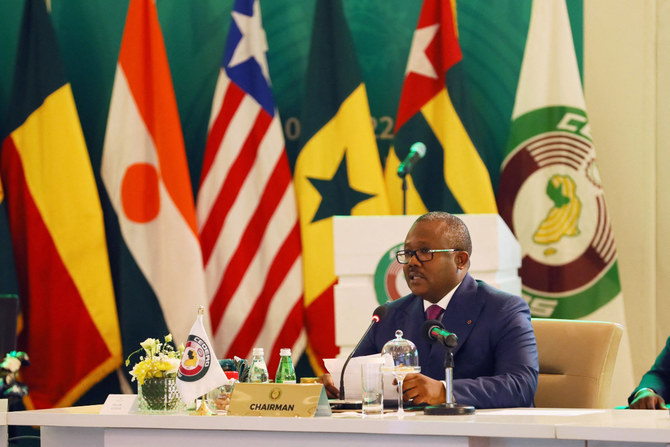
Economic Community of West African States (ECOWAS) heads of state and government pose for a group photo at the ECOWAS 61st Ordinary Session in Accra, Ghana, on July 3, 2022. (AFP)
2 / 2
Guinea-Bissau's President Umaro Sissoco Embalo speaks after being elected as ECOWAS chairperson on July 3, 2022. (AFP)
Short Url
Updated 04 July 2022
Follow

West Africa leaders lift sanctions on military-led neighbors

  • ECOWAS had imposed sanctions on Mali, Guinea and Burkina Faso after their rulers plunged them into authoritian rule

ACCRA, Ghana: West African leaders attending a regional summit Sunday lifted sanctions against three neighbors led by military governments that are now promising a return to democratic rule.
The summit of the Economic Community of West African States resolved to lift all economic and financial sanctions imposed on Mali, Guinea and Burkina Faso, although those countries remain suspended from the regional bloc, said Jean-Claude Kassi Brou, an Ivorian politician who has been serving as president of the ECOWAS Commission.
The three nations’ suspension from ECOWAS will remain in effect until elections are held, he told reporters, adding that regional leaders urge development partners to resume assistance to them.
In lifting the sanctions, leaders attending the summit in Ghana’s capital, Accra, accepted a transition road map by Malian authorities who proposed scheduling a presidential election by March 2024.
ECOWAS sanctioned Mali severely in January by shutting down most commerce with the country, along with its land and air borders with other countries in the bloc. The measures have crippled Mali’s economy, raising humanitarian concerns amid widespread suffering.
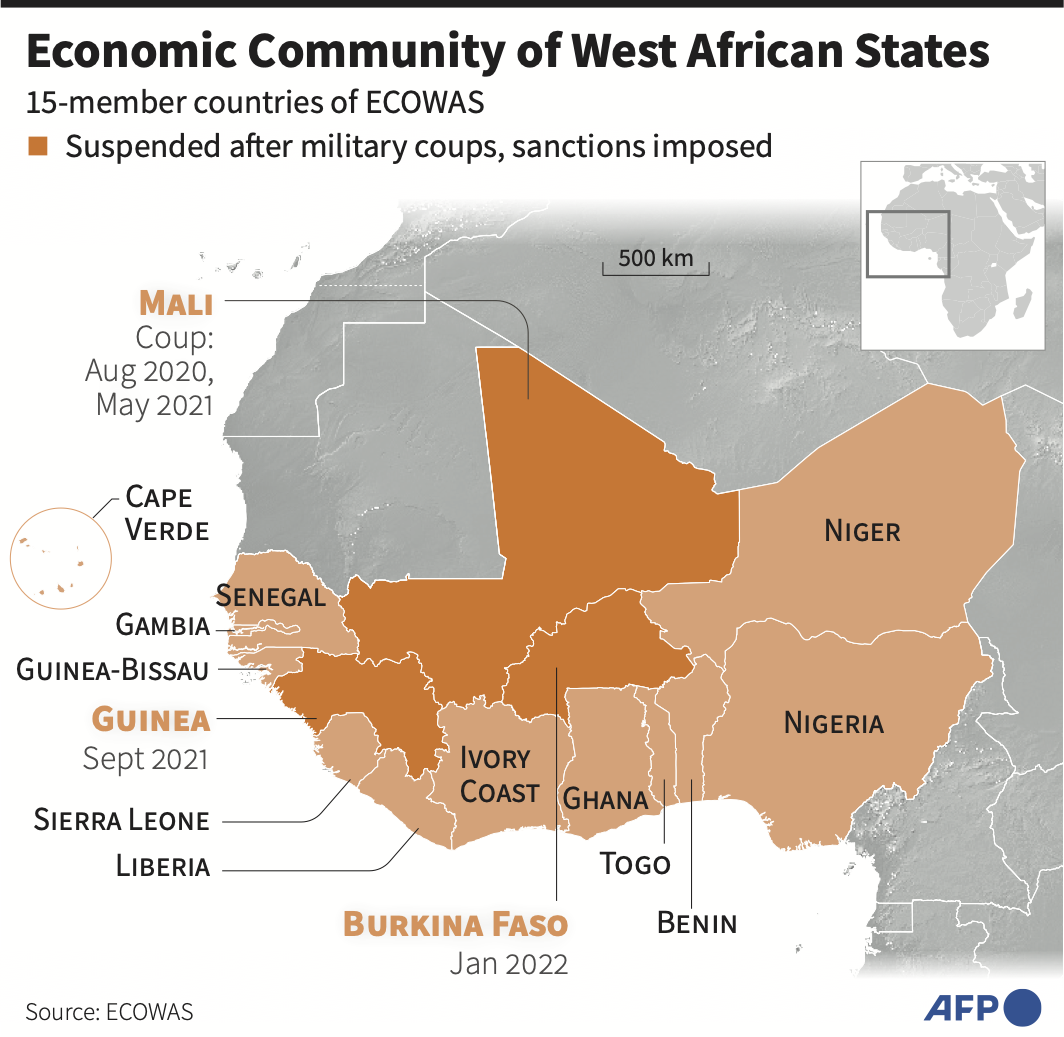
The military leaders in Guinea and Burkina Faso have also proposed varying transition periods eventually leading to polls. It remains unclear when elections will be held there.
The wave of military coups began in August 2020, when Col. Assimi Goita and other soldiers overthrew Mali’s democratically elected president. Nine months later, he carried out a second coup, dismissing the country’s civilian transitional leader and assuming the presidency himself.
Mutinous soldiers deposed Guinea’s president in September 2021, and Burkina Faso leader Roch Marc Christian Kabore was ousted in a January coup. Burkina Faso authorities said Saturday that Kabore, who has been under house arrest, is now a free man.
The political upheaval came as many observers started to think that military power grabs were a thing of the past in West Africa, an increasingly restive region that also faces growing danger from Islamic extremist fighters.
Some leaders who spoke at Accra’s one-day summit urged action as armed groups expand their footprint in the region.
“These terrorist attacks are now not only focusing on the Sahel, but also expanding to the coastal states in our region,” Ghanaian President Nana Akufo-Addo. “It is imperative for us to continue to implement our regional action plan against terrorism and to coordinate our various security initiatives.”
In the first half of 2022, the region recorded a total of 3,500 deaths from 1,600 extremist attacks targeting countries including Togo, Burkina Faso, Niger and Nigeria, according to Brou.
In Burkina Faso, where attacks blamed on Islamic extremist fighters are soaring, gunmen killed at least 55 people in the country’s northern Seno province last month.


Prominent figures, doctors urge restoration of medical care in Gaza

Updated 38 min 1 sec ago
Follow

Prominent figures, doctors urge restoration of medical care in Gaza

  • Letter will be presented to UK, EU leaders

LONDON: Dozens of prominent figures, including Cynthia Nixon, Mark Ruffalo and Ilana Glazer, have joined doctors, human rights leaders and humanitarian organizations in calling for the immediate restoration of medical care in Gaza, in a letter addressed to Israel and world leaders.

“Israel’s systematic attacks on hospitals and unlawful blockade have collapsed Gaza’s healthcare system,” the letter says.

“Through its policies and military activities the government of Israel has deliberately inflicted conditions of life calculated to bring about the destruction of Palestinians in Gaza, and then denied the very help that could save them.”

The letter, shared with The Guardian, will be presented to UK and EU leaders this week and calls for the “immediate, unconditional, unhindered and sustained humanitarian access into Palestine,” including the entry of medical and humanitarian personnel.

The first signatory was Wesam Hamada, the mother of 5-year-old Hind Rajab, who was killed by Israeli fire in January 2024 while waiting for Palestinian paramedics whose ambulance was shelled as it tried to reach her.

Her story is told in Tunisian director Kaouther Ben Hania’s Oscar-shortlisted film “The Voice of Hind Rajab.”

Ben Hania said: “Hind Rajab did not die because help was impossible, but because it was denied.”

Human rights groups, including B’Tselem and Physicians for Human Rights, have also signed the letter, along with figures such as Brian Eno and Rosie O’Donnell.

The UN Human Rights Office estimates that 94 percent of Gaza’s hospitals have been damaged or destroyed since the conflict began in 2023, and at least 1,722 healthcare workers have been killed.

Many medical items, including wheelchairs and walkers, have been barred from entering the territory. UN experts have described the attacks on the healthcare sector as “medicide”.

Israel recently banned dozens of aid agencies, including Medecins Sans Frontieres, from working in Gaza and the West Bank.

The Coordinator of Government Activities in the Territories, also known as COGAT, the Israeli military agency that controls access to Gaza, said “the registration process is intended to prevent the exploitation of aid by Hamas,” although a US analysis found no evidence of Hamas systematically looting aid convoys.

More than 18,500 Palestinians are awaiting medical evacuation from Gaza, MSF estimated in December, with at least 1,000 people having died while waiting for care.

Dr. Thaer Gazawneh, a Chicago-based emergency physician who has signed the letter, said: “(They) are making the living conditions in Gaza so unbearable that people will be forced to be displaced again.”

Ilana Glazer said: “This call for medical access is urgent because medicine and care is the bare minimum of humanity, and when even that’s blocked, it puts every person on the planet at risk of being treated the same way: subhuman.”

Rajab’s mother said the issue was deeply personal because her daughter had dreamed of becoming a doctor.

Hamada said: “Hind never bought any ordinary toys or dolls like other children. She always chose doctor’s toys: a stethoscope, a plastic syringe, a small first-aid kit. She would treat her dolls, pat them, and promise them that everything would be all right.

“Hind’s dream is no longer to become a doctor, but for the children of Gaza to find a doctor, a hospital, medicine, and safety.”