Mali army strikes militants after massacre, army says

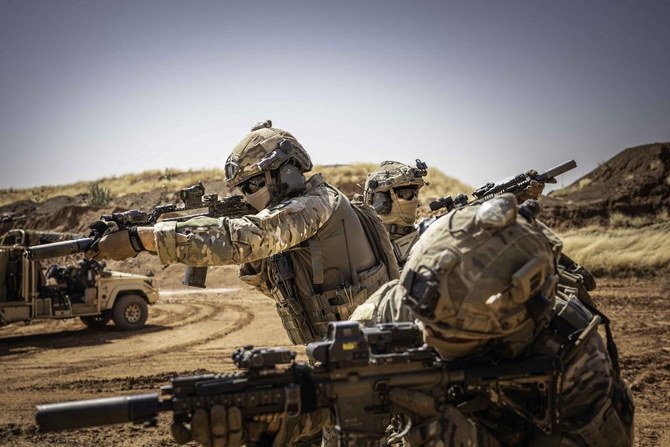
The UN, France and other international observers have expressed grave concern about the deteriorating security situation in Mali. (AFP)
Short Url
Updated 23 June 2022
Follow

Mali army strikes militants after massacre, army says

  • Strikes carried out between Monday and Wednesday around Bankass and Segue, near where the mass killing took place

BAMAKO: Mali’s army on Thursday said it had carried out air strikes against Al-Qaeda affiliated Macina Katiba militants in the country’s center following the massacre of at least 132 civilians.
It carried out strikes between Monday and Wednesday around Bankass and Segue, near where the mass killing took place, and also further afield around Djenne and Tenenkou, the army said in a statement.
“These actions resulted from efforts to search for and gather information on the perpetrators of the attacks against civilians on 18 June,” the statement said.
The army did not provide any assessment of the operations, which no other sources have confirmed.
Mali suffered one of its worst civilian killings over the weekend, the latest in an ongoing series of massacres across the Sahel.
According to the government, 132 civilians were killed in Diallassagou and two surrounding villages, a few dozen kilometers from the town of Bankass.
The Malian army described the killings as a backlash against the “strong pressure” it says it has put them under in recent months.
The UN, France and other international observers have expressed grave concern about the deteriorating security situation in Mali.
Dozens of civilians protested on Tuesday in Bankass to demand state protection.
Mali has since 2012 been rocked by militant insurgencies.
Violence began in the north and then spread to the center and neighboring Burkina Faso and Niger.


Japan to test mine rare-earth mud from deep seabed

Updated 25 December 2025
Follow

Japan to test mine rare-earth mud from deep seabed

TOKYO: Japan will conduct test mining of rare-earth-rich mud from the deep seabed off Minamitori Island, some 1,900 ​kilometers (1,180 miles) southeast of Tokyo, from January 11 to February 14, the head of the government-backed project said on Tuesday.
The operation will mark the world’s first attempt to continuously lift rare-earth mud from a depth of around 6,000 meters on to a vessel.
Tokyo, like its Western allies, is seeking to secure stable supplies of critical minerals as China, the ‌dominant supplier ‌of rare earths, tightens export controls.
“One of ‌our ⁠missions ​is ‌to build a supply chain for domestically produced rare earths to ensure stable supply of minerals essential to industry,” Shoichi Ishii, program director of the Cabinet Office’s national platform for innovative ocean developments, told reporters.
The Japanese government is pressing ahead with a national project as part of broader efforts to strengthen maritime and economic ⁠security.
The January test will focus on connecting the deep-sea mining system and confirming ‌its ability to lift 350 metric ‍tons of rare-earth mud per day. ‍Environmental impacts will be monitored both on board and on ‍the seabed throughout the operation.
No production target has been set, but if successful, a full-scale mining trial will be conducted in February 2027.
The government-funded project has spent about 40 billion yen ($256 million) ​since 2018, Ishii said, though estimated reserves have not been disclosed.
Ishii also said that while their research ⁠vessel was conducting rare-earth surveys within Japan’s exclusive economic zone (EEZ) around Minamitori Island from May 27 to June 25, a Chinese naval fleet entered the waters on June 7.
“We feel a strong sense of crisis that such intimidating actions were taken, despite our activities being limited to seabed resource surveys within our EEZ,” he said.
China’s foreign ministry said the activities of its military vessels are in line with international law and international conventions, and called on Japan to “refrain from hyping up threats and provoking ‌confrontation,” in a reply to Reuters’ request for comment.