

China not giving material support for Russia’s war in Ukraine — US Commerce Department

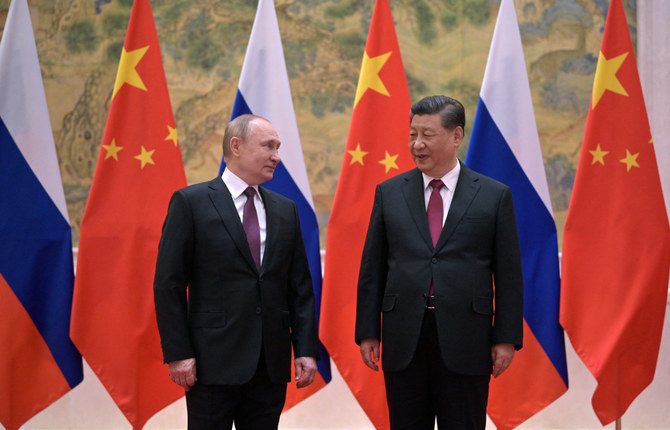
Russian President Vladimir Putin (L) and Chinese President Xi Jinping during their meeting in Beijing on Feb. 4, 2022. (Sputnik / AFP)
Short Url
Updated 01 July 2022
Follow

China not giving material support for Russia’s war in Ukraine — US Commerce Department

  • While saying it has not provided military assistance to Russia, China vowed to take “necessary measures” to protect the rights of its companies

WASHINGTON: The United States has not seen China evade sanctions or provide military equipment to Russia, a senior US official said on Thursday, adding that enforcement measures taken earlier in the week targeted certain Chinese companies, not the government.
The Commerce Department added five companies in China to a trade blacklist on Tuesday for allegedly supporting Russia’s military and defense industrial base as Moscow carries out its war in Ukraine.
US officials have warned of consequences, including sanctions, should China offer material support for Russia’s war effort, but have consistently said they have yet to detect overt Chinese military and economic backing of Moscow.
“China is not providing material support. This is normal course-of-business enforcement action against entities that have been backfilling for Russia,” a senior Biden administration official told Reuters, referring to the Commerce blacklist.
“We have not seen the PRC (People’s Republic of China) engage in systematic evasion or provide military equipment to Russia,” the official said on condition of anonymity.
The United States has set out with allies to punish Russian President Vladimir Putin for the invasion, which Moscow calls a “special operation,” by sanctioning a raft of Russian companies and oligarchs and adding others to a trade blacklist.
China has refused to condemn Russia’s actions and has criticized the sweeping Western sanctions on Moscow. Beijing also says that it has not provided military assistance to Russia or Ukraine, but that it would take “necessary measures” to protect the rights of its companies.
The Commerce Department action means US suppliers need a license before they can ship items to listed companies. But the department also targeted dozens of other entities, including some in allied countries, such as the United Kingdom and Lithuania. 


End of US-Russia nuclear pact a ‘grave moment’: UN chief

Updated 05 February 2026
Follow

End of US-Russia nuclear pact a ‘grave moment’: UN chief

  • Guterres urged Washington and Moscow “to return to the negotiating table without delay and to agree upon a successor framework”

UNITED NATIONS, United States: UN chief Antonio Guterres on Wednesday urged the United States and Russia to quickly sign a new nuclear deal, as the existing treaty was set to expire in a “grave moment for international peace and security.”
The New START agreement will end Thursday, formally releasing both Moscow and Washington from a raft of restrictions on their nuclear arsenals.
“For the first time in more than half a century, we face a world without any binding limits on the strategic nuclear arsenals of the Russian Federation and the United States of America,” Guterres said in a statement.
The UN secretary-general added that New START and other arms control treaties had “drastically improved the security of all peoples.”
“This dissolution of decades of achievement could not come at a worse time — the risk of a nuclear weapon being used is the highest in decades,” he said, without giving more details.
Guterres urged Washington and Moscow “to return to the negotiating table without delay and to agree upon a successor framework.”
Russia and the United States together control more than 80 percent of the world’s nuclear warheads but arms agreements have been withering away.
New START, first signed in 2010, limited each side’s nuclear arsenal to 1,550 deployed strategic warheads — a reduction of nearly 30 percent from the previous limit set in 2002.
It also allowed each side to conduct on-site inspections of the other’s nuclear arsenal, although these were suspended during the Covid-19 pandemic and have not resumed since.