

PM urges precautions as Pakistan reports over 500 COVID-19 cases in single day

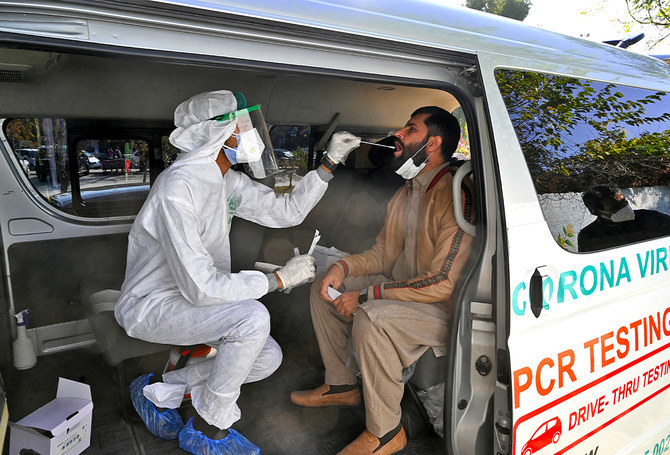
A health official collects a swab sample to test for the COVID-19 inside a van in Islamabad, Pakistan, on November 26, 2020. (AFP/File)
Short Url
Updated 29 June 2022
Follow

PM urges precautions as Pakistan reports over 500 COVID-19 cases in single day

  • Pakistan last reported over 500 infections on March 16, when 514 people contracted the virus
  • The PM chaired a meeting of federal ministers to take stock of the coronavirus situation in Pakistan

ISLAMABAD: Prime Minister Shehbaz Sharif on Wednesday urged people to take necessary precautions against the coronavirus, as Pakistan reported the highest single-day COVID-19 infections in three months.
Pakistan reported over 500 coronavirus cases for the first time since March, according to official data from the country’s health ministry, with the positivity ratio in Karachi, the country’s largest city, recorded at 18 percent.
Pakistan last reported over 500 infections on March 16, when 514 people contracted the disease. According to official data from the National Institute of Health (NIH), 15,462 coronavirus tests were conducted in the last 24 hours, out of which 541 turned out positive. One person succumbed to the respiratory infection while the national positivity rate was 3.5 percent.
PM Sharif asked people to be more careful while chairing a meeting of Pakistan’s federal ministers and provincial chief secretaries.
“In view of the resurgence of coronavirus cases in the country, I urge the entire nation to follow coronavirus-related SOPs [standard operating procedures] and directives,” he said in a Twitter post.


The prime minister was informed during the meeting about the new omicron variant of the virus and how it had recently led to an increase in the number of cases in Pakistan, said the state-run Radio Pakistan.
Pakistan disbanded the National Command and Operations Center, its main pandemic response body, on March 31 as infections fell to the lowest since the outbreak began in 2020.
But as COVID-19 cases rise again, the government has called for the Center to start working again and the Pakistan’s Civil Aviation Authority (PCAA) has made it mandatory for all passengers on domestic flights to wear masks as a protective measure.
“After a slight change in Covid-19 cases in some cities, the NCOC has recommended mask-wearing on all domestic flights, railways, and public transport within the country is mandatory,” the NIH said on Monday. “So all citizens are requested to wear a face mask during travel.”
Authorities are also now urging all eligible individuals not to delay getting booster vaccine shots. Pakistan has administered at least 267,200,445 doses of COVID-19 vaccines so far. Assuming every person needs two doses, that’s enough to have vaccinated about 61.7 percent of the country’s population.


Pakistan, UK sign £35 million Green Compact to strengthen climate resilience

Updated 21 December 2025
Follow

Pakistan, UK sign £35 million Green Compact to strengthen climate resilience

  • Pakistan ranks among nations most vulnerable to climate change and has seen erratic changes in its weather patterns
  • UK will help Pakistan mobilize climate finance, strengthen regulatory frameworks and develop bankable climate projects

ISLAMABAD: Pakistan and the United Kingdom (UK) have formalized a comprehensive climate partnership with the launch of a Green Compact that aims to enhance climate resilience, accelerate clean energy transition and scale up nature-based solutions, including mangrove conservation, Pakistani state media reported on Sunday.

The agreement, signed in Islamabad by Federal Minister for Climate Change and Environmental Coordination Dr. Musadik Malik and UK Minister for International Development Jennifer Chapman, unlocks £35 million in targeted support for green development and long-term climate action, according to Radio Pakistan broadcaster.

Pakistan ranks among nations most vulnerable to climate change and has seen erratic changes in its weather patterns that have led to frequent heatwaves, untimely rains, storms, cyclones, floods and droughts in recent years. In 2022, monsoon floods killed over 1,700 people, displaced another 33 million and caused over $30 billion losses, while another 1,037 people were killed in floods this year.

Mohammad Saleem Shaikh, a spokesperson for Pakistan’s Ministry of Climate Change, described the compact as a “decisive move toward action-oriented climate cooperation,” noting that its implementation over the next decade will be critical for Pakistan which regularly faces floods, heatwaves and water stress.

“The Compact is structured around five core pillars: climate finance and investment, clean energy transition, nature-based solutions, innovation and youth empowerment, and adaptation and resilience,” the report read.

“Under the agreement, the UK will work with Pakistan to mobilize public and private climate finance, strengthen regulatory frameworks for green investment, and develop bankable climate projects.”

Clean energy forms a central component of Pakistan’s transition, with Islamabad planning to expand solar and wind generation to reduce fossil fuel dependence, improve energy security and stabilize power costs, according to Shaikh.

“Renewable energy is now economically competitive, making the transition both environmentally and financially viable,” he was quoted as saying.

“Nature-based solutions, particularly large-scale mangrove restoration, will protect coastal communities from storm surges and erosion while enhancing biodiversity and carbon sequestration.”

Under the Compact, technical support, mentoring and access to investors will be provided to climate-smart startups and young innovators, reflecting Pakistan’s recognition of youth-led initiatives as central to future climate solutions.

On the occasion, Chapman, on her first official visit to Pakistan, underscored the urgency of climate action, highlighting the UK’s support for renewable energy, mangrove and ecosystem restoration, early-warning systems, climate budgeting and international investment flows into Pakistan.

Shaikh described the Green Compact as “a strategic turning point” in Pakistan–UK relations on climate change, saying its effective implementation is essential for Pakistan to meet its national climate targets.