

Top business body says talks to sign Pak-GCC free trade agreement at ‘advanced stage’

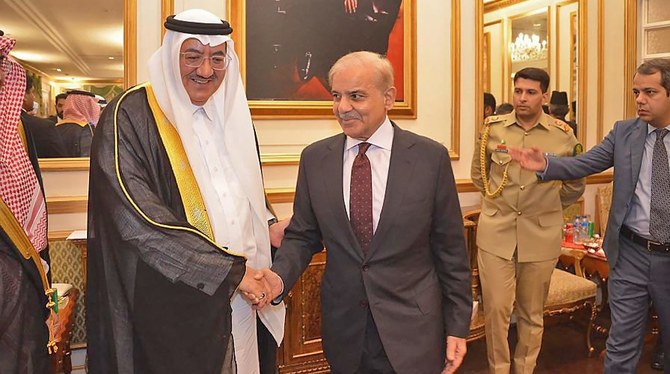
Pakistan's Prime Minister Shehbaz Sharif (right) shakes hand with the chairman of the Saudi-Pak Business Council, Fahad Bin Muhammad Al-Bash, in Islamabad, Pakistan, on on June 20, 2022. (Photo Courtesy: @SPAeconomic/Twitter)
Short Url
Updated 29 June 2022
Follow

Top business body says talks to sign Pak-GCC free trade agreement at ‘advanced stage’

  • Pakistani officials say expect Saudi trade delegation to request their government to set up Pak-Saudi joint investment body
  • FPCCI requests kingdom for swift visa processing and simpler documentation requirements for exports to Saudi Arabia

ISLAMABAD: A week-long visit to Pakistan by a Saudi business delegation had created new opportunities for collaboration and partnership agreements were expected to be signed in several sectors, a senior Saudi diplomat said on Tuesday, while the president of the Federation of Pakistan Chambers of Commerce and Industry said negotiations to sign a Pak-Gulf Cooperation Council Free Trade Agreement were at an “advanced stage.”

The 15-member delegation, nominated by the Saudi government and led by Fahad Bin Muhammad Al-Bash, the chairman of the Saudi-Pak Business Council, arrived in Pakistan on June 20 to explore investments and joint ventures. While in Pakistan, the group visited Islamabad, Lahore, Sialkot, Faisalabad, and Karachi and met representatives from various chambers of commerce and the board of investment, as well as conducted business-to-business meetings in each city. The group also visited factories in Sialkot, Faisalabad and Karachi, before flying out to the kingdom on June 27.

After the conclusion of the visit, Irfan Iqbal Sheikh, president of the Federation of Pakistan Chambers of Commerce and Industry, said in a statement negotiations to sign Pak-GCC FTA were at an “advanced stage.”

“Pakistan should target IT & IT-enabled services exports to Saudi Arabia; along with skilled workforce in Information and Communication Technologies (ICT),” Sheikh said in a statement released by the FPCCI.

“Value-added textiles, leather products, footwear, handicrafts, sports goods, pharmaceuticals, surgical goods, gems & jewelry, rice, fruits & vegetables and construction materials can fetch major additional orders from Saudi Arabia worth billions of dollars annually.”
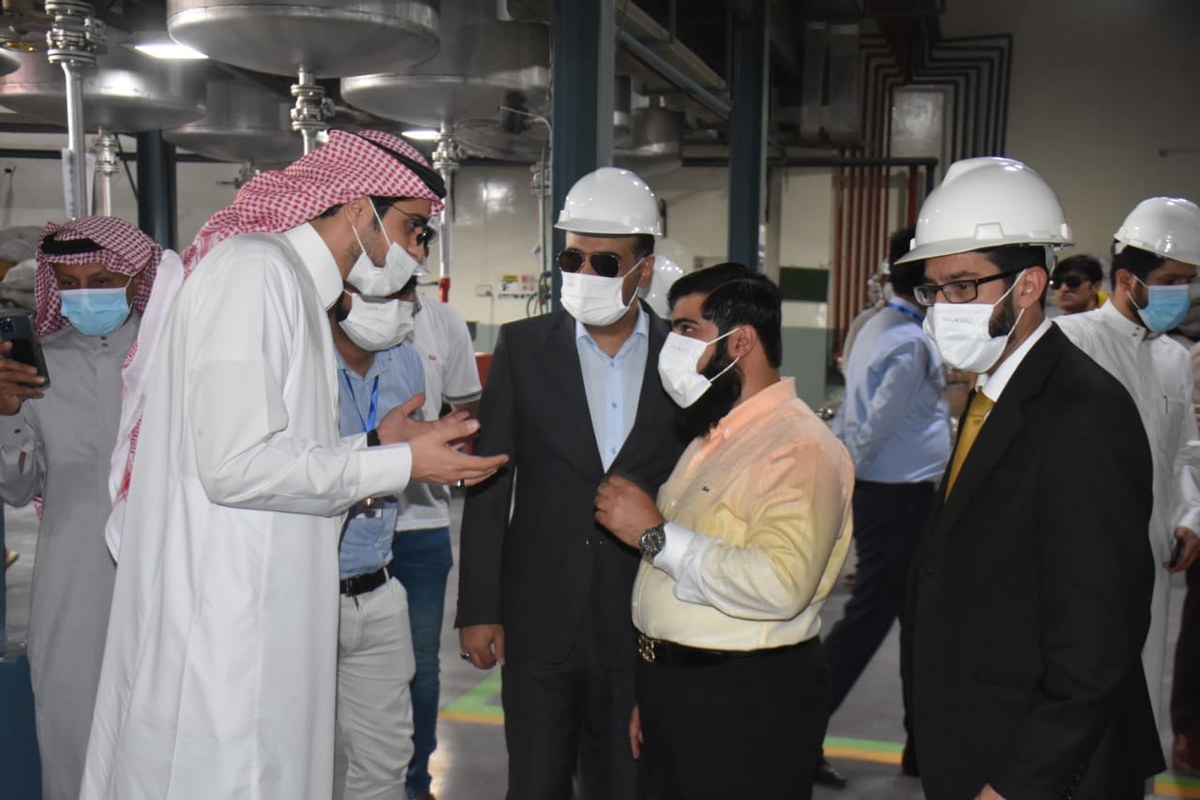


Saudi business delegation visits Happilac Paints factory in Faisalabad, Pakistan, on June 23, 2022. (Photo courtesy: Saudi embassy, Islamabad)

Sheikh added that this was the “only sustainable way” to curtail Pakistan’s trade deficit, which is expected to be close to $48 billion when the final figures come out for fiscal year 2021-22.

Azhar Ali Dahar, the trade and investment minister at the Pakistani embassy in Riyadh, said the recent trade visit reflected the Saudi government’s desire to deepen economic relations with Pakistan.

“They [Saudi delegation] have a plan to ask the Saudi government to establish a Pak-Saudi investment body to streamline collaborations between both countries’ businessmen,” Dahar told Arab News.

Mubsher Alshehri, a commercial attaché at the Saudi embassy in Islamabad, told Arab News partnership agreements were expected to be concluded in various sectors including FinTech [financial technology], paints, renewable energy, and construction, as well as the production sector of livestock, rice, and feed.

Muhammad Idrees, the president of the Karachi Chamber of Commerce and Industry (KCCI), said the visit had changed the Saudi perception of the business landscape in Pakistan as well as Karachi, its financial hub.

“They have shown their interest in establishing joint ventures in coastal tourism and construction,” Idrees said, adding that the Saudi businessmen were interested in introducing new brands of international standard garments for exports to Gulf countries.

“They have also invited us to exhibit our products in Saudi Arabia and it was decided to nominate a focal person on both sides to coordinate this event where our businessmen will visit the kingdom to show their products,” the KCCI president added.
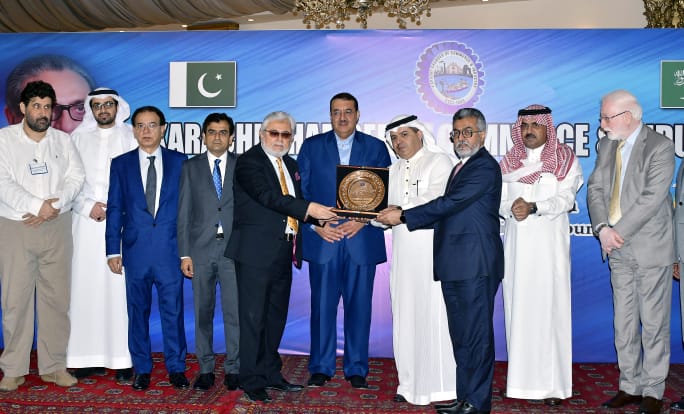


Officials of Karachi Chamber of Commerce and Industry meet Saudi-Pak Business Council members in Karachi, Pakistan, on June 28, 2022. (@CommissionerKhi/Twitter)

Fayyaz Ahmed, vice president of the Faisalabad Chamber of Commerce and Industry, said the Saudi businessmen had shown “keen interest” in the textile and paint industry.

“The Saudi delegation visited a textile and paint factory in Faisalabad where they have shown satisfaction over the quality and standard of our products,” he told Arab News, hoping this would soon translate into collaborations and joint ventures.

Al-Bash, chairman of Saudi-Pak Business Council, was quoted in an FPCCI statement as inviting “practical proposals” from the Pakistani business community for “swift and tangible development on projects of mutual interest.”

“Pakistani rice, spices, fruits and cuisine are very popular in Saudi Arabia and Pakistani exporters should come forward for a bigger market share,” Al-Bash said.

Junaid Makda, Chairman of FPCCI's Pak-Saudi Arabia Joint Business Council, said after the COVID-19 pandemic, which had been a major obstacle in people-to-people, business-to-business and chamber-to-chamber contacts between the two countries, the two sides had agreed on regular contact and single-country trade fairs and exhibitions.

“He also requested Saudi authorities to facilitate Pakistani businessmen with the swift visa processing and simpler documentation requirements for exports to the kingdom,” the FPCCI said.


‘Happy faces’: Karachi’s Down syndrome students gain confidence through culinary training

Updated 4 sec ago
Follow

‘Happy faces’: Karachi’s Down syndrome students gain confidence through culinary training

  • Students learn practical kitchen skills from boiling eggs to making chicken sandwiches under guided instruction
  • Parents say the program has helped children become more independent at home, including preparing simple meals

KARACHI: In a bright training kitchen in Karachi, young adults with Down syndrome chop vegetables, measure ingredients and prepare sandwiches under the guidance of their culinary instructor, skills their parents once believed were beyond their reach.

The medical condition, caused by the presence of an extra chromosome, can affect learning, motor coordination and speech.

Experts say structured, hands-on training, especially in practical life skills such as cooking, significantly improves independence and confidence, which is what the Karachi Down Syndrome Program (KDSP) aims to deliver through its “Education for Life” initiative.

“Parents say their child could not even turn the stove on earlier,” Shayan Zafar, General Manager Communications and Awareness at KDSP, told Arab News on Friday. “They were scared of a mishap when the child entered the kitchen. Now, thanks to the kitchen and KDSP, they make evening tea for their parents at home.”

Launched three years ago for individuals aged 16 and above, the three-year program offers weaving, sewing, stitching, arts and crafts and a dedicated culinary stream taught in small, supervised groups.

Students learn everything from boiling an egg to baking cupcakes as they progress through the curriculum.

“At the end of the day, when the class concludes and you see their happy faces, it makes you happy too,” Zainab Durrani, the culinary and pastry instructor guiding the class, said. “And that motivates you to do all of this.”

Student Dua Shahid is chopping chicken in Karachi, Pakistan, on Dececmber 12, 2025. (AN Photo)

Trained at the College of Tourism and Hotel Management (COTHM), Pakistan’s leading international hospitality college, she said the facility did not have a proper kitchen when she first joined it.

However, that changed as its management decided to introduce culinary classes.

“In the first year, we teach them the basic skills enough for them to make their breakfast at home. For instance, boiled egg, toast and fried egg,” she continued.

The 10 students taking the class said they enjoyed working with Durrani who helps them acquire cooking skills.

“Today, I am making a chicken cheese sandwich and cupcakes along with it,” 20-year-old Dua Shahid, one of Durrani’s students, said while slicing spring onions with careful focus.

“[My most favorite is] chicken cheese sandwich,” she added. “[It is made with] onion, capsicum, chicken, cucumber, bread, mayonnaise [and some] sauce.”

Dua said she also cooks the dishes she learns at home.

“I made chicken vegetable pasta at home. It was very delicious, everyone liked it.”

Another student, Nauroz Khan, 21, shared proudly: “I know how to make pizza, burger [and] eggs. I make all of these at home. I really enjoy [being part of the class].”

Durrani said students often struggle initially with motor skills or coordination, requiring gradual introduction.

“For instance, they may have a problem holding the knife,” she added. You can give them a toy knife and I suggest giving them play dough to begin with,” she said, adding that visual aids help them identify ingredients.

Zafar, who leads communications and awareness programs, said the initiative has demonstrated tangible outcomes.

“We have had a previous batch who just graduated with us, and they are running their own businesses. They have their own Instagram pages which they are running by themselves. Each of them has their respective niche, from weaving to block printing.”

KDSP, now in its 11th year, operates five facilities nationwide — three in Karachi, one in Islamabad and one in Faisalabad — with new centers planned for Hyderabad and Lahore.

Under its KDSP Café brand, the organization also provides a platform for students to promote and sell their work in corporate settings.

“There would be 30,000 individuals with Down syndrome in Karachi while the number would be 300,000 in the entire Pakistan,” said Zafar.

“At this point, we are serving 2,800 of them,” he added. “The goal is to get to every individual, and we have plans to do that through the development of an app and other initiatives across the country.”