BAB BERRED: Since he started growing cannabis at 14, Mohamed Makhlouf has lived in the shadows, losing sleep while bracing for a knock on his door from authorities that could mean prison or his entire harvest confiscated.
But after decades of operating in secret, Makhlouf finally has gained peace of mind as Morocco expands legal cultivation and works to integrate veteran growers like him into the formal economy.
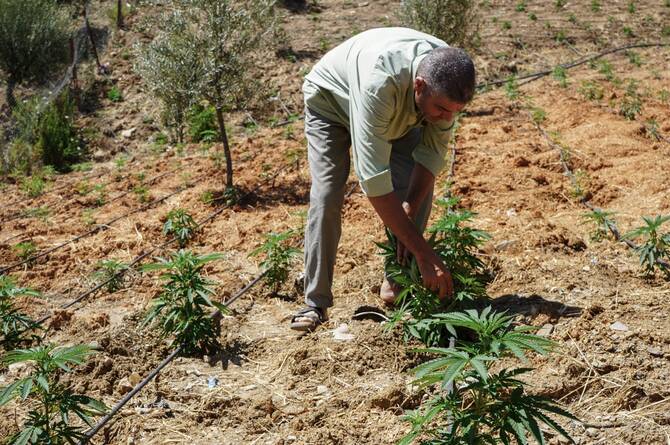
On his farmland deep in the Rif Mountains, stalks of a government-approved cannabis strain rise from the earth in dense clusters. He notices when police pass on a nearby road. But where the crop’s aroma once meant danger, today there is no cause for concern. They know he sells to a local cooperative.
“Legalization is freedom,” Makhlouf said. “If you want your work to be clean, you work with the companies and within the law.”
The 70-year-old Makhlouf’s story mirrors the experience of a small but growing number of farmers who started in Morocco’s vast black market but now sell legally to cooperatives producing cannabis for medicinal and industrial use.
New market begins to sprout
Morocco is the world’s biggest producer of cannabis and top supplier of the resin used to make hashish. For years, authorities have oscillated between looking the other way and cracking down, even as the economy directly or indirectly supports hundreds of thousands of people in the Rif Mountains, according to United Nations reports and government data.
Abdelsalam Amraji, another cannabis farmer who joined the legal industry, said the crop is crucial to keeping the community afloat.
“Local farmers have tried cultivating wheat, nuts, apples, and other crops, but none have yielded viable results,” he said.
The region is known as an epicenter of anti-government sentiment and growers have lived for years with arrest warrants hanging over them. They avoided cities and towns. Many saw their fields burned in government campaigns targeting cultivation.
Though cannabis can fetch higher prices on the black market, the decreased risk is worth it, Amraji said.
“Making money in the illegal field brings fear and problems,” he said. “When everything is legal, none of that happens.”
Market remains under tight regulation
The change began in 2021 when Morocco became the first major illegal cannabis producer, and the first Muslim-majority country, to pass a law legalizing certain forms of cultivation.
Officials heralded the move as a way to lift small-scale farmers like Makhlouf and Amraji out of poverty and integrate cannabis-growing regions into the economy after decades of marginalization.
In 2024, King Mohammed VI pardoned more than 4,800 farmers serving prison sentences to allow longtime growers “to integrate into the new strategy,” the justice ministry said at the time.
Since legalization was enacted in 2022, Morocco has tightly regulated every step of production and sale from seeds and pesticides to farming licenses and distribution. Though certain cultivation is authorized, officials have shown no sign of moving toward legalization or reforms targeting recreational consumers.
“We have two contradictory missions that are really to allow the same project to succeed in the same environment,” said Mohammed El Guerrouj, director-general of Morocco’s cannabis regulatory agency. “Our mission as policemen is to enforce regulations. But our mission is also to support farmers and operators so they succeed in their projects.”
Licensing and cooperatives are part of new ecosystem
The agency issued licenses last year to more than 3,371 growers across the Rif and recorded nearly 4,200 tons of legal cannabis produced.
Near the town of Bab Berred, the Biocannat cooperative buys cannabis from roughly 200 small farmers during harvest season. The raw plant is transformed into neat vials of CBD oil, jars of lotion and chocolates that have spread across Morocco’s pharmacy shelves.
Some batches are milled into industrial hemp for textiles. For medicinal use and export, some of the product is refined into products with less than 1 percent THC, the psychoactive compound that gives cannabis its high.
Aziz Makhlouf, the cooperative’s director, said legalization created a whole ecosystem that employed more than just farmers.
“There are those who handle packaging, those who handle transport, those who handle irrigation — all of it made possible through legalization,” said Makhlouf, a Bab Berred native whose family has long been involved in cannabis farming.
Legalization has brought licenses, formal cooperatives and the hope of steady income without fear of arrest. But the shift also has exposed the limits of reform. The legal market remains too small to absorb the hundreds of thousands who depend on the illicit trade and the new rules have introduced more pressures, farmers and experts say.
Protests erupted in parts of nearby Taounate in August after cooperatives there failed to pay growers for their crop. Farmers waved banners reading “No legalization without rights” and “Enough procrastination,” furious that payments they were promised for working legally at the government’s urging never came, local media reported.
Illegal cultivation persists
The government insists the transformation is only beginning and challenges can be overcome.
But black market demand remains high. Today, cannabis is grown legally on 14,300 acres (5,800 hectares) in the Rif, while more than 67,000 acres (27,100 hectares) are used for illegal growing, according to government data. The number of farmers entering the legal system remains tiny compared with the number thought to be tied to the illicit market.
An April report from the Global Institute Against Transnational Organized Crime characterized the industry as “more one of coexistence of both markets than a decisive transition from one to the other.”
“A substantial proportion of the population continue to rely on illicit cannabis networks for income generation, perpetuating the dynamics that the state is trying to reform,” the report said.
For now, Morocco’s two cannabis economies exist side by side — one regulated and one outlawed — as the country tries to coax a centuries-old trade out of the shadows without leaving its farmers behind.
“Cannabis is legal now, just like mint,” Amraji said. “I never imagined I’d one day be authorized to grow it. I’m shocked.”


![]()

Morocco aims to boost legal cannabis farming and tap a global boom
Short Url
https://arab.news/72c3x
Morocco aims to boost legal cannabis farming and tap a global boom
- Morocco is the world’s biggest producer of cannabis and top supplier of the resin used to make hashish


Latest updates


Recommended


© 2026 SAUDI RESEARCH & PUBLISHING COMPANY, All Rights Reserved And subject to Terms of Use Agreement.