

India In-Focus — Shares rise; Minister says Indian economy to touch $30tln in next 30 years

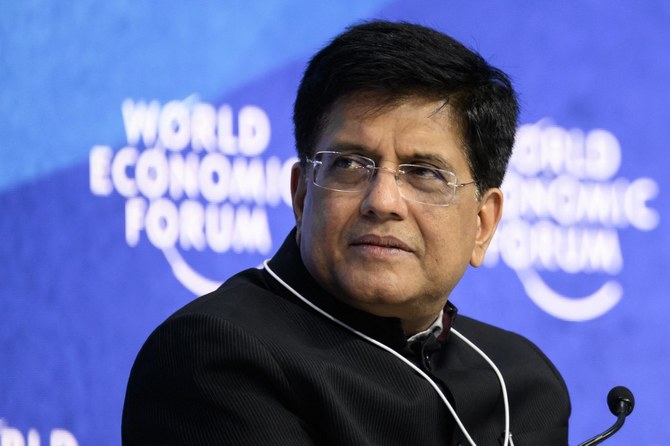
Piyush Goyal, the Central Minister for Commerce and Industry said that the Indian economy will touch $30 trillion in the next 30 years. (AFP/File)
Short Url
Updated 27 June 2022
Follow

India In-Focus — Shares rise; Minister says Indian economy to touch $30tln in next 30 years

MUMBAI: Indian shares rose on Monday to their highest in more than two weeks, with technology and metal stocks leading the gains as easing oil prices tempered inflation fears.

The NSE Nifty 50 index rose 1.2 percent to 15,887.15, as of 0500 GMT, and the S&P BSE Sensex climbed 1.16 percent to 53,340.36, leaving it on track for a third straight session of gains.

Welspun Corp. jumped 4.8 percent after the steel products maker said it got orders worth 6 billion rupees ($76 million).

Gaming platform Nazara Technologies surged 7.1 percent to its highest in nearly seven weeks after it said it would buy a stake in sports media company Absolute Sports.

Indian economy to touch $30 trillion in next 30 years

Piyush Goyal, the Central Minister for Commerce and Industry said that the Indian economy will touch $30 trillion in the next 30 years. 

According to the minister, if India grows at 8 percent every year on a compounded annual growth basis, the economy will double in about nine years, Financial Express reported. 

The minister also predicted that the country’s economy will reach $6.5 trillion from $3.2 trillion today in the next nine years. 

“Eighteen years from now, we will be about $13 trillion economy. And then another nine years after that, that is 27 years from now, we will be a $26 trillion economy… Then obviously, 30 years from today, confidently we can all expect that the Indian economy will be a $30 trillion economy,” said the minister. 

(With inputs from Reuters)


Saudi POS spending jumps 28% in final week of Jan: SAMA

Updated 06 February 2026
Follow

Saudi POS spending jumps 28% in final week of Jan: SAMA

RIYADH: Saudi Arabia’s point-of-sale spending climbed sharply in the final week of January, rising nearly 28 percent from the previous week as consumer outlays increased across almost all sectors. 

POS transactions reached SR16 billion ($4.27 billion) in the week ending Jan. 31, up 27.8 percent week on week, according to the Saudi Central Bank. Transaction volumes rose 16.5 percent to 248.8 million, reflecting stronger retail and service activity. 

Spending on jewelry saw the biggest uptick at 55.5 percent to SR613.69 million, followed by laundry services which saw a 44.4 percent increase to SR62.83 million. 

Expenditure on personal care rose 29.1 percent, while outlays on books and stationery increased 5.1 percent. Hotel spending climbed 7.4 percent to SR377.1 million. 

Further gains were recorded across other categories. Spending in pharmacies and medical supplies rose 33.4 percent to SR259.19 million, while medical services increased 13.7 percent to SR515.44 million. 

Food and beverage spending surged 38.6 percent to SR2.6 billion, accounting for the largest share of total POS value. Restaurants and cafes followed with a 20.4 percent increase to SR1.81 billion. Apparel and clothing spending rose 35.4 percent to SR1.33 billion, representing the third-largest share during the week. 

The Kingdom’s key urban centers mirrored the national surge. Riyadh, which accounted for the largest share of total POS spending, saw a 22 percent rise to SR5.44 billion from SR4.46 billion the previous week. The number of transactions in the capital reached 78.6 million, up 13.8 percent week on week. 

In Jeddah, transaction values increased 23.7 percent to SR2.16 billion, while Dammam reported a 22.2 percent rise to SR783.06 million. 

POS data, tracked weekly by SAMA, provides an indicator of consumer spending trends and the ongoing growth of digital payments in Saudi Arabia.  

The data also highlights the expanding reach of POS infrastructure, extending beyond major retail hubs to smaller cities and service sectors, supporting broader digital inclusion initiatives.  

The growth of digital payment technologies aligns with Saudi Arabia’s Vision 2030 objectives, promoting electronic transactions and contributing to the Kingdom’s broader digital economy.