Morocco: 18 migrants dead in stampede in bid to enter Spain's Melilla

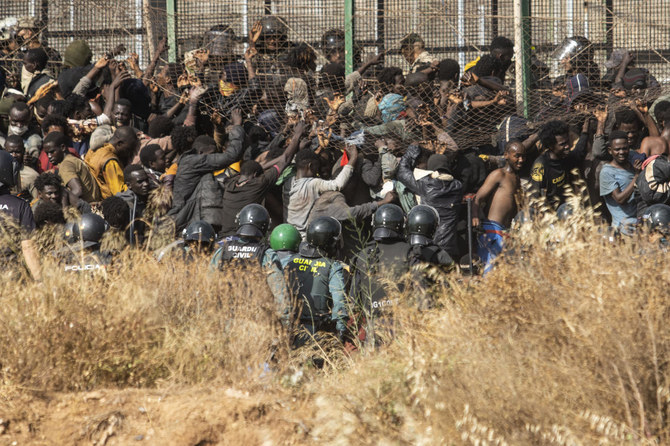
Migrants arrive on Spanish ground after crossing the fences separating the Spanish enclave of Melilla from Morocco in Melilla, on Friday. (AP)
Short Url
Updated 25 June 2022
Follow

Morocco: 18 migrants dead in stampede in bid to enter Spain's Melilla

  • About 2,000 migrants breached the border between Morocco and Melilla on Friday
  • The casualties occurred when people tried to climb the iron fence

RABAT, Morocco: At least 18 African migrants died when a huge crowd tried to cross into the Spanish enclave of Melilla in northern Morocco, according to an update from Moroccan authorities.
Around 2,000 migrants approached Melilla at dawn Friday and more than 500 managed to enter a border control area after cutting a fence with shears, the Spanish government’s local delegation said in a statement about the first such incursion since Spain and Morocco mended diplomatic relations last month.
Moroccan officials said late Friday that 13 migrants had died of injuries sustained in the incursion, in addition to five who were confirmed dead earlier in the day.
“Some fell from the top of the barrier” separating the two sides, a Moroccan official said, adding that 140 security personnel and 76 migrants were injured during the attempt to cross.
The Spanish Civil Guard, which monitors the other side of the fence, said it had no information on the tragedy and referred enquiries to Morocco.
The border of the Spanish enclave and the neighboring Moroccan city of Nador were calm early Saturday, without police deployment, AFP journalists said.
Morocco had deployed a “large” number of forces to try to repel the assault on the border, who “cooperated actively” with Spain’s security forces, it said earlier in a statement.
Images on Spanish media showed exhausted migrants lying on the pavement in Melilla, some with bloodied hands and torn clothes.
Speaking in Brussels, Spanish Prime Minister Pedro Sanchez condemned the “violent assault,” which he blamed on “mafias who traffic in human beings.”
Melilla and Ceuta, Spain’s other tiny North African enclave, have the European Union’s only land borders with Africa, making them a magnet for migrants.
On Thursday night migrants and security forces had “clashed” on the Moroccan side of the border, Omar Naji of Moroccan rights group AMDH told AFP.
Several of them were hospitalized in Nador, he added.
The AMDH’s Nador chapter called for the opening of “a serious investigation to determine the circumstances of this very heavy toll” which shows that “the migration policies followed are deadly with borders and barriers that kill.”
It was the first such mass incursion since Spain and Morocco mended diplomatic relations last month.
In March, Spain ended a year-long diplomatic crisis by backing Morocco’s autonomy plan for Western Sahara going back on its decades-long stance of neutrality.
Sanchez then visited Rabat, and the two governments hailed a “new stage” in relations.
The row began when Madrid allowed Brahim Ghali, leader of Western Sahara’s pro-independence Polisario Front, to be treated for Covid-19 in a Spanish hospital in April 2021.
A month later, some 10,000 migrants surged across the Moroccan border into Spain’s Ceuta enclave as border guards looked the other way, in what was widely seen as a punitive gesture by Rabat.
Rabat calls for the Western Sahara to have an autonomous status under Moroccan sovereignty but the Polisario Front wants a UN-supervised referendum on self-determination as agreed in a 1991 cease-fire agreement.
In the days just before Morocco and Spain patched up their ties, there were several attempted mass crossings of migrants into Melilla, including one involving 2,500 people, the largest such attempt on record. Nearly 500 made it across.
Patching up relations with Morocco — the departure point for many migrants — has meant a drop in arrivals, notably in Spain’s Atlantic Canary Islands.
The number of migrants who reached the Canary Islands in April was 70 percent lower than in February, government figures show.
Sanchez earlier this month warned that “Spain will not tolerate any use of the tragedy of illegal immigration as a means of pressure.”
Spain will seek to have “irregular migration” listed as one of the security threats on the NATO’s southern flank when the alliance gathers for a summit in Madrid on June 29-30.
Over the years, thousands of migrants have attempted to cross the 12-kilometer (7.5-mile) border between Melilla and Morocco, or Ceuta’s eight-kilometer border, by climbing the barriers, swimming along the coast or hiding in vehicles.
The two territories are protected by fences fortified with barbed wire, video cameras and watchtowers.
Migrants sometimes use hooks and sticks to try to climb the border fence, and throw stones at police.


Aoun reassures Lebanon that risk of war is ‘fading’ in year-end message

Addressing Internal Security officials, Aoun said that the “situation is among the best.”
Updated 10 sec ago
Follow

Aoun reassures Lebanon that risk of war is ‘fading’ in year-end message

BEIRUT: Lebanese President Joseph Aoun on Wednesday sought to reassure citizens in his year-end address, saying “the overall atmosphere remains positive and the risk of war is fading,” amid widespread concern over a possible Israeli escalation against Hezbollah.

Fear of renewed attacks followed Israeli criticism of a Lebanese Army weapons-confiscation operation that is set to enter its second phase at the start of the 2026. The plan include the expansion from areas north of the Litani River to the Awali River, after the first phase was completed south of the Litani.

President Aoun cautioned that this does not mean “completely eliminating the risk of war,” stressing that “work is underway with various friendly and brotherly countries to completely neutralize the threat of war.”

Addressing Internal Security officials, Aoun said that the “situation is among the best,” noting that this assessment has been echoed by foreign visitors to Lebanon, despite the strain caused by large numbers of Syrian and Palestinian refugees.

He added that security forces were fully carrying out their duties and solving crimes with notable speed, pointing to the successful visit of Pope Leo XIV earlier this year as further evidence of progress.

On Monday, Egyptian Ambassador to Lebanon Alaa Moussa stressed during a Beirut press conference that implementing “international agreements and resolutions, foremost among them the Nov. 27, 2014 agreement and Resolution 1701, constitutes the fundamental approach to sparing Lebanon further security tensions,” speaking of “dire consequences that could result from continued escalation.”

The Egyptian diplomat indicated that “there are no hidden warnings or threats directed at Lebanon, but rather a clear commitment to the agreements signed by the concerned parties, which must be fully implemented by everyone.”

The ambassador stated that his country, under the directives of President Abdel Fattah El-Sisi, is “exerting intensive efforts to reduce tensions in southern Lebanon and the region in general, through active diplomatic contacts led by the Minister of Foreign Affairs Badr Abdelatty with relevant regional and international parties.”

Israeli military spokesman Avichai Adraee published on Wednesday a summary of Israeli attacks on Hezbollah in Lebanon in 2025.

“The Army targeted approximately 380 armed operatives, including Ali Tabatabai (chief of staff), Hassan Kamal (responsible for anti-tank missiles on the southern front), Abbas Hassan Karky (logistics officer in the southern command), and Khodr Saeed Hashem (commander of the naval force in the Radwan Unit),” he said.

“It also attacked approximately 950 military targets, including 210 launch sites and weapons depots, 140 military buildings, and about 60 tunnel entrances,” Adraee added.

In the statement, he accused Hezbollah of committing about 1,920 ceasefire violations and said the military would continue its raids and targeting operations in the new year.

UNIFIL Com. Gen. Diodato Abagnara said in his end-of-the-year message that “UNIFIL will continue to support Lebanon and Israel in implementing their obligations under Resolution 1701, building on the stability achieved in 2025 and strengthening efforts toward a lasting peace.”

As part of the weapons restriction plan, on Tuesday, the Fatah movement — the Palestinian National Security Forces in Lebanon — handed over a new batch of heavy and medium weapons from the Ain Al-Hilweh Palestinian refugee camp to the Lebanese Army in four trucks, away from the media.

This is the second batch of weapons to be handed over from the camp, which is the largest Palestinian refugee camp in Lebanon. It represents the fifth phase of the Palestinian weapons handover process in the camps, four of which were completed between Aug. 21 and Sept. 13, 2025, encompassing nine camps, including Ain Al-Hilweh.

The handover follows and implements an agreement reached between Aoun and Palestinian President Mahmoud Abbas after the latter’s visit to Lebanon in May.

Abbas had announced “the Palestinian Authority’s support for the Lebanese state’s plan to extend its authority over all Lebanese territory, including the Palestinian camps.”

Hamas continues to refuse to hand over its weapons to the Lebanese Army, while Hezbollah maintains its weapons north of the Litani River.

The Lebanese Army implemented “exceptional security measures in various Lebanese regions on New Year’s Eve, with the aim of maintaining security.”

It called on citizens to “cooperate with the security measures taken to maintain public safety and prevent incidents,” warning of the consequences of firing weapons, which will be prosecuted as it poses a threat to public safety.

In another measure, authorities announced that gun licenses and traffic permits will be suspended until Jan. 2, 2026.

In Beirut’s southern suburbs, residents signed a pledge as part of an Internal Security Forces campaign against celebratory gunfire on New Year’s Eve, committing not to fire weapons in public and to report violations with photos or videos.