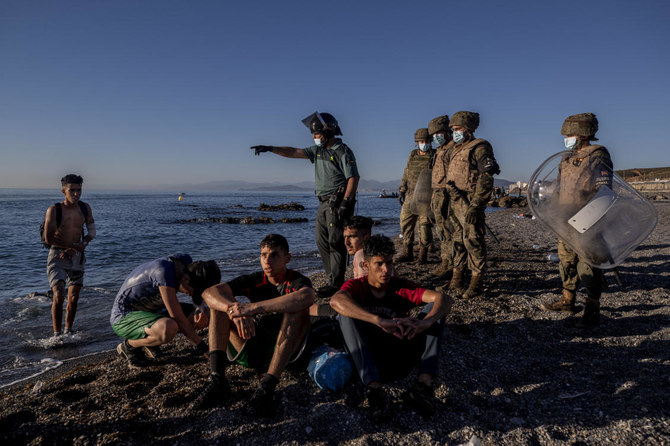
MADRID: Around 350 migrants tried to scale the fence from Morocco into Spain’s Melilla enclave before dawn on Saturday but none managed to get across, a Spanish government spokesman said.
Spanish border forces had been alerted at around 5:30 am by their Moroccan counterparts that “a group of 350 sub-Saharan Africans” were trying to scale the fence near the Barrio Chino border post, prompting Guardia Civil police to deploy a helicopter to head them off.
“No one got across,” the spokesman said, speaking on condition of anonymity.
Another group of more than 300 people had tried to cross into Melilla on August 20 but none managed to get in, he said.
Three days earlier, more than 50 did succeed in entering the tiny enclave when around 150 people stormed the fence. And on July 22, more than 230 people managed to sneak into Melilla in one of the largest influxes in recent years.
Spain’s two tiny enclaves of Ceuta and Melilla have Europe’s only land border with Africa, making them a magnet for migrants desperate to escape grinding poverty and hunger.
In mid-May, Spain was caught off guard when more than 10,000 people swam or used small inflatable boats to cross into Ceuta as the Moroccan border forces looked the other way.
The influx came during a diplomatic crisis between Spain and Morocco, with Madrid angering Rabat by allowing a Western Sahara separatist leader to be treated at a Spanish hospital.
The border breach was widely seen as a punitive move by Morocco. Although most migrants were returned immediately, by the end of July some 2,500 remained in Ceuta, officials there said, among them around 800 unaccompanied minors.

350 migrants stopped from crossing into Spain’s Melilla
https://arab.news/9dbke
350 migrants stopped from crossing into Spain’s Melilla
- Spanish forces had been alerted by Moroccan counterparts that "a group of 350 sub-Saharan Africans" were trying to scale the fence
- Another group of more than 300 people had tried to cross into Melilla on August 20
Suspect arrested after a fire damages a historic Mississippi synagogue
- The 160-year-old synagogue, the largest in Mississippi and the only one in Jackson, was the site of a Ku Klux Klan bombing in 1967
- The synagogue will continue its regular worship programs and services for Shabbat, likely at one of the local churches that reached out
Congregants and leaders vowed to rebuild a historic Mississippi synagogue that was heavily damaged by fire and an individual was taken into custody for what authorities said Sunday was an act of arson.
The fire ripped through the Beth Israel Congregation in Jackson shortly after 3 a.m. on Saturday, authorities said. No congregants were injured in the blaze.
Photos showed the charred remains of an administrative office and synagogue library, where several Torahs were destroyed or damaged.
Jackson Mayor John Horhn confirmed that a person was taken into custody following an investigation that also included the FBI and the Joint Terrorism Task Force.
“Acts of antisemitism, racism, and religious hatred are attacks on Jackson as a whole and will be treated as acts of terror against residents’ safety and freedom to worship,” Horhn said in a statement.
He did not provide the name of the suspect or the charges that the person is facing. A spokesperson for the Jackson FBI said they are “working with law enforcement partners on this investigation.”
The 160-year-old synagogue, the largest in Mississippi and the only one in Jackson, was the site of a Ku Klux Klan bombing in 1967 — a response to the congregation’s role in civil rights activities, according to the Institute of Southern Jewish Life, which also houses its office in the building.
“That history reminds us that attacks on houses of worship, whatever their cause, strike at the heart of our shared moral life,” said CJ Rhodes, a prominent Black Baptist pastor in Jackson, in a Facebook post.
“This wasn’t random vandalism — it was a deliberate, targeted attack on the Jewish community,” Jonathan Greenblatt, CEO of The Anti-Defamation League, said in a statement.
“That it has been attacked again, amid a surge of antisemitic incidents across the US, is a stark reminder: antisemitic violence is escalating, and it demands total condemnation and swift action from everyone,” Greenblatt said.
The congregation is still assessing the damage and received outreach from other houses of worship, said Michele Schipper, CEO of the Institute of Southern Jewish Life and past president of the congregation. The synagogue will continue its regular worship programs and services for Shabbat, the weekly Jewish Sabbath, likely at one of the local churches that reached out.
“We are a resilient people,” said Beth Israel Congregation President Zach Shemper in a statement. “With support from our community, we will rebuild.”
One Torah that survived the Holocaust was behind glass not damaged in the fire, Schipper said. Five Torahs inside the sanctuary are being assessed for smoke damage. Two Torahs inside the library, where the most severe damage was done, were destroyed, according to a synagogue representative.
The floors, walls and ceiling of the sanctuary were covered in soot, and the synagogue will have to replace upholstery and carpeting.
“A lot of times we hear things happening throughout the country in other parts, and we feel like this wouldn’t happen in our part,” said chief fire investigator Charles Felton “A lot of people are in disbelief that this would happen here in Jackson, Mississippi.”


