

UK ministers in Turkey discuss fighter jet deals, NATO policy

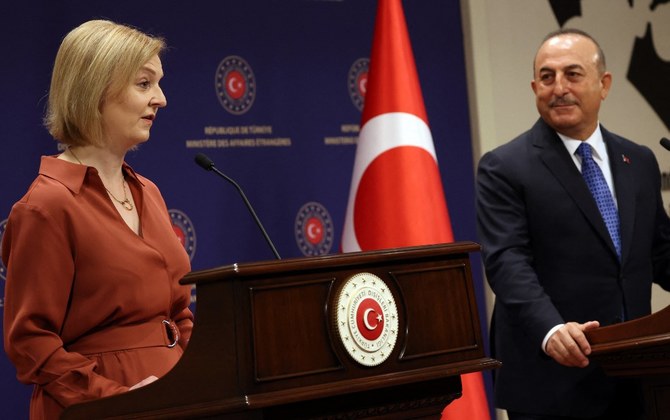
Liz Truss, the UK foreign secretary, met senior Turkish figures, including foreign minister Melut Cavusoglu. (AFP)
Short Url
Updated 24 June 2022
Follow

UK ministers in Turkey discuss fighter jet deals, NATO policy

  • Visit comes amid flurry of Middle East diplomatic activity

LONDON: UK ministers visited Turkey on Thursday to discuss NATO policy and possible sales of military equipment ahead of a major summit of the alliance next week.

Days after the high-level trip by Saudi Crown Prince Mohammed bin Salman, UK Defense Secretary Ben Wallace and Foreign Secretary Liz Truss visited Ankara in the hopes of swaying Turkey to abandon its opposition to Sweden and Finland joining NATO.

Turkey opposes Swedish and Finnish admission to the alliance because of what it claims is Stockholm’s support for outlawed Kurdish groups.

Earlier in June, Kurdish activists at a rally in Sweden showed images of Abdullah Ocalan, a founding member of the Kurdistan Workers’ Party, or PKK, which is banned by Turkey as a terrorist organization.

In response to the protests, Ankara said it would block Swedish admission to NATO, a move that angered US lawmakers, who have threatened to halt a deal to sell F-16 fighter jets to Turkey.

Turkey was also removed from the F-35 jet program after its purchase — in violation of US sanctions — of Russian S-400 anti-aircraft systems.

As part of the UK-Turkey talks, Wallace met his counterpart Hulusi Akar in Ankara. The UK is reportedly pushing for sales of the Eurofighter Typhoon jet amid rumors of a threat to the F-16 deal.

Qatar, a major Turkish ally, signed a $6 billion Typhoon deal in 2017.

A UK Ministry of Defense spokesman said: “The defense secretary is meeting his counterpart in Turkey today for routine bilateral talks on cooperation and security issues ahead of the NATO summit next week.”

Meanwhile, Liz Truss, the UK foreign secretary, met senior Turkish figures, including foreign minister Melut Cavusoglu, to discuss defense cooperation, the NATO summit and the conflicts in Ukraine as well as Syria.

The visit comes amid a flurry of diplomatic activity in the region. Israel’s foreign minister also visited Ankara following the Saudi meeting.

Before the UK visit, Prime Minister Boris Johnson spoke with Turkish President Recep Tayyip Erdogan to discuss defense cooperation and the Ukraine conflict.


Sudan now has highest number of people in need ‘anywhere in the world,’ UN warns

Updated 15 sec ago
Follow

Sudan now has highest number of people in need ‘anywhere in the world,’ UN warns

  • Spokesperson Stephane Dujarric presses states to provide urgent financial support to help meet humanitarian needs that have reached ‘extraordinary levels’
  • 34m people expected to need aid this year; UN response plan calls for $2.9bn of funding to provide food, nutrition, clean water, health and protection services, and education

NEW YORK CITY: The UN on Friday pressed member states to provide urgent financial support to help stave off further suffering in war-torn Sudan, where nearly 34 million people are now expected to need assistance this year — the highest number anywhere in the world.

Spokesperson Stephane Dujarric said that despite the “extraordinary humanitarian needs,” operations remain perilously underfunded and aid workers face mounting risks.

The UN’s 2026 Humanitarian Response Plan for Sudan calls for $2.9 billion of funding to provide more than 20 million people with life-saving food, nutrition, clean water, health and protection services, and education. But funding lags behind needs, complicating efforts to scale up deliveries of aid.

The civil war between rival military factions in the country, which will enter its fourth year in April, is driving several overlapping emergencies, including acute food insecurity and outbreaks of disease.

According to the UN’s World Food Programme, more than 21 million people in Sudan face high levels of acute hunger, and famine conditions have been confirmed, or are feared to be present, in several regions.

Humanitarian workers continue to face “grave danger,” Dujarric said. In recent months, 92 of them, mostly Sudanese, have been killed, injured, kidnapped or detained, he added, and more than 65 attacks on healthcare providers and patients have been recorded.

Aid groups also warn that conflict-related obstacles, including blockades, drone strikes, and sporadic access restrictions, continue to hamper distribution efforts.

The UN has highlighted the fact that amid the growing displacement of people in North Darfur and North Kordofan, where hundreds of thousands of civilians have been uprooted, water and sanitation services are collapsing in affected areas.

The humanitarian crisis is compounded by regional spillover. Neighboring Chad has closed its border with Sudan amid security concerns, complicating the cross-border flow of aid and threatening already fragile refugee-support systems.

Dujarric warned that without increased donor support and improved access, the skills and commitment of aid workers will not be enough to keep pace with spiraling needs.

“Delivering aid at this scale requires flexible funding and guaranteed humanitarian access, so that workers can reach people in need and they can reach them safely and rapidly and without any obstruction,” he said.