

Tunisia trade unions chief rejects IMF reforms

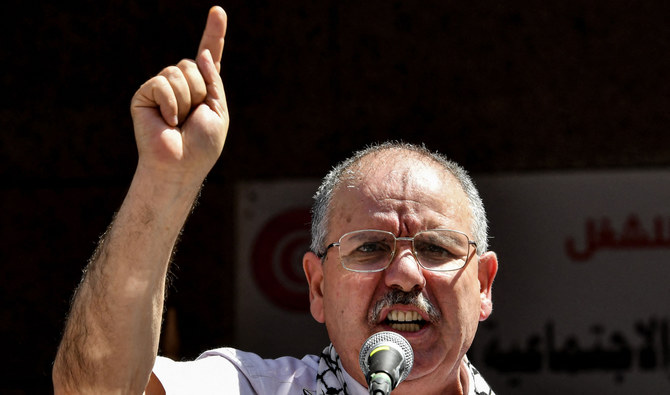
“We reject the conditions set by the IMF, given Tunisians’ low salaries, lack of means, rising poverty and unemployment,” Noureddine Taboubi told reporters. (AFP/File)
Short Url
Updated 24 June 2022
Follow

Tunisia trade unions chief rejects IMF reforms

  • The IMF’s regional chief Jihad Azour said Wednesday that the fund was set to begin formal talks on a new financial aid package “in the coming weeks,” saying the economic fallout from the Ukraine war made it ever more pressing

TUNIS: The head of Tunisia’s powerful UGTT trade union confederation on Thursday rejected conditions set by the International Monetary Fund for a new loan to bail out the country’s struggling economy.

“We reject the conditions set by the IMF, given Tunisians’ low salaries, lack of means, rising poverty and unemployment,” Noureddine Taboubi told reporters.

The global lender has called for “ambitious reforms” to tackle the heavily indebted country’s public finances and reform its state-owned companies.

The IMF’s regional chief Jihad Azour said Wednesday that the fund was set to begin formal talks on a new financial aid package “in the coming weeks,” saying the economic fallout from the Ukraine war made it ever more pressing.

Azour had reiterated an IMF call for “swift implementation of ambitious reforms,” saying Tunisia “needs to urgently tackle its fiscal imbalances” including by replacing generalized subsidies with transfers targeting the poor.

But on Thursday Taboubi, whose union members last week staged a crippling public sector strike, said the UGTT rejected “the painful options they’re talking about.”

“We support reforms, but we don’t share the vision of reforms supported by this government,” he said.

He also indirectly criticized President Kais Saied, who in July last year sacked the previous administration and suspended parliament in moves opponents have called a coup against the only democracy to emerge from the Arab Spring uprisings.

The UGTT, a co-laureate of the Nobel Peace Prize for its efforts in a previous national dialogue following Tunisia’s 2011 revolution, initially backed Saied’s moves but has become increasingly critical as Saied extended his power grab.

On Thursday, Taboubi said: “When there is a government produced by institutions and elections, it will have the legitimacy to start negotiations over reforms.”

The IMF has previously conditioned any bailout deal on the union’s consent.

Azour visited Tunisia this week, meeting with President Kais Saied and other officials, and welcomed government plans to start tackling dire economic issues exacerbated by the war in Ukraine.


US resumes food aid to Somalia

Updated 29 January 2026
Follow

US resumes food aid to Somalia

  • The United States on Thursday announced the resumption of food distribution in Somalia, weeks after the destruction of a US-funded World Food Programme (WFP) warehouse at Mogadishu’s port

NAIROBI: The United States on Thursday announced the resumption of food distribution in Somalia, weeks after the destruction of a US-funded World Food Programme (WFP) warehouse at Mogadishu’s port.
In early January, Washington suspended aid to Somalia over reports of theft and government interference, saying Somali officials had “illegally seized 76 metric tons of donor-funded food aid meant for vulnerable Somalis.”
US officials then warned any future aid would depend on the Somali government taking accountability, a stance Mogadishu countered by saying the warehouse demolition was part of the port’s “expansion and repurposing works.”
On Wednesday, however, the Somali government said “all WFP commodities affected by port expansion have been returned.”
In a statement Somalia said it “takes full responsibility” and has “provided the World Food Program with a larger and more suitable warehouse within the Mogadishu port area.”
The US State Department said in a post on X that: “We will resume WFP food distribution while continuing to review our broader assistance posture in Somalia.”
“The Trump Administration maintains a firm zero tolerance policy for waste, theft, or diversion of US resources,” it said.
US president Donald Trump has slashed aid over the past year globally.
Somalis in the United States have also become a particular target for the administration in recent weeks, targeted in immigration raids.
They have also been accused of large-scale public benefit fraud in Minnesota, which has the largest Somali community in the country with around 80,000 members.