
KABUL: Rescuers in eastern Afghanistan continued relief efforts on Thursday to help the survivors of a deadly earthquake that according to official figures killed at least 1,000 people in the mountainous region.
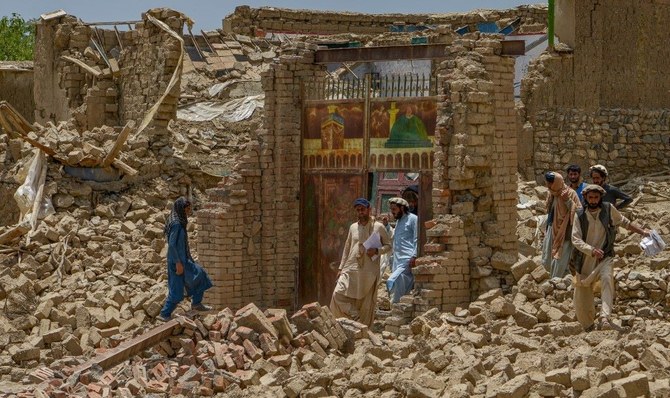
The earthquake of magnitude 6.1 hit areas of Paktika and Khost provinces neighboring Pakistan on Tuesday night, flattening homes as people slept inside.
Paktika was worst affected, with officials estimating that more than 1,000 people were killed and over 1,500 injured in the province’s Gayan and Barmal districts alone.
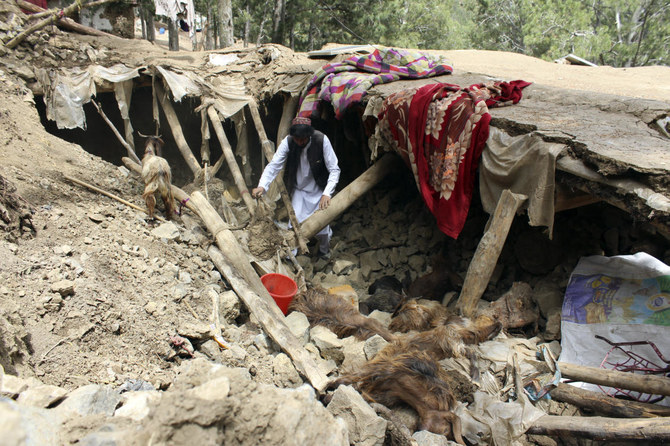
The extent of the destruction in the villages tucked away in the mountains was slow in coming to light, as search and rescue efforts were hampered by heavy rain and poor connectivity in the affected areas. UN World Food Program teams deployed to deliver emergency supplies estimated that more than 70 percent of homes in the worst-hit regions have been destroyed.
“The whole area looks like an open camp,” Qais Mohammad Muslim, an aid worker who arrived in Gayan district, told Arab News. “People have no shelter and no food to eat. The aid (that reached) the area so far is little and insufficient.”
BACKGROUND
The extent of the destruction in the villages tucked away in the mountains was slow in coming to light, as search and rescue efforts were hampered by heavy rain and poor connectivity.
Abdul Qudos, a resident of Paktika, said he had never experienced a quake as powerful and destructive.
“Entire villages were drowned in soil in Barmal and Gayan districts. There are families who lost all members,” he said. “We must do everything possible to help them. The international community has to deliver urgent aid to avoid further damage and loss.”
The response is complicated because rescuers are working without heavy equipment and proper medical support, after many organizations pulled out of the aid-dependent country when the Taliban seized power last August.
In the wake of the Taliban government’s call for foreign assistance, its chief spokesman Zabihullah Mujahid said on Thursday that aircraft with aid have already arrived from Qatar and Iran, and trucks with food reached Paktika by road from Pakistan.
But more aid is needed.
Naeem Hakim from the Afghan aid group Ehsas Welfare and Social Services Organization, who arrived in Paktika on Wednesday, said local hospitals were struggling to treat the injured.
“There’s an urgent need for blood (for) the seriously injured and medicine,” he told Arab News. “Six hundred to 700 wounded people have been brought to the nearest hospital in Urgun district since yesterday. Around 200 are still there today. The more serious ones are transferred to the military hospital in the provincial capital Sharana, the provincial hospital and hospitals in Gardez and Ghazni.”
The quake was the deadliest in Afghanistan since 1998, when magnitude 6.5 tremors killed more than 4,000 people in Takhar province in the country’s north.
Ramiz Alakbarov, UN deputy special representative for Afghanistan, said on Wednesday at least $15 million of aid was needed to respond to the disaster — a figure expected to rise in the coming days.