

Heart to get: Doctors in Pakistan’s Lahore perform lifesaving cardiovascular surgeries on Afghan children

An afghan child with congenital heart diseases sit inside a hospital in Lahore, Pakistan in this undated photo. These children were brought to Pakistan for treatment by the Afghanistan Red Crescent Society and Pakistan's Al-Khidmat Foundation.(Al-Khidmat Foundation, Pakistan)
Short Url
Updated 21 June 2022
Follow

Heart to get: Doctors in Pakistan’s Lahore perform lifesaving cardiovascular surgeries on Afghan children

  • Around 7,000 children in Afghanistan need urgent surgeries to recover from congenital heart diseases
  • Afghan Red Crescent Society, Al-Khidmat Foundation facilitating treatment of these children in Pakistan

LAHORE: Pakistani doctors in the eastern city of Lahore on Sunday performed lifesaving surgeries on two Afghan children suffering from congenital heart diseases (CHD), the first among 40 children whose treatment is being facilitated by Pakistani and Afghan non-governmental organizations (NGOs). 

Around 7,000 children in Afghanistan suffer from CHD, with more than 1,000 of them registered since the start of 2021 awaiting treatment inside or outside the war-torn country. Congenital heart diseases are present at birth and can affect the structure of a newborn’s heart and the way it works. They can affect the blood flow through the heart and out to the rest of the body. 

In Pakistan, Al-Khidmat Foundation and a private medical teaching hospital have collaborated with the ARCS for the treatment of these children. The first batch of nine such children arrived in Pakistan from Kabul on June 17. 

On Sunday, the first two operations were conducted, while the rest of the seven children will be treated this week. 

“We operated upon two minors on the first day and with God’s help, all is well,” Dr. Asim Khan, a pediatric cardiac surgeon, told Arab News. “The condition of the two children is satisfactory and they will be able to lead a normal life in weeks.” 
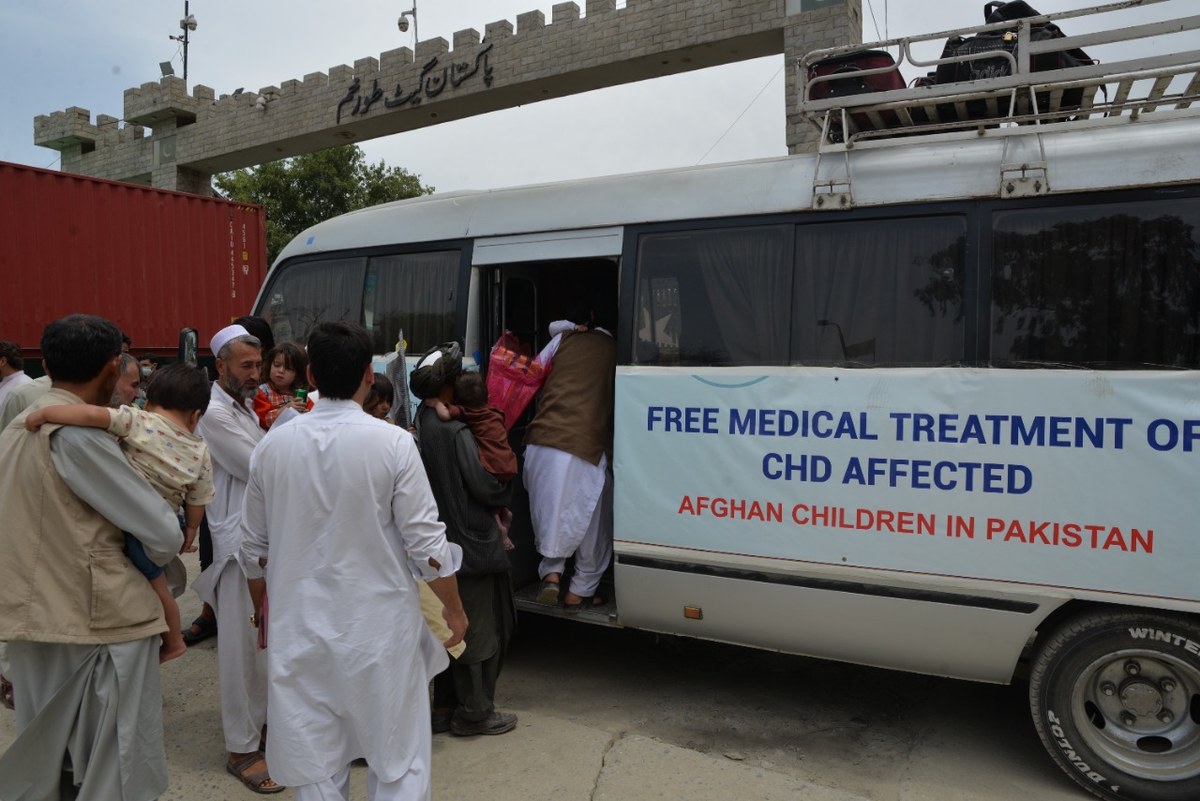


The picture posted on June 17, 2022 shows Afghan parents along with their children boarding on a bus at Torkham Border to get medical treatment of Congenital Heart Diseases at Teaching Hospital in Lahore, Pakistan. (@AlkhidmatOrg/Twitter)

The two children included five-year-old Muhammad Nauman and 18-month-old Murtaza Muhammad. 

“Allah has blessed my son with a new life. I am thankful to Afghan Red Crescent and Pakistani doctors,” said Aman Khan, the father of Nauman.  

“My son was ill and I had no resources for his treatment. I took him to Red Crescent Center and they enlisted my son for the treatment. I have no words to say thank you.” 

The children and their parents will continue to stay at the Lahore hospital free of cost for 15 days after the operation. 

“There are 7,000 children in Afghanistan, registered with ARCS, waiting for medical treatment of Congenital Heart Diseases (CHD), while 9,000 have been treated in the last ten years in different countries, including India, Germany and China, under the ongoing Red Cross program,” Dr. Khalil Ahmad Hijrat, a cardiac surgeon and director of the ARCS department of CHD, told Arab News.  

“This year Pakistani organizations have offered help and nine children have been brought to Lahore for operation out of 40 registered for the program in Pakistan.” 

The Al-Khidmat Foundation is providing logistics to ARCS to bring patients to Pakistan and helping the global charity organization with medical facilities in Afghanistan. 

Shahid Iqbal, acting chief of Al-Khidmat Foundation, said Al-Khidmat delegates recently visited Afghanistan, where the ARCS requested them to help Afghan children suffering from CHD.  

“We have already been working there in the [health] sector to lessen the sufferings of our brothers,” he said. “Al-Khidmat took the responsibility and with the collaboration of other charity organizations agreed to bring the children and provide them treatment.” 


ADB approves $381 million for climate-resilient agriculture, social services in Punjab

Updated 8 sec ago
Follow

ADB approves $381 million for climate-resilient agriculture, social services in Punjab

  • Support will upgrade Punjab’s education and nursing systems, improving learning outcomes and health care capacity
  • Package includes $124 million for agriculture, $107 million for STEM schooling and $150 million for nursing reforms

KARACHI: The Asian Development Bank (ADB) said on Saturday it approved $381 million in financing for Pakistan’s Punjab province to modernize agriculture and strengthen education and health services, with a major focus on building climate resilience after monsoon floods this year caused widespread destruction across the country’s most populous province.

The package includes concessional loans and grants for farm mechanization, STEM education, and nursing sector reforms.

ADB said the investments are intended to help Punjab, home to more than half of Pakistan’s population and a key contributor to its economy, recover from climate shocks and transition toward more sustainable and resilient development.

“Investing in education, health, and agricultural mechanization will play a transformative role in driving the growth of Punjab, a vital pillar of Pakistan’s economy,” said ADB Country Director for Pakistan Emma Fan. “These strategic investments will modernize agriculture, enhance human capital, and significantly improve livelihoods for millions of people across Punjab.”

The bank approved $120 million in concessional loans and a $4 million grant for the Punjab Climate-Resilient and Low-Carbon Agriculture Mechanization Project, which will support 220,000 rural farm households.

The program aims to reduce climate vulnerability by shifting farmers toward modern, low-emission machinery, provide alternative livelihoods for agricultural workers and train 15,000 women in new skills. It will also introduce a financing model to help small farmers access advanced equipment.

Punjab produces most of Pakistan’s wheat, rice, and maize but still relies on outdated machinery, contributing to grain losses and routine burning of crop residues, a major source of air pollution, said ADB.

It noted the new project will promote modern mechanization, including rice harvesters, to address these issues.

ADB also approved $107 million for the Responsive, Ready, and Resilient STEM Secondary Education in Punjab Program, including a $7 million grant from the Asian Development Fund.

The results-based program aims to modernize secondary schooling by expanding inclusive STEM education, improving access and quality across the province.

A further $150 million concessional loan was approved for the Punjab Nursing and Health Workforce Reform Program, which will upgrade nursing curricula, develop disaster-resilient training facilities, strengthen workforce governance, and introduce digital human-resource systems.

The program seeks to expand the pool of qualified nurses to strengthen health service delivery and meet rising national and global demand.

Key components include the establishment of three centers of excellence in Lahore, Multan and Rawalpindi, equipped with simulation labs, digital learning platforms, and gender-responsive hostels.

ADB said it remains committed to supporting climate-resilient and inclusive development across Asia and the Pacific through innovative financing tools and partnerships.