

After mosque bombing, Islamabad intensifies patrols, surveillance during Ramadan prayers, iftar

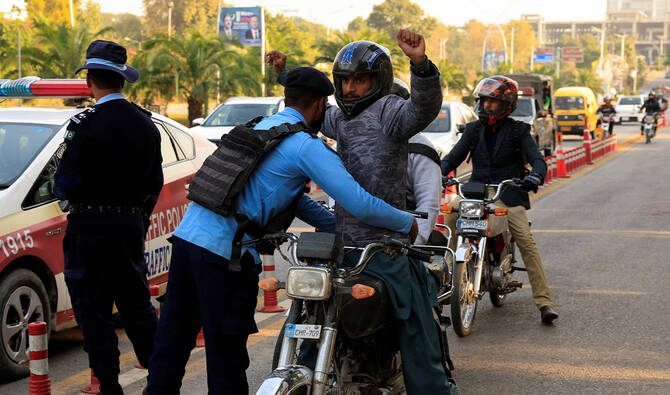
A police officer frisks a biker at a security check post along a road following yesterday's blast outside the district court building, in Islamabad, Pakistan, November 12, 2025. (Reuters/File)
Short Url
Updated 25 February 2026
Follow

After mosque bombing, Islamabad intensifies patrols, surveillance during Ramadan prayers, iftar

  • Police chief orders enhanced screening at capital city’s entry and exit points after Feb. 6 blast
  • Safe City cameras to monitor Islamabad round the clock as special pre-iftar traffic plan enforced

ISLAMABAD: Police in the federal capital have been instructed to step up patrols, surveillance and checkpoint inspections during Ramadan prayers and iftar hours, an official statement said on Wednesday, as the city’s police chief chaired a security meeting following a deadly mosque bombing earlier this month.

Inspector General of Police Syed Ali Nasir Rizvi directed senior officers to ensure “foolproof security” across the city, with special focus on mosques during peak congregational times.

The meeting comes after a suicide bombing at a mosque on the outskirts of Islamabad on Feb. 6 that killed at least 32 people. The blast targeted the Qasr-e-Khadijatul Kubra mosque and imambargah during Friday prayers and was claimed by Daesh that said one of its militants detonated an explosive vest inside the congregation.

“All officers must ensure their presence in the field and properly brief personnel about their duties,” Rizvi said, according to a statement issued by the police.

“Strict security arrangements should be ensured at mosques, imambargahs and Ramadan bazaars,” he continued. “Special patrols should be conducted during Fajr, iftar and Taraweeh hours.”

The police chief said Safe City cameras would be used for round-the-clock effective monitoring across the capital.

In addition to security measures, he reviewed traffic arrangements and directed strict implementation of a special traffic plan during pre-iftar rush hours, calling for additional deployment on major roads and at commercial centers.

Islamabad, which has generally seen fewer large-scale militant attacks than some other parts of Pakistan, has faced sporadic security incidents in the past, prompting authorities to tighten monitoring during religious gatherings and other high-risk events.


Islamabad launches real-time fuel monitoring system as Iran war rattles oil markets

Updated 1 min 52 sec ago
Follow

Islamabad launches real-time fuel monitoring system as Iran war rattles oil markets

  • Authorities say they will track petrol stocks at 145 stations through City Islamabad app
  • Petrol stations in the city are required to upload daily stock data to prevent shortages

ISLAMABAD: Authorities in Pakistan’s capital have launched a digital system to monitor petroleum stocks at fuel stations in real time, and official statement said on Tuesday, as the government steps up oversight of supplies following market disruptions linked to tensions in the Middle East.

The system has been introduced by the Islamabad district administration days after authorities sealed seven petrol stations for refusing fuel to motorists. It will allow officials to track fuel inventories through the “City Islamabad” mobile application, requiring petrol pump operators to upload daily stock details as authorities seek to prevent hoarding and artificial shortages.

The initiative comes days after Pakistan raised fuel prices sharply and authorities across the country launched crackdowns on hoarding amid fears that escalating conflict in the Middle East could disrupt global energy shipments and push oil prices higher.

“Real-time monitoring will ensure that any shortage of petroleum products can be addressed immediately,” Islamabad Deputy Commissioner Irfan Memon said in the statement announcing the system.

The statement noted the new digital tool would enable authorities to track stock levels at 145 fuel stations across Islamabad and monitor transactions through the mobile platform.

Under the system, petrol pump owners must upload daily stock information, while the district administration has released a tutorial explaining how to use the feature.

Authorities warned that failure to upload stock data could result in action against fuel station owners.

Pakistan has tightened monitoring of fuel supplies in recent days after global oil markets were rattled by United States and Israeli strikes on Iran, which raised concerns about possible disruptions to shipping routes in the Middle East, particularly around the Strait of Hormuz, a key corridor for global energy trade.

The government has said it is closely watching domestic supply conditions and international oil markets while taking steps to ensure fuel availability and prevent panic buying.