

Italy to grant 10,500 work visas, waive entry requirement for Pakistani diplomats — ministry

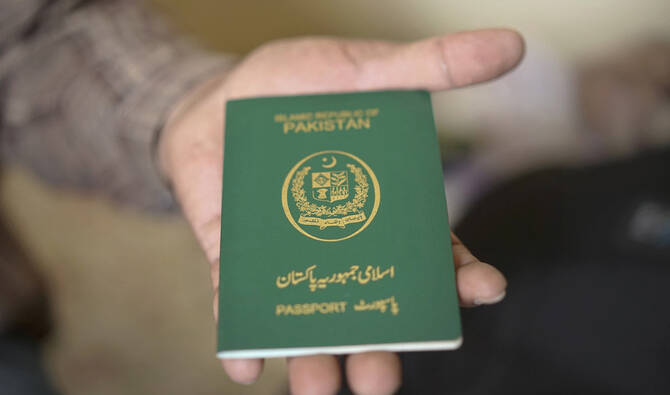
This photo taken on November 3, 2018, shows a man holdong a Pakistani passport in Bangkok, Thailand. (AFP/File)
Short Url
Updated 25 February 2026
Follow

Italy to grant 10,500 work visas, waive entry requirement for Pakistani diplomats — ministry

  • Interior minister meets Italian counterpart to review measures preventing illegal immigration
  • Pakistan says it achieved a 47 percent drop in illegal immigration to European states in 2025

KARACHI: Italy has announced to grant 10,500 visas to Pakistani nationals to promote legal migration and exempt diplomatic passport holders from visa requirements, Pakistan’s interior ministry said on Wednesday.

The development took place during a meeting between Pakistan’s Interior Minister Mohsin Naqvi and his Italian counterpart Matteo Piantedosi to review internal security relations and measures to prevent illegal immigration.

Pakistan intensified action against illegal migration in 2023 after hundreds of migrants, including many Pakistanis, drowned when an overcrowded vessel sank off the Greek town of Pylos, making it one of the deadliest boat disasters in the Mediterranean.

Authorities continue to target smuggling networks sending citizens abroad through dangerous routes, following heightened scrutiny at airports and a series of arrests involving forged documents.

“10,500 work visas will be issued for Pakistan’s skilled labor force to promote legal migration,” Piantedosi was quoted as saying by the ministry in its statement. “On the demand of Interior Minister Mohsin Naqvi, Pakistani diplomatic passport holders will be exempted from Italian visas.”

The ministry said the discussions also focused on strengthening cooperation to more effectively combat drug trafficking, human smuggling and militancy.

It quoted Naqvi as saying that strict airport and sea borders surveillance had helped reduce illegal immigration.

“The achievements of Pakistani institutions in preventing human trafficking and drugs are commendable,” the ministry quoted Piantedosi as saying. “We will increase mutual cooperation to promote legal migration.”

Pakistan said last year it had achieved a 47 percent drop in illegal immigration to Europe in 2025, with more than 1,700 human smugglers arrested as part of an expanded nationwide crackdown.

The country also announced in December plans to roll out an artificial intelligence-based immigration screening system in Islamabad to detect forged travel documents and prevent illegal departures.

Pakistan’s Federal Investigation Agency released a list of more than 100 of the country’s “most wanted” human smugglers in September while identifying major hubs of trafficking activity in the country.


Pakistan’s Mahnoor Omer named among TIME’s ‘Women of the Year’ for 2026

Updated 01 March 2026
Follow

Pakistan’s Mahnoor Omer named among TIME’s ‘Women of the Year’ for 2026

  • Omer moved a Pakistani court against the so-called ‘period tax’ in Sept. 2025 which has since sparked a national debate
  • Taxes on sanitary pads in Pakistan can add up to 40 percent to retail price, UNICEF says only around 12 percent women use such products

ISLAMABAD: Pakistani women’s rights activist Mahnoor Omer, who fought against taxes on menstrual products, has been named among the TIME magazine’s ‘Women of the Year’ for 2026.

Omer’s efforts have been recognized alongside 16 activists, artists, athletes and businesswomen in the TIME’s Women of the Year 2026 list, including Olympic gold medalist Sydney McLaughlin-Levrone and Oscar-nominated filmmaker Chloe Zhao.

Dissatisfied with the efforts to educate Pakistani girls about sexual violence, Omer founded the Noor Foundation at the age of 14 and held her own workshops with village girls about everything from climate change to menstruation, according to the TIME magazine.

Two years later, a conversation with a domestic worker about the price of pads made her realize that not everyone could afford these essentials. She moved a court against the so-called “period tax” in Sept. 2025 and the case has sparked a national debate on the subject, considered a taboo by many in Pakistan, since its first hearing late last year.

“A decade and one law degree after her interest in activism was sparked, Omer, now 25, is putting her passion and expertise to work in the name of gender equity,” TIME wrote about Omer on its website.

Taxes imposed on sanitary products in Pakistan can add up to 40 percent to the retail price. UNICEF estimates just 12 percent of women in the country use commercially produced pads or tampons. The alternative, using cloth, risks health impacts including rashes and infections, and can make it impossible for girls to attend school while menstruating.

Omer’s suit, which awaits the government response, has sparked a national discussion. She says she spoke about menstruation to her father and male cousins, who thanked her for standing up for their daughters.
The 25-year-old, who is currently enrolled in a master’s degree in gender, peace, and security at the London School of Economics, sees this case as just the first of many.

“I’m not free until every woman is free,” she was quoted as saying by TIME. “I want to leave no stones unturned in terms of what I can do with the next few decades, as a lawyer for the women in my country and gender minorities in general.”