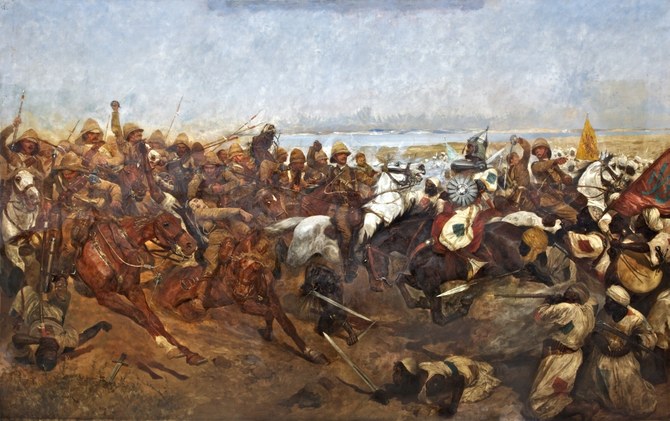

LONDON: Sudan is seeking the return of numerous historical items from the UK, including antiques, artefacts, and human remains, taken during the colonial period after the British Empire invaded the region in 1898.
The list includes two skulls belonging to Sudanese soldiers taken from the battlefield at Omdurman that year, as part of a wider pattern of trophy-hunting and looting by British soldiers, which was seen as revenge for the death of Maj. Gen. Charles Gordon at the siege of Khartoum in 1885.
The skulls were passed to the Edinburgh Anatomical Museum by the businessman Henry Wellcome, where they joined a collection of human remains from throughout Africa used to promote racist scientific theories popular in 19th-century Europe and North America.
Authorities in Khartoum are keen for the remains of the two Sudanese soldiers to be returned.
Dr. Eglal El-Malik, director of conservation at the National Corporation for Antiquities and Museums, said: “We have to have a big campaign. These people are our brothers, our heroes. They unified and defended our country. It is a very special story of resistance to imperialism. Their descendants should see this all here.”
A banner taken from Omdurman, currently at Durham University’s Palace Green Library, and a suit of armor held at the Royal Armories collection, are also among the items Sudan wants returned, with the aim of displaying them at a specialist museum in Omdurman, recently restored with money from the British Council dedicated to the battle and the legacy of British colonial rule, which ended in 1956.
Ahmed Mohammed, a curator at the museum, told The Guardian: “I want to show the real detail of the battle of Omdurman, and I cannot do that without all the items. It is very important for the Sudanese people to know.”
Some items have already been repatriated, including a robe worn by a Sudanese warrior returned by a British family whose ancestor took it from the battlefield.
Despite this, many practical challenges remain, including legal and security issues.
“There are lots of Sudanese (people) who want these items back now (but) they need to be aware of the legal issues. The reality is we have so many difficulties (in Sudan). It would be great if we had all these things back now but (they are) in a good situation where it is and so many people see it. So, we have to be reasonable,” El-Malik added.
Not all Sudanese experts even agree that the country’s treasures should be returned yet, given that the nation has been ravaged by war for decades, hampering its ability to recover and safeguard its looted heritage.
As well as British investment in the museum at Omdurman, the country’s National Museum in Khartoum is being refurbished with a $1 million donation from the Italian government.
Ghalia Gharelnabi, acting director of the National Museum, said: “The situation here is not suitable. For the moment they (the items) should stay where they are, but of course eventually we would like to have them in our museum.”
El-Malik noted that academics and officials at UK institutions holding Sudanese items had been “very helpful on the whole” about the issue of repatriation.
A spokesperson for Durham University said: “We work closely with the National Corporation of Antiquities and Museums in Sudan, including currently on loan requests for several items from the Sudan Archive to be displayed in Sudan. They and we recognize this is not without difficulties.”
Prof. Tom Gillingwater, of the Edinburgh Anatomical Museum, said his institution had not received a formal request for the return of the Sudanese skulls.
“Anatomical remains are now utilized for research into the history of genetics, diets, and the movement of people. We take our colonial legacy, and its contemporary impact, very seriously, and are continuing to examine ways to address these important issues,” he added.
Britain’s vast number of historical artefacts taken from overseas during the age of its empire has been a source of controversy for some time, including other items from Sudan dating back to the ancient Roman and Egyptian eras.
Other European countries have also grappled with the issue: In 2021 Germany became the first country to return famous statues looted from West Africa in the 19th century known as the Benin bronzes — a number of which still reside in the British Museum.