

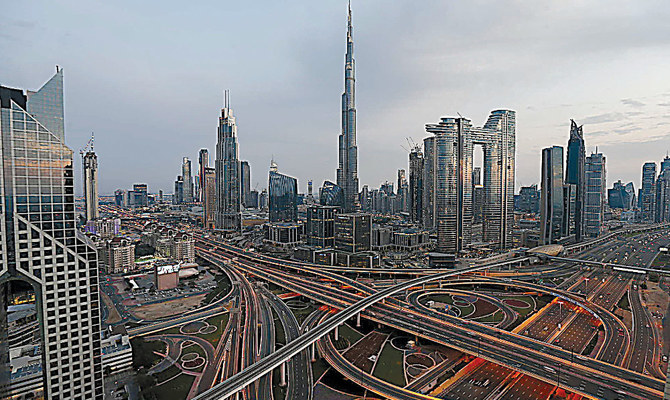
DUBAI: Six years after the Dubai Roads and Transportation Authority laid the roadmap for driverless vehicles by 2030, smart mobility has swept the landscape with intelligent concepts that are changing the region’s social infrastructure.
The move has already spurred sustainable cities into high gear with smart transportation such as autonomous shuttles, e-bikes and e-buggies set to own the roads.
An excellent example of a fully-integrated residential project is Sharjah Sustainable City. This eco-friendly concept is powering a net-zero energy community with energy-efficient villas that promise to offer sustainable living at no extra cost.
Developed by Sharjah Investment and Development Authority in partnership with Diamond Developers, the sustainable city will host the best green technology, including solar-powered smart homes, bio-domes for vertical farming, electric vehicle chargers, driverless shuttles and a biogas plant.
“The UAE is the first country in the Gulf Cooperation Council to commit to net-zero by 2050; all growth and development must align with that commitment, which means we have to do our bit,” Karim El-Jisr, chief sustainability officer, SSC, told Arab News.

Karim El-Jisr
Sustainability pyramid
Comparing smart mobility to a pyramid, El-Jisr explained that the bottom constituted soft mobility, including people who walked or cycled to commute. The SSC master plan covered this aspect by building roads with no zebra crossings.
“There would be no need to cross zebra lines or intersect with vehicles to reach any of the 1,250 villas in SSC. The residents and visitors could connect to those villas on foot,” said El-Jisr.
The next pyramid level involved shared mobility, using electric buggies and concierge services.
“The concierge team would manage buggies, which residents can book over their smartphones. The concierge team can increase the numbers based on future demand,” he added.
The topmost level of the pyramid featured electric vehicles, and SSC will encourage people to switch from gasoline to electric cars.
“We will provide charging stations throughout the development. It will be the highest density of charging points in any project across the GCC,” said El-Jisr, adding that there will be 80 charging points in the community.
The sustainable city is also studying the autonomous shuttle trials in Dubai to determine if they should implement them.
Advent of faceless mobility
The story doesn’t end there. Last December, UAE-based sustainable transport company ION broke all barriers to mobility by launching the UAE’s first autonomous shuttle service along the Ajman Corniche.
The autonomous shuttle uses a public road between the Fairmont Hotel and the Coral Beach Hotel on the Ajman Corniche. ION is a joint venture between Bee’ah, the Middle East’s sustainability pioneer, and Sharjah-based Crescent Enterprises.
“In addition to deep learning technologies, the autonomous shuttle is equipped with 3D vision, automatic routing, navigation, IoT sensors for optimal safety, and motion sensors to open and close doors,” Nasir Al-Shamsi, director of sustainable mobility at Bee’ah, told Arab News.

Nasir Al-Shamsi
By receiving data from traffic lights and traffic signals, the autonomous shuttle detects the surroundings of the shuttle and sends an alert whenever it approaches a pedestrian crossing.
Along with wheelchair accessibility, the shuttle has an emission-free design and can seat 15 passengers simultaneously.
Al-Shamsi said that about half of Dubai’s population does not own vehicles and relies heavily on public transportation, adding that autonomous vehicles are safer than human-driven ones since a driver could make a mistake that causes an accident.
“More than 90 percent of accidents in the UAE are caused by human error. If you translate that 90 percent, these are equivalent to billions of UAE dirhams. This loss by itself weakens the economy,” he said.
According to Al-Shamsi, the company is also toying with the idea of launching drone delivery solutions beyond the visual line of sight, which could lead to goods delivered between buildings.
The company is currently testing the system and will soon launch the first trial in cooperation with the Sharjah Civil Aviation Department.
Bee’ah is looking into ways to incorporate micro-mobility through electric bikes and scooters.
Biking on zero-carbon footprint
Dubai-based Careem Bike is poised to become the world’s largest pedal-assisted docked bike-share scheme by deploying 175 stations next month.
The company initially introduced 800 e-bikes and 80 stations across the city under a 15-year partnership with Dubai’s Road and Transportation Authority.
“We just exceeded 2 million trips and about 10 million kilometers in the distance traveled, displacing about 450 cars in the city in terms of CO2 emissions,” Sami Amin, senior director of operations, Careem Bike, told Arab News, while adding that the company plans to expand to 3,500 bikes and 350 stations.

Sami Amin
Like most cities in this region, Dubai is car-centric, and the roads are not designed for cyclists. However, RTA is keen on transforming the area into the most cycle-friendly city in the world.
With a clear focus on sustainable mobility, the company is exploring autonomous vehicles, delivery robots, and other electrified vehicles. “Driving sustainability is our core strategy,” said Amin.
Through sustainable cities, reducing cars, and implementing micro-mobility, communities will be more livable by decreasing the cost of transportation, making them accessible, and reducing the carbon footprint and general pollution. Smart mobility is all about communities.


