

Sindh chief minister orders ‘strict action’ after election violence kills one in Karachi

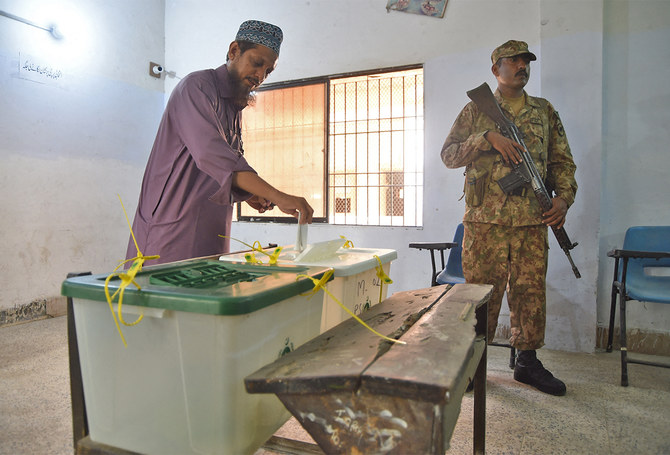
A Pakistani man casts his vote as a soldier stands guard at a polling station during Pakistan's general election in Karachi, Pakistan, on July 25, 2018. (AFP/File)
Short Url
Updated 16 June 2022
Follow

Sindh chief minister orders ‘strict action’ after election violence kills one in Karachi

  • The by-election in NA-240 was held after the death of a National Assembly member in April
  • Chief Minister Shah asks political parties to demonstrate responsible attitude, avoid violence

ISLAMABAD: Sindh Chief Minister Syed Murad Ali Shah on Thursday took notice of a firing incident during a by-poll in a National Assembly constituency in Karachi, saying his administration would not tolerate any disruption to the election process.

One person was killed and nine others injured, according to the Jinnah Postgraduate Medical Center (JPMC), when violence erupted among rival political parties in NA-240.

The by-election was held in the constituency after the death of Iqbal Muhammad Ali, a National Assembly member from the Muttahida Qaumi Movement-Pakistan (MQM-P) party, in April.

“We cannot allow anybody to disrupt the peaceful polling process,” the chief minister said according to an official statement.

He instructed Sindh inspector general police Ghulam Nabi Memon to take “strict action” against the persons involved in the firing incident and skirmishes during the voting process.

Shah also urged political parties to demonstrate a responsible attitude.

“We are political people and should not allow violence,” he said.

According to the JPMC record, a 65-year-old man, Saifuddin Kaleem Siddique, was brought dead to the hospital after receiving a gunshot wound.

Different political parties contesting the by-poll blamed one another for instigating violence.

The election authorities started counting the votes after the polling process ended in the afternoon.

The official result of the contest is yet to be announced.


Pakistan plans Benghazi consulate, lending legitimacy to Libya’s eastern authorities

Updated 6 sec ago
Follow

Pakistan plans Benghazi consulate, lending legitimacy to Libya’s eastern authorities

  • Libya descended into turmoil after a 2011 NATO-backed uprising toppled Muammar Qaddafi and has been divided into eastern, western authorities
  • The UN-recognized government in Tripoli controls the west, while the Libyan National Army forces based in ‌Benghazi hold ‌the east and the south

KARACHI: Pakistan is in talks to open a consulate ​in the eastern Libyan city of Benghazi, three sources with knowledge of the matter said, a move that could give a diplomatic boost to eastern authorities in their rivalry with Libya’s west.

Libya descended into turmoil after a 2011 NATO-backed uprising toppled Muammar Qaddafi and has been divided into eastern and western authorities since a 2014 civil war. The UN-recognized government in Tripoli controls the west, while

Libyan National Army leader Field Marshal Khalifa Haftar’s forces based in ‌Benghazi hold ‌the east and south, including major oilfields.

Islamabad would be ‌joining ⁠a ​small ‌group of countries with a diplomatic presence in Benghazi. Haftar discussed the move with officials during an ongoing visit to Pakistan, the sources said.

Haftar met Pakistan’s army chief on Monday to discuss “professional cooperation,” the Pakistani military said. He was due to sit down with Prime Minister Shehbaz Sharif on Tuesday, the sources said, declining to be identified because they were not authorized to speak to the media.

Pakistan’s prime ⁠minister’s office and foreign ministry did not respond to requests for comment.

The LNA’s official media page ‌said Haftar and his son Saddam met senior Pakistani ‍army officials “within the framework of strengthening bilateral ‍relations and opening up broader horizons for coordination in areas of common ‍interest.” It did not give further details and Reuters could not immediately reach eastern Libyan authorities for comment.

Pakistan’s air force said in a statement that Saddam Khalifa Haftar met Air Chief Zaheer Ahmed Baber Sidhu to discuss expanding defense cooperation, including joint training, ​with Islamabad reaffirming its support for the “capability development” of the Libyan air force. Pakistan’s army chief Field Marshal Asim Munir visited Benghazi in December, ⁠where he signed a multibillion-dollar defense deal with the LNA, previously reported by Reuters.

All three sources said the decision to open a consulate in Benghazi was linked to the $4 billion defense deal, one of Pakistan’s largest-ever arms sales.

Libya has been under a UN arms embargo since 2011, although UN experts have said it is ineffective. Pakistani officials involved in the December deal said it did not violate UN restrictions. Haftar has historically been an ally of the UAE, which supported him with air power and viewed him as a bulwark against extremists, while Pakistan — the only nuclear-armed Muslim-majority nation — signed a wide-ranging mutual defense pact with Saudi Arabia ‌late last year.