

European leaders meet Zelensky in Kyiv for first time since war began

1 / 2
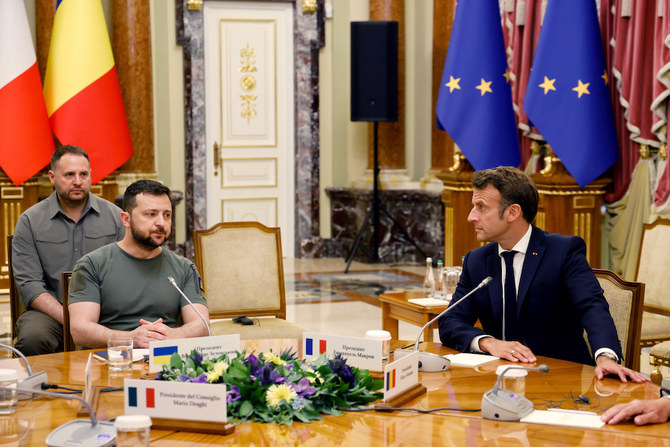
Ukrainian President Volodymyr Zelenskyy, left, speaks with French President Emmanuel Macron in Mariyinsky Palace, in Kyiv. (AP)
2 / 2
From right: German Chancellor Olaf Scholz, French President Emmanuel Macron and Italian Prime Minister Mario Draghi on board a train bound to Kyiv after departing from Poland on June 16, 2022. (AFP)
Short Url
Updated 16 June 2022
Follow

European leaders meet Zelensky in Kyiv for first time since war began

  • Kyiv has criticized France, Germany and, to a lesser extent, Italy, for alleged foot-dragging in their support for Ukraine

IRPIN, Ukraine: The leaders of France, Germany, Italy and Romania met Ukrainian President Volodymyr Zelensky on Thursday in a show of support which Kyiv hopes will be followed by more weapons and tougher action to help in the war with Russia.

In the first such visit to the capital since Russia unleashed its invasion, France’s Emmanuel Macron, Germany’s Olaf Scholz, Italy’s Mario Draghi and Romania’s Klaus Iohannis, shook hands with Zelensky, who has not left Ukraine since war began.

The meeting came after the four European leaders had walked around ruined buildings and wrecked cars in the nearby town of Irpin, the scene of heavy fighting early in the invasion.

The tour was designed to highlight what Ukraine and its backers say were large-scale atrocities committed by Russian troops, what Scholz described as the scene of “unimaginable cruelty” and “senseless violence.”

Standing by gutted, burnt-out buildings, the leaders looked stern as they listened to a Ukrainian minister explaining what had happened there.

They were shown the wreckage of a car which Ukraine says was targeted by Russian troops when a mother and children were inside. Russia denies allegations that its forces committed atrocities.

“It’s a heroic city...marked by the stigma of barbarism,” Macron told reporters.

The leaders, dressed in suits but not wearing any visible protective equipment, were surrounded by heavily armed soldiers.

Kyiv has accused France, Germany and, to a lesser extent, Italy, of foot-dragging in their support for Ukraine, saying they have been slow to deliver weapons and have put their own prosperity ahead of Ukraine’s freedom and security.

Asked about that criticism, Macron pointed to arms deliveries and financial support.

“France and Europe have been standing by Ukraine and its population since the beginning,” he said.

Ukraine’s bid to join the 27-nation European Union, and its demand for more weapons to fight off Russia, are expected to be two main themes of the EU leaders’ talks with Zelensky, who did not accompany them to Irpin.

Shown a slogan on a wall of a damaged building in Irpin that said “Make Europe not war,” Macron said: “It’s very moving to see that. This is the right message.”

After the leaders spoke to Irpin’s mayor and other officials, Draghi added: “Much of what they talked about was reconstruction. Words of pain, of hope, but also of what they want to do in the future.”

The Kremlin said the leaders should use their time with Zelensky to take a “realistic look at the state of affairs” rather than discussing more arms shipments to Kyiv.

Dmitry Medvedev, deputy head of Russia’s Security Council, mocked the visit as having “zero use” and having “promised EU membership and old howitzers to Ukraine.”


German drone deal under scrutiny over Thiel stake in start-up

Updated 4 sec ago
Follow

German drone deal under scrutiny over Thiel stake in start-up

  • Dietmar Bartsch of the far-left Die Linke called for halting the deal
  • The proposed contracts have an initial combined value of $630m

BERLIN: A major proposed combat drone deal for Germany’s military is facing scrutiny from lawmakers worried about US tech billionaire Peter Thiel’s involvement in one of the defense start-ups.
Contracts for Berlin-based Stark Defense, where Thiel holds a stake, and Munich-based Helsing to supply the attack drones will come before parliament’s budget committee next week.
Greens MP Sara Nanni, a security policy spokeswoman for her party, told AFP on Thursday that the controversial right-wing billionaire’s influence raises possible problems.
The strategic importance of the deal means that investor-related risks need to be carefully vetted, she said, adding that “I have to take a very close look at it.”
The German-born Thiel, a co-founder of tech firms PayPal and Palantir and a key early investor in Facebook, is a close confidante of US President Donald Trump.
His right-wing libertarian views and outspoken skepticism of liberal democracies have made him a highly polarizing figure.
Dietmar Bartsch of the far-left Die Linke called for halting the deal, arguing to AFP that paying billions to a firm sponsored by “an avowed opponent of liberal democracies is unacceptable.”
Defense Minister Boris Pistorius, a Social Democrat (SPD), also expressed reservations when he said Tuesday that, before awarding the contract to Stark Defense, it must be clarified “what influence Mr.Thiel actually has.”
The proposed contracts have an initial combined value of 536 million euros ($630 million) but include options that could expand the value into the billions.
The chairman of parliament’s defense committee, conservative MP Thomas Roewekamp, largely dismissed concerns about Thiel in comments to the RND news network.
The “small stake held by an American investor” is only of “minor importance,” he said, adding that the drones are urgently needed, particularly to defend German troops deployed to NATO’s eastern flank in Lithuania.
Roewekamp said there remained “open questions regarding the price, the quantity and the technical capabilities” of the drones — but that those issues can be resolved “through the usual parliamentary process.”
Stark Defense declined to disclose details about Thiel’s stake, other than that is remains below 10 percent.
Thiel’s stake does not involve outsized special rights or influence, the company said, and outside access to confidential technical information is regulated by German authorities.
Speaking generally, lawmakers such as Nanni have voiced support for taking risks in order to build up Europe’s tech and defense industries.
“If we don’t want to buy high-tech equipment from the US, then we also have to be prepared to take on more risk,” Nanni told AFP.
SPD MP Andreas Schwarz, a budget and defense policy expert, told AFP there is still broad support in parliament for awarding the drone contracts.
He also noted that Thiel “has stakes in other software companies used by German authorities and NATO.”
But if the defense minister thinks more clarity is need about Thiel’s influence, then “parliament will support him in this,” Schwarz said.