

Conflict between two utility companies causing prolonged power outages in Karachi

Traders use plastic hand fan to cool themselves during a power cut at their shop in the Pakistan's port city of Karachi on July 15, 2020. (AFP/File)
Short Url
Updated 15 June 2022
Follow

Conflict between two utility companies causing prolonged power outages in Karachi

  • K-Electric owes outstanding dues of Rs9 billion to Sui Southern Gas Company Limited
  • Lack of adequate power generation is making life difficult for traders and residents of Karachi

KARACHI: An ongoing conflict between two utility companies in southern Pakistan has led to prolonged power outages in the country’s most densely populated Karachi city, making residents and traders say the situation has been making their lives and businesses suffer.

The conflict relates to outstanding dues, with K-Electric (K-E), which generates, transmits and distributes electricity in Karachi, owing Rs9 billion to the Sui Southern Gas Company Limited (SSGCL) for the months of May and June.

The situation has reached a stage where Prime Minister Shehbaz Sharif had to take notice of it, seeking an amicable resolution to the dispute which has been affecting the lives of millions of people and disrupting work at thousands of industrial and commercial units spread across the city.

Pakistan’s textile mills’ association urged the government in the beginning of the month to ensure low cost and smooth supply of electricity and natural gas to Karachi, the country’s commercial capital, to prevent it from turning into a “graveyard of industries.”

“Although there has been some improvement in the last couple of days, yet we don’t get electricity in trade centers of the city for four to five hours,” Atiq Mir, president of Karachi’s top union of merchants, told Arab News.
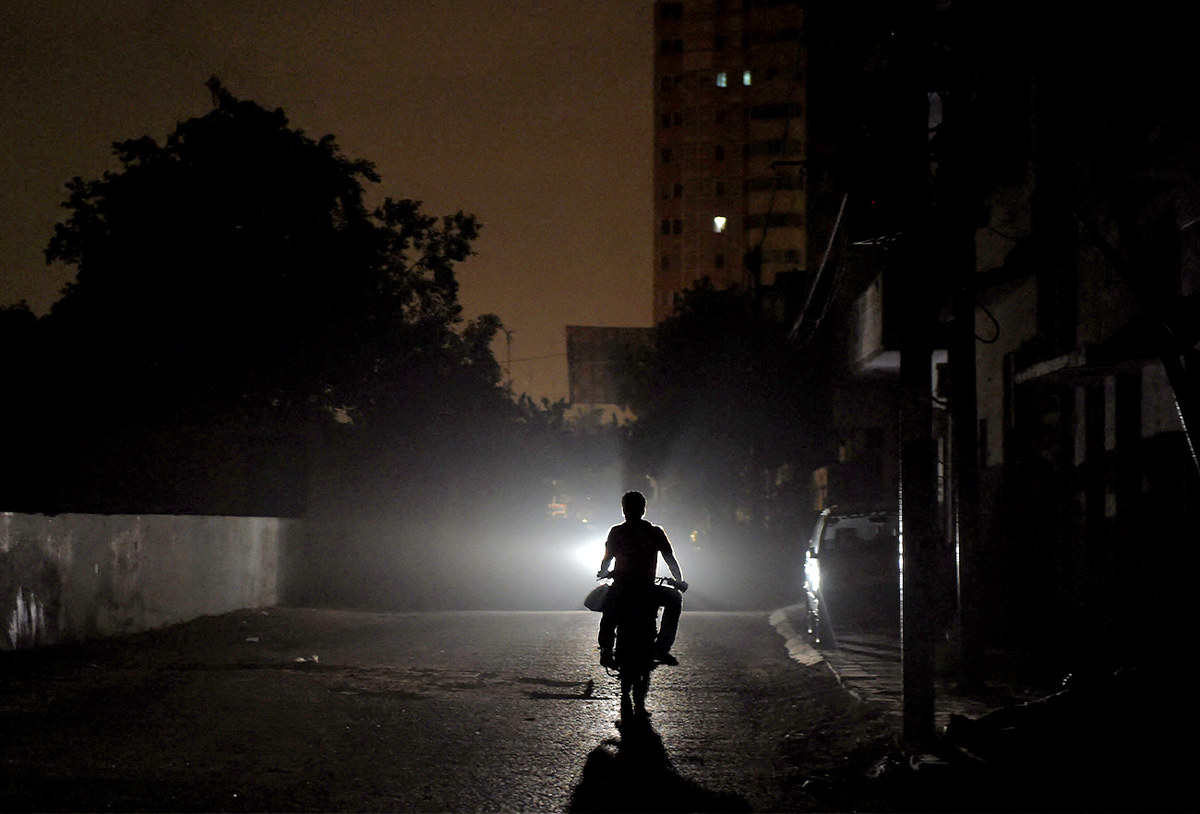


A Pakistani motorist drives on an unlit street during a power cut in Karachi, Pakistan, on July 8 2015. (AFP/File)

He said K-E was unable to maintain sustained power supply, adding it was hurting businesses which were already suffering due to the fragile situation of Pakistan’s national economy.

K-E recently made partial payment of Rs3.2 billion in June to the gas company before adding another Rs1 billion to it on Wednesday.

Mumtaz Ansari, a tailor in downtown Saddar, said power outages, especially before the Muslim festival of Eid next month, was severely affecting his business.

“The price hike [in power tariffs] has already made things difficult for us,” he told Arab News. “Now this load-shedding has also started depriving us of three to five hours of work on a daily basis.”

Ansari said he could not afford to buy a generator and pay for its fuel.

In some parts of the city, residents complained they were deprived of electricity for no less than 12 hours.

“The people of our locality have to face power outages four times a day for three consecutive hours,” said Faizullah Khan who lives in Gulshan-e-Areesha colony.

Rabia Gul, a resident of Gulistan-e-Jauhar area, said prolonged power cuts was causing great distress to many people.

“We cannot wash our clothes or cook anything,” she said. “And then we see elderly members of our family getting sick due to extreme weather conditions.”

The situation recently drew attention of lawmakers in Karachi who requested a special meeting at the energy ministry.

According to Usama Qadri, a National Assembly member present at the official gathering, K-E officials said there would be more power cuts if their company did not get adequate amount of natural gas.

“As per the agreed formula, the SSGCL has to provide 190 mmcfd [million cubic feet per day] of gas to K-E,” he said. “But currently, it is supplying less than 90 mmcfd to the company which is resulting in these outages.”

In a written reply to Arab News, K-E chief executive officer Moonis Alvi said his company had requested the energy ministry for urgent support to ensure the release of about Rs25 billion in net receivables on account of tariff differential subsidies.

“These funds are critical for the continued purchase of fuel to sustain Karachi’s power demand,” he said.

In a recent statement, the SSGCL described K-E as a “defaulter” while warning of reducing gas supply to it under the circumstances.


IMF warns against policy slippage amid weak recovery as it clears $1.2 billion for Pakistan

Updated 11 December 2025
Follow

IMF warns against policy slippage amid weak recovery as it clears $1.2 billion for Pakistan

  • Pakistan rebuilt reserves, cut its deficit and slowed inflation sharply over the past one year
  • Fund says climate shocks, energy debt, stalled reforms threaten stability despite recent gains

ISLAMABAD: Pakistan’s economic recovery remains fragile despite a year of painful stabilization measures that helped pull the country back from the brink of default, the International Monetary Fund (IMF) warned on Thursday, after it approved a fresh $1.2 billion disbursement under its ongoing loan program.

The approval covers the second review of Pakistan’s Extended Fund Facility (EFF) and the first review of its climate-focused Resilience and Sustainability Facility (RSF), bringing total disbursements since last year to about $3.3 billion.

Pakistan entered the IMF program in September 2024 after years of weak revenues, soaring fiscal deficits, import controls, currency depletion and repeated climate shocks left the economy close to external default. A smaller stopgap arrangement earlier that year helped avert immediate default, but the current 37-month program was designed to restore macroeconomic stability through strict monetary tightening, currency adjustments, subsidy rationalization and aggressive revenue measures.

The IMF’s new review shows that Pakistan has delivered significant gains since then. Growth recovered to 3 percent last year after shrinking the year before. Inflation fell from over 23 percent to low single digits before rising again after this year’s floods. The current account posted its first surplus in 14 years, helped by stronger remittances and a sharp reduction in imports. And the government delivered a primary budget surplus of 1.3 percent of GDP, a key program requirement. Foreign exchange reserves, which had dropped dangerously low in 2023, rose from US$9.4 billion to US$14.5 billion by June.

“Pakistan’s reform implementation under the EFF arrangement has helped preserve macroeconomic stability in the face of several recent shocks,” IMF Deputy Managing Director Nigel Clarke said in a statement after the Board meeting.

But he warned that Islamabad must “maintain prudent policies” and accelerate reforms needed for private-sector-led and sustainable growth.

The Fund noted that the 2025 monsoon floods, affecting nearly seven million people, damaging housing, livestock and key crops, and displacing more than four million, have set back the recovery. The IMF now expects GDP growth in FY26 to be slightly lower and forecasts inflation to rise to 8–10 percent in the coming months as food prices adjust.

The review warns Pakistan against relaxing monetary or fiscal discipline prematurely. It urges the State Bank to keep policy “appropriately tight,” allow exchange-rate flexibility and improve communication. Islamabad must also continue raising revenues, broadening the tax base and protecting social spending, the Fund said.

Despite the progress, Pakistan’s structural weaknesses remain severe.

Power-sector circular debt stands at about $5.7 billion, and gas-sector arrears have climbed to $11.3 billion despite tariff adjustments. Reform of state-owned enterprises has slowed, including delays in privatizing loss-making electricity distributors and Pakistan International Airlines. Key governance and anti-corruption reforms have also been pushed back.

The IMF welcomed Pakistan’s expansion of its flagship Benazir Income Support Program, which raises cash transfers for low-income families and expands coverage, saying social protection is essential as climate shocks intensify. But it warned that high public debt, about 72 percent of GDP, thin external buffers and climate exposure leave the country vulnerable if reform momentum weakens.

The Fund said Pakistan’s challenge now is to convert short-term stabilization into sustained recovery after years of economic volatility, with its ability to maintain discipline, rather than the size of external financing alone, determining the durability of its gains.