

Conflict between two utility companies causing prolonged power outages in Karachi

Traders use plastic hand fan to cool themselves during a power cut at their shop in the Pakistan's port city of Karachi on July 15, 2020. (AFP/File)
Short Url
Updated 15 June 2022
Follow

Conflict between two utility companies causing prolonged power outages in Karachi

  • K-Electric owes outstanding dues of Rs9 billion to Sui Southern Gas Company Limited
  • Lack of adequate power generation is making life difficult for traders and residents of Karachi

KARACHI: An ongoing conflict between two utility companies in southern Pakistan has led to prolonged power outages in the country’s most densely populated Karachi city, making residents and traders say the situation has been making their lives and businesses suffer.

The conflict relates to outstanding dues, with K-Electric (K-E), which generates, transmits and distributes electricity in Karachi, owing Rs9 billion to the Sui Southern Gas Company Limited (SSGCL) for the months of May and June.

The situation has reached a stage where Prime Minister Shehbaz Sharif had to take notice of it, seeking an amicable resolution to the dispute which has been affecting the lives of millions of people and disrupting work at thousands of industrial and commercial units spread across the city.

Pakistan’s textile mills’ association urged the government in the beginning of the month to ensure low cost and smooth supply of electricity and natural gas to Karachi, the country’s commercial capital, to prevent it from turning into a “graveyard of industries.”

“Although there has been some improvement in the last couple of days, yet we don’t get electricity in trade centers of the city for four to five hours,” Atiq Mir, president of Karachi’s top union of merchants, told Arab News.
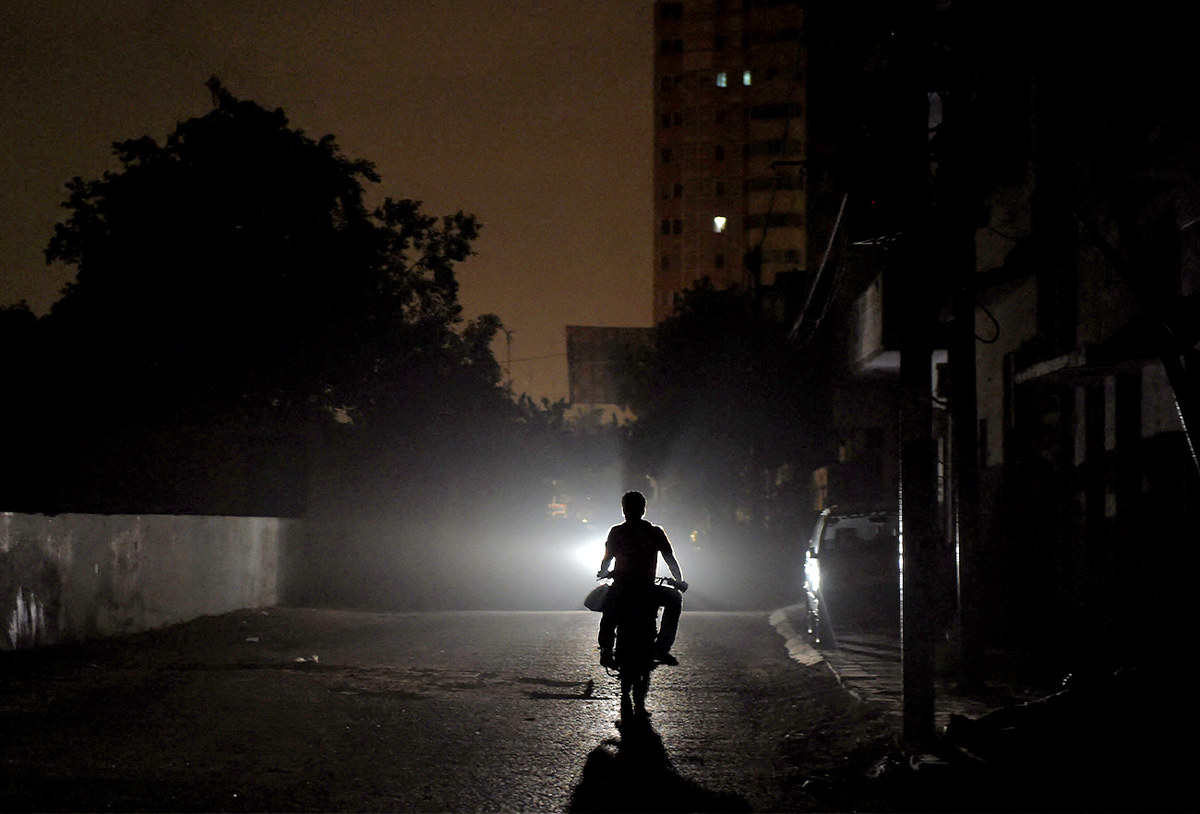


A Pakistani motorist drives on an unlit street during a power cut in Karachi, Pakistan, on July 8 2015. (AFP/File)

He said K-E was unable to maintain sustained power supply, adding it was hurting businesses which were already suffering due to the fragile situation of Pakistan’s national economy.

K-E recently made partial payment of Rs3.2 billion in June to the gas company before adding another Rs1 billion to it on Wednesday.

Mumtaz Ansari, a tailor in downtown Saddar, said power outages, especially before the Muslim festival of Eid next month, was severely affecting his business.

“The price hike [in power tariffs] has already made things difficult for us,” he told Arab News. “Now this load-shedding has also started depriving us of three to five hours of work on a daily basis.”

Ansari said he could not afford to buy a generator and pay for its fuel.

In some parts of the city, residents complained they were deprived of electricity for no less than 12 hours.

“The people of our locality have to face power outages four times a day for three consecutive hours,” said Faizullah Khan who lives in Gulshan-e-Areesha colony.

Rabia Gul, a resident of Gulistan-e-Jauhar area, said prolonged power cuts was causing great distress to many people.

“We cannot wash our clothes or cook anything,” she said. “And then we see elderly members of our family getting sick due to extreme weather conditions.”

The situation recently drew attention of lawmakers in Karachi who requested a special meeting at the energy ministry.

According to Usama Qadri, a National Assembly member present at the official gathering, K-E officials said there would be more power cuts if their company did not get adequate amount of natural gas.

“As per the agreed formula, the SSGCL has to provide 190 mmcfd [million cubic feet per day] of gas to K-E,” he said. “But currently, it is supplying less than 90 mmcfd to the company which is resulting in these outages.”

In a written reply to Arab News, K-E chief executive officer Moonis Alvi said his company had requested the energy ministry for urgent support to ensure the release of about Rs25 billion in net receivables on account of tariff differential subsidies.

“These funds are critical for the continued purchase of fuel to sustain Karachi’s power demand,” he said.

In a recent statement, the SSGCL described K-E as a “defaulter” while warning of reducing gas supply to it under the circumstances.


Pakistan moves to digitize payments for 10 million women under flagship poverty initiative

Updated 5 sec ago
Follow

Pakistan moves to digitize payments for 10 million women under flagship poverty initiative

  • BISP Official says accounts will be linked to phones to boost financial inclusion and curb payment deductions
  • Over 1.9 million SIMs issued as the nationwide rollout continues across provinces ahead of the March deadline

ISLAMABAD: Pakistan’s flagship poverty alleviation initiative, the Benazir Income Support Program (BISP), plans to equip 10 million women with digital bank accounts linked to their phone numbers within four months in one of the largest such exercises in the world, one of its top officials said on Wednesday.

Launched in 2008, the initiative is named after the late former prime minister Benazir Bhutto and has a budget of Rs716 billion ($2.5 billion) during the current fiscal year. Through its Benazir Kafaalat — or financial assistance — program, BISP provides quarterly stipends of Rs13,500 ($48) to around 10 million women.

In an exclusive interview with Arab News, BISP Secretary Amir Ali Ahmed said the opening of digital bank accounts for the beneficiaries was part of Prime Minister Shehbaz Sharif’s initiative related to a cashless economy and digital transformation of the country.

“I’m glad to share that 10 million bank accounts, wallet accounts were created,” he said. “This is a follow-up of the same exercise whereby now 10 million SIMs are being distributed.

“It is significant to share that the entire beneficiary network that we have is female-centric,” he continued. “So these are 10 million female accounts that have been created.”

Ahmed said the process of issuing mobile phone SIM cards to BISP beneficiaries had started on November 17 and would be completed by March next year.

“Let me share that this is one of the largest such exercises to be conducted in the world which is female-centric, linked with financial inclusion and financial empowerment.”

The BISP official added that out of the more than 10 million beneficiaries, only five to 10 percent had bank accounts, but nearly 90 to 95 percent were excluded from the system.

He said they were being linked to the banking system with cellphone SIMs that are being distributed with the help of the IT ministry, Pakistan Telecommunication Authority, National Database and Registration Authority and telecom companies across the country.

“We feel that this initiative of the government of Pakistan will not only result in financial empowerment of our beneficiaries, it will also result in financial inclusion of a segment which was not part of the banking sector in Pakistan,” he said, adding that the move will also lead to transparency.

In the past, there have been complaints of women not getting their full payment from bank officials in the absence of their own accounts, but Ahmed said this was going to change.

“They will be free from any exploitation at the agent networks, the queues that one would witness, the complaints of corruption or deductions that would emerge,” he continued.

According to official data, more than 1.9 million SIMs have so far been issued for BISP beneficiaries across the country.

The province of Punjab leads the rollout with 810,597 SIMs, followed by Sindh with 523,629 and Khyber Pakhtunkhwa with 371,427 SIMs.

In other regions, Azad Jammu and Kashmir has received 59,617, Balochistan 82,826, Gilgit-Baltistan 45,184, and Islamabad 4,508 SIMs.