Memorials held five years on from London fire tragedy

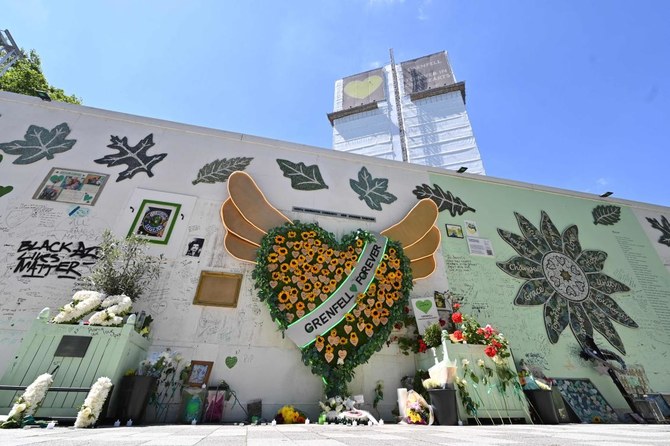
A photograph taken on Tuesday shows messages of support written on a wall surrounding Grenfell tower in west London, on the fifth anniversary of the tragedy. (AFP)
Short Url
Updated 14 June 2022
Follow

Memorials held five years on from London fire tragedy

  • Survivors and families of the victims of the Grenfell Tower fire gathered at Westminster Abbey for the first of a day of events to remember the tragedy
  • Attendees observed a 72-second silence and laid flowers at the foot of the tower

LONDON: The names of the 72 people who perished in Britain’s worst residential fire since World War II were read out on Tuesday at a church service marking the fifth anniversary of the blaze.
Survivors and families of the victims of the Grenfell Tower fire gathered at Westminster Abbey for the first of a day of events to remember the tragedy.
The fire started in a faulty freezer and ripped through the 24-story block in west London in an inferno that was visible across the British capital.
An official report blamed highly combustible cladding fixed to the exterior of the high-rise as the “principal reason” the fire spread.
But despite a costly ongoing public inquiry, the government has been accused of failing to implement urgent safety changes to prevent a similar tragedy.
Also on Tuesday, attendees observed a 72-second silence and laid flowers at the foot of the tower, which is still shrouded in tarpaulin.
Five years on, emotions remain raw about the treatment of survivors and the bereaved, some of whom are yet to be permanently rehoused.
The local Anglican Bishop of Kensington, Graham Tomlin, said in the years before the fire, Grenfell had become a “tinderbox” and a tragedy was inevitable.
“The memory of today is really hard for people,” he told Times Radio. “People are still deeply traumatized by it.”
Firefighters who braved the heat and flames to try to rescue residents have accused the government of failing to take fire safety seriously.
The general secretary of the Fire Brigades Union, Matt Wrack, said firefighters and the Grenfell community had a “bond that was forged in tragedy.”
But there had been job cuts across the service since 2017.
“The community has faced constant denials from those responsible for Grenfell being covered in cladding as flammable as petrol,” he said.
“They have faced a wait for criminal charges that continues to this day.”
The FBU has also highlighted “multiple failings” in the testing and approval of cladding, insulation and other material used in the Grenfell Tower.
It claimed the tragedy could have been averted had the building’s regulator not been privatised and been “dependent on fee income” from manufacturers.
Grenfell campaigners say the fire and its aftermath has exposed gaping social inequality.
They argue changes would have been implemented sooner had low-income workers and ethnic minority families in social housing not been the ones affected.
There has also been a wider outcry among homeowners who have been forced to pay for the removal of unsafe cladding in the high-rises where they live.
Many have been unable to sell their properties or get proper insurance.
The Times newspaper reported that some 640,000 people were still living in buildings with the same type of cladding material.
Government ministers have also been condemned for advising as late as last month that residents should wait for help before evacuating during a high-rise fire.
“A lot of people who managed to survive were people who managed to get out early because they ignored the ‘stay put’ advice,” said Tiago Alves, 25, who escaped with his mother, father and younger sister.
“I’m gobsmacked at the fact that we’re still having this conversation five years on.”
London Mayor Sadiq Khan, from the main opposition Labour party, praised survivors for their campaign to improve public safety.
The ongoing public inquiry was “painstakingly unearthing the truth” — that profits were prioritized over public safety and deregulation weakened building standards, he said.
“The response from the government, building developers and owners has fallen far short of what the families of the victims and survivors have every right to expect,” he wrote in The Observer on Sunday.
“We still have too many residents in London and across the country living in high-rise buildings that are covered in dangerous flammable cladding, and we are still seeing designs for buildings that have critical safety failings.”


Trump cuts India tariffs as Modi ‘agrees’ to stop buying Russian oil

Updated 32 min 24 sec ago
Follow

Trump cuts India tariffs as Modi ‘agrees’ to stop buying Russian oil

  • US will impose an 18 percent tariff on Indian goods, down from the earlier 50 percent punitive levy
  • Withdrawal from Russian oil may affect India’s relations with BRICS, expert says

NEW DELHI: The US and India have announced reaching a trade agreement after months of friction, with President Donald Trump saying that Prime Minister Narendra Modi had “agreed” to halt purchases of Russian oil.

In August, Trump accused India, which imports most of its crude oil, of funding Moscow’s war in Ukraine and subjected it to a combined tariff rate of about 50 percent on most of the exports.

Following a call with Modi on Monday, Trump took to social media to say that he would cut with immediate effect US levies on Indian goods to 18 percent after Modi “agreed to stop buying Russian Oil, and to buy much more from the United States and, potentially, Venezuela.”

At the same time, India, Trump wrote, would “reduce their Tariffs and Non Tariff Barriers against the United States, to ZERO,” committing to buy “over $500 BILLION DOLLARS of US Energy, Technology, Agricultural, Coal, and many other products.”

Modi confirmed the agreement on social media, saying: “Made in India products will now have a reduced tariff of 18 percent,” without commenting on Russian oil or duty-free imports of American goods.

When the US announced its punitive tariffs last year, India quickly moved forward with free trade negotiations with other countries — signing a deal with Oman and finalizing negotiations with New Zealand and the EU.

While the agreements were expected to partially offset the loss of exports to the US, economists did not expect they would immediately mitigate it, as shifting supply chains takes time.

The newly announced agreement with the US will therefore offer short-term relief for Indian exporters — especially of textiles, gems, jewelry and marine products — who were facing the threat of a market exit.

“In that case, the trade deal with the US is a welcome step. It provides short-term relief, allowing India to continue exporting to the US without being forced to exit the US market and diversify with a huge transition cost,” said Anisree Suresh, geoeconomics researcher at the Takshashila Institution.

“However, one shouldn’t look at it as a comprehensive long-term trade deal like the one India signed with the EU. The unpredictability of the Trump administration remains a major concern, regardless of whether there is a trade deal with the US ... India cannot treat this deal the same as other FTAs, as it is limited in scope and subject to reversal.”

When the US imposed its punitive tariffs on India, about 66 percent of total Indian exports were subject to that rate. Overall, India recorded a negative margin of 19.5 percent, meaning its exports were taxed more heavily than those of its competitors.

“From that point of view, Indian goods will have a larger market over there. However, there’s a problem when we talk about a 0 percent tariff on the US,” said Prof. Arun Kumar, a development economist.

“The US will be able to export a lot more to India, and therefore it will affect our production within the economy. And that will be a setback, so while exports may rise, the internal economy may actually suffer because of this decrease in tariffs on American goods. And especially if it affects agriculture.”

The sudden withdrawal from India’s partnership with Russia may not have a serious economic impact but politically could affect New Delhi’s relations, also with other countries, especially those from BRICS — a grouping that besides India and Russia includes also Brazil and China, and is the most powerful geopolitical forum outside of the Western world.

“You can always substitute Russian oil with some other oil, but I think it’s more of a strategic question, because India and Russia have had long-standing relationships, and if we bend to US pressure and reduce purchases from Russia, then it will affect in future also our relationship with Russia, because we will not be seen as a stable ally,” Kumar said.

“BRICS nations will not trust India very much in the future ... and that’s what Trump wants. He wants to disrupt BRICS. That’s what he has been doing right since the beginning to divide nations and deal with them individually.”