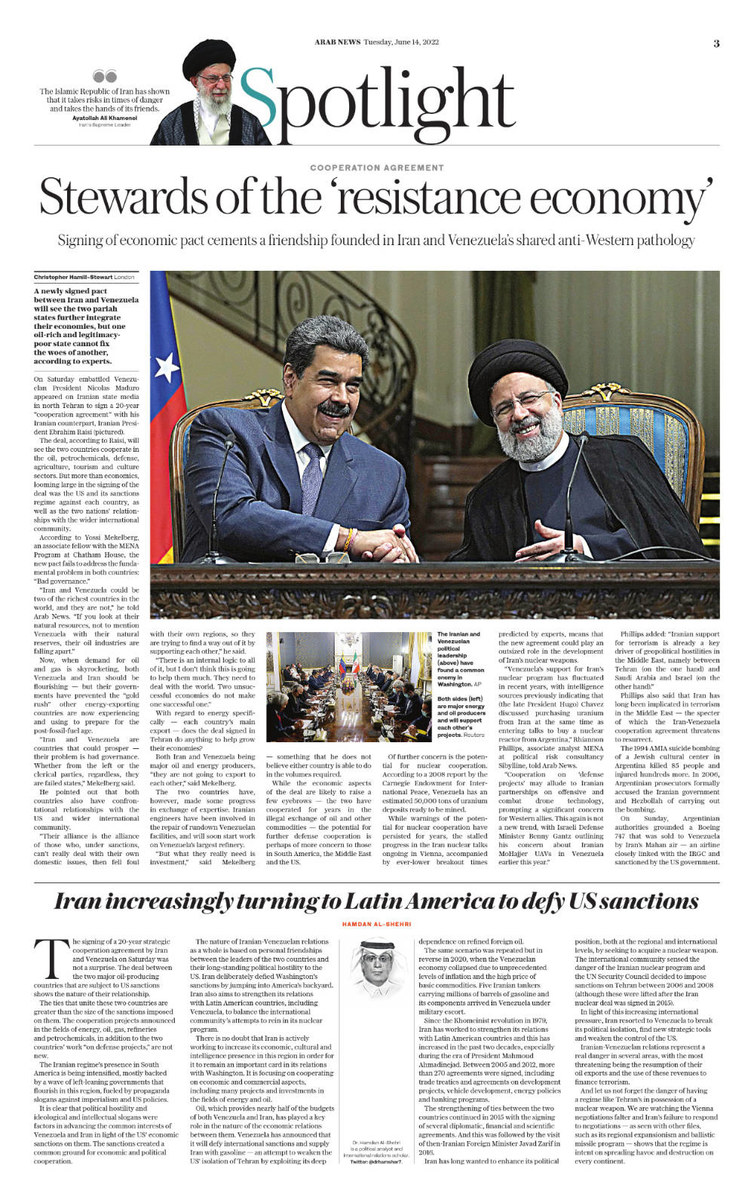
LONDON: A newly inked cooperation deal between Iran and Venezuela will see the two pariah states further integrate their economies, but one oil-rich and legitimacy-poor state cannot fix the woes of another, according to experts.
On Saturday embattled Venezuelan President Nicolas Maduro appeared on Iranian state media in north Tehran to sign a 20-year “cooperation agreement” with his Iranian counterpart, Iranian President Ebrahim Raisi.
The deal, according to Raisi, will see the two countries cooperate in the oil, petrochemicals, defense, agriculture, tourism and culture sectors. But more than economics, looming large in the signing of the deal — an unlikely covenant between a Shiite theocratic regime on one side and a communist dictatorship on the other — was the US and its sanctions regime against each country, as well as the two nations’ relationships with the wider international community.
“Venezuela has shown exemplary resistance against sanctions and threats from enemies and imperialists,” Iran’s Raisi said. “The 20-year cooperation document is testimony to the will of the two countries to develop ties.”

“Sanctions and threats against the Iranian nation over the past 40 plus years have been numerous, but the Iranian nation has turned these sanctions into an opportunity for the country’s progress.”
But to Yossi Mekelberg, an associate fellow with the MENA Program at Chatham House, the deal fails to address the fundamental problem in both countries: “Bad governance.”
“Iran and Venezuela could be two of the richest countries in the world, and they are not,” he told Arab News. “If you look at their natural resources, not to mention Venezuela with their natural reserves, their oil industries are falling apart.”
Now, when demand for oil and gas is skyrocketing, both Venezuela and Iran should be flourishing — but their governments have prevented the “gold rush” other energy-exporting countries are now experiencing and using to prepare for the post-fossil-fuel age.
“Iran and Venezuela are countries that could prosper — their problem is bad governance. Whether from the left or the clerical parties, regardless, they are failed states,” Mekelberg said.
He pointed out that both countries also have confrontational relationships with the US and wider international community.
“Their alliance is the alliance of those who, under sanctions, can’t really deal with their own domestic issues, then fell foul with their own regions, so they are trying to find a way out of it by supporting each other,” he said.
Opinion
This section contains relevant reference points, placed in (Opinion field)
“There is an internal logic to all of it, but I don’t think this is going to help them much. They need to deal with the world. Two unsuccessful economies do not make a successful one.”
With regard to energy specifically — each country’s main export — does the deal signed in Tehran do anything to help grow their economies?
Both Iran and Venezuela being major oil and energy producers, “they are not going to export to each other,” said Mekelberg.
The two countries have, however, made some progress in exchange of expertise. Iranian engineers have been involved in the repair of rundown Venezuelan facilities, and will soon start work on Venezuela’s largest refinery.
“But what they really need is investment,” said Mekelberg — something that he does not believe either country is able to do in the volumes required.
While the economic aspects of the deal are likely to raise few eyebrows — the two have cooperated for years in the illegal exchange of oil and other commodities — the potential for further defense cooperation is perhaps of more concern to those in South America, the Middle East and the US.
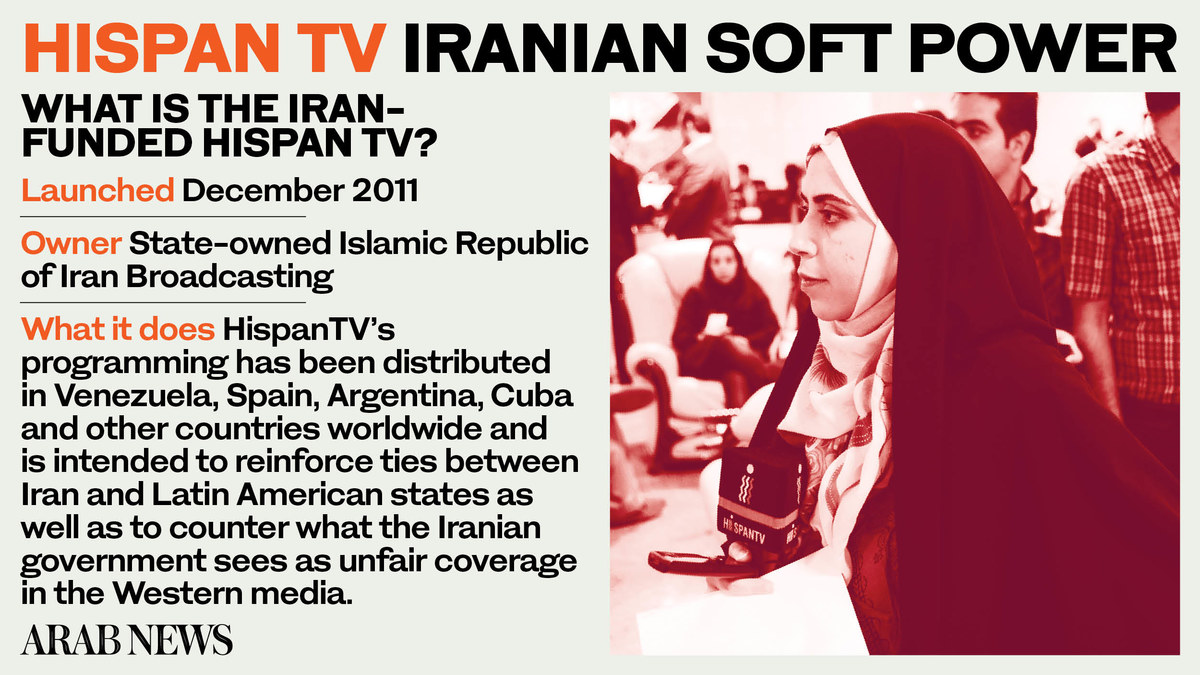
As early as 2006, Venezuela and Iran cooperated militarily. In a speech given to the Brookings Institution in 2009, a district attorney for New York raised the alarm about Iran’s training of Venezuelan fighters into Hezbollah-style terrorists.
“It has been reported that since 2006 Iranian military advisers have been embedded with Venezuelan troops,” the late Robert Morgenthau had said. “Asymmetric warfare, taught to members of Iran’s Revolutionary Guard, Hezbollah and Hamas, has replaced US army field manuals as the standard Venezuelan military doctrine.”
And perhaps of further concern is the potential for nuclear cooperation. According to a 2008 report by the Carnegie Endowment for International Peace, Venezuela has an estimated 50,000 tons of uranium deposits ready to be mined.
While warnings of the potential for nuclear cooperation have persisted for years, the stalled progress in the Iran nuclear talks ongoing in Vienna, accompanied by ever-lower breakout times predicted by experts, means that the new agreement could play an outsized role in the development of Iran’s nuclear weapons.
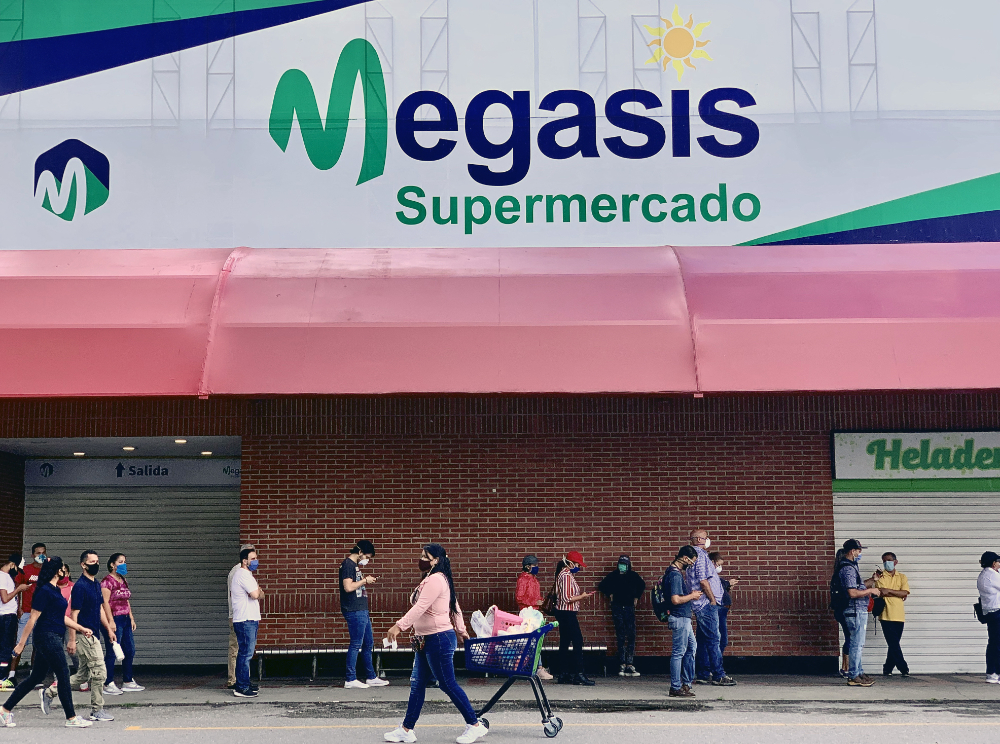
The new deal will see the two pariah states further integrate their economies. (AFP)
“Venezuela’s support for Iran’s nuclear program has fluctuated in recent years, with intelligence sources previously indicating that (the late President Hugo) Chavez discussed purchasing uranium from Iran at the same time as entering talks to buy a nuclear reactor from Argentina,” Rhiannon Phillips, associate analyst MENA at political risk consultancy Sibylline, told Arab News.
“Cooperation on ‘defense projects’ may allude to Iranian partnerships on offensive and combat drone technology, prompting a significant concern for Western allies. This again is not a new trend, with Israeli Defense Minister Benny Gantz outlining his concern about Iranian MoHajjer UAVs in Venezuela earlier this year, with reported ranges of up to 200 km.”
Phillips added: “Iranian support for terrorism is already a key driver of geopolitical hostilities in the Middle East, namely between Tehran (on the one hand) and Saudi Arabia and Israel (on the other hand). But it could elevate concerns among Latin American countries if Venezuelan capabilities exceed or violate the threshold of regional security.
FASTFACTS
• Agreement covers political, cultural, tourism, economic, oil and petrochemical fields.
• Iran has delivered the second of four vessels it is contracted to build for Venezuela.
“Notably, Diego Molano, Colombia’s defense minister, has already expressed concern over the presence of Iranian proxies in Venezuela, namely Hezbollah militants, and the likelihood of these groups seeking to utilize Iranian military technology to carry out domestic attacks.”
Phillips also said that Iran has long been implicated in terrorism in the Middle East — the specter of which the Iran-Venezuela cooperation agreement threatens to resurrect.
The 1994 AMIA suicide bombing of a Jewish cultural center in Argentina killed 85 people and injured hundreds more. In 2006, Argentinian prosecutors formally accused the Iranian government and Hezbollah of carrying out the bombing. And it appears that Argentina has not forgotten that attack.
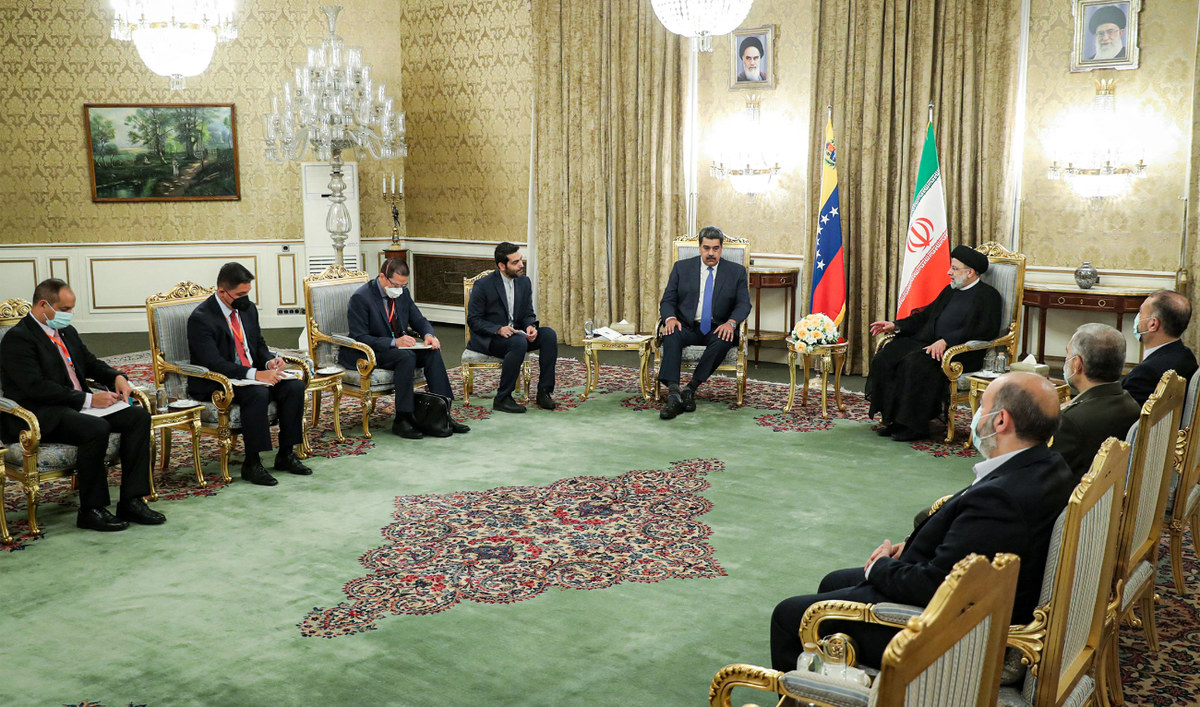
Both sides are major energy and oil producers and will support each other’s projects. (AFP)
On Sunday, Argentinian authorities grounded a Boeing 747 that was sold to Venezuela by Iran’s Mahan air — an airline closely linked with the IRGC and sanctioned by the US government.
According to an Argentinian Interior Ministry document shared with Reuters by Argentine lawmaker Gerardo Milman, 14 Venezuelans and 5 Iranians were traveling on the plane. Milman warned: “Our information is that this is a plane that has come to conduct intelligence in Argentina.”
It is not clear what the agents were investigating. What is clear, though, is that Argentina, acutely and tragically familiar with Iranian terrorism, is unwilling to take the risk of waiting too long where national security is involved.