

Pakistani megapolis appoints women as duty officers in male-dominated police force

This photo shared by Special Services Unit Sindh on March 9, 2020 shows women cops in Pakistan's Sindh province. (Facebook/SSU Sindh Police)
Short Url
Updated 12 June 2022
Follow

Pakistani megapolis appoints women as duty officers in male-dominated police force

  • Police hope the presence of female officers will encourage more people to seek help
  • Sindh police chief says women duty officers will also be appointed at other police stations across the province 


KARACHI: Police authorities in Pakistan’s southern megapolis of Karachi have started appointing women as duty officers to improve the culture of the male-dominated force, a top official said on Saturday.
While women police stations were introduced in Karachi, the capital of Sindh province, two decades ago, and female personnel have been appointed as station house officers, it is the first time for them to serve as duty officers and moharars — police clerks who record complaints.
“We are trying to improve the culture of police stations and for this purpose have started to appointing women as duty officers and head and assistant moharars in police stations in Karachi,” Sindh Police Inspector General Ghulam Nabi Memon told Arab News, adding that in such appointments will also be made at other police stations across the province.
Police hope the presence of female duty officers will encourage more women to seek help when needed.

“Duty officers and clerks are the first points of contact for complainants at police stations. Appointment of women at these basic posts of direct public dealing will push complainants, especially women, to go to police stations and lodge FIRs,” Memon said.
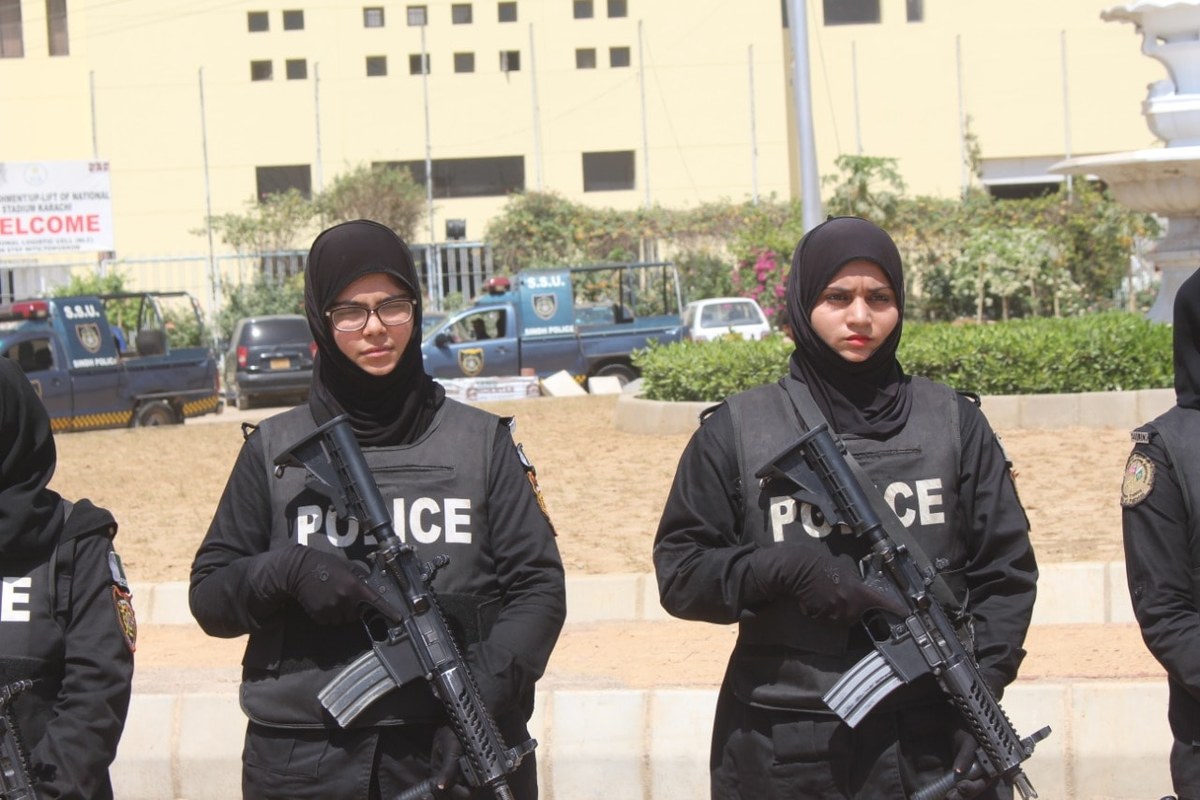


This photo shared by Special Services Unit Sindh on March 9, 2020 shows women cops in Pakistan's Sindh province. (Facebook/SSU Sindh Police)

Zoha Waseem, assistant professor at University of Warwick who researches policing in South Asia, said the appointment of women was a “positive move.”

“It’s believed that the appointment of women on such positions can encourage female victims to file complaints because the stations are otherwise male dominated,” she told Arab News.

For the initiative to be sustainable, she added, the police force would however need to adjust the working hours of female staff, giving women officers the chance to attend to their family duties as well.

“The sustainability can be possible only if female officers at junior levels are given proper promotions, their duty hours are made better and if they have kids they should also be taken care of,” Waseem said. “If you don’t take their time and family considerations into account, they may not stay.”

For Muhammad Ramzan Channa, a retired inspector general who has been a member of police reform committees, the Sindh police initiative was a “huge way forward toward a better police system.”

“The conduct of women is relatively good compared to male officers at police stations,” he said. “It will benefit society, help empower women, but most importantly, this initiative will result in better policing and improve police’s image.”


Pakistan approves $713 million to ease power sector’s cash flow constraints

Updated 5 sec ago
Follow

Pakistan approves $713 million to ease power sector’s cash flow constraints

  • Finance minister chairs Economic Coordination Committee meeting to approve grants, review economic situation
  • Pakistan is grappling with a ballooning “circular debt,” or unpaid bills and subsidies, that has choked its power sector

KARACHI: Pakistan’s top economic body this week approved a grant of $713 million to ease the power sector’s cash flow constraints, the Finance Division said in a statement, as Islamabad looks to reform its priority sectors. 

The development took place as Finance Minister Muhammad Aurangzeb chaired a meeting of the Economic Coordination Committee (ECC) to approve grants for various projects and review the overall economic situation of the country. 

“[ECC approved] another Technical Supplementary Grant amounting to Rs200 billion ($713 million) under the head of Government of Pakistan investment in DISCOs’ equity to address cash flow constraints in the power sector,” the Finance Division said on Thursday. 

DISCOs, which handle billing, recoveries and grid maintenance, have long suffered from corruption and political interference. 

Pakistan has attempted to privatize its loss-making state-owned enterprises to raise funds and reform them as envisaged under a $7 billion International Monetary Fund (IMF) program secured last year. 

Prime Minister Shehbaz Sharif’s government plans to privatize three DISCOs, the Islamabad Electric Supply Company (IESCO), Faisalabad Electric Supply Company (FESCO) and Gujranwala Electric Power Company (GEPCO) in the months ahead. 

The Pakistani government, which owns or controls much of the power infrastructure, is grappling with a ballooning “circular debt,” or unpaid bills and subsidies, that has choked the power sector and weighed on the economy.

The liquidity crunch has disrupted supply, discouraged investment and added to fiscal pressure, making it a key focus under Pakistan’s IMF program.

The ECC also approved, on the interior ministry’s proposal, a provision of Rs 4.775 billion [$17.19 million] as payment to 945 families of “missing persons” as identified by the Commission of Inquiry on Enforced Disappearances. 

“The disbursement will be made under the supervision of the Commission in accordance with approved procedures,” it added. 

Taking stock of the economic situation, the ECC noted that cumulative inflation for the period July–November averaged 5 percent, which it said was “significantly lower” than the 7.9 percent figure recorded during the corresponding period of the previous year. 

It attributed this improvement to prudent fiscal management, effective price stabilization measures and close market monitoring by the government.