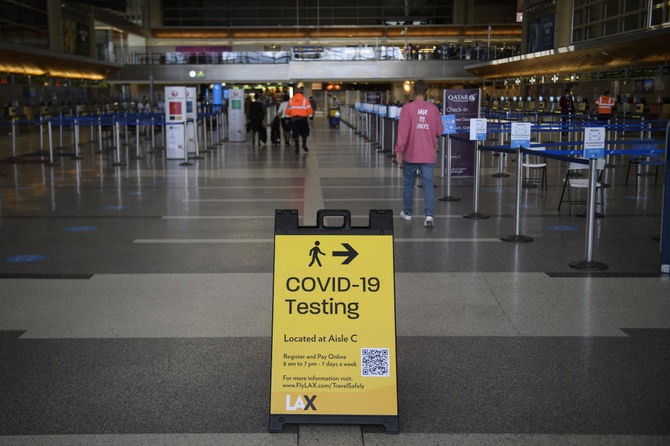
WASHINGTON: The Biden administration is lifting its requirement that international travelers test negative for COVID-19 within a day before boarding a flight to the United States, ending one of the last remaining government mandates designed to contain the spread of the coronavirus.
The Centers for Disease Control and Prevention announced Friday that the requirement will end early Sunday morning. The health agency said it will continue to monitor state of the pandemic and will reassess the need for a testing requirement if the situation changes.
“This step is possible because of the progress we’ve made in our fight against COVID-19,” said US Health Secretary Xavier Becerra.
Airline and tourism groups have been pressing the administration for months to eliminate the testing requirement, saying it discourages people from booking international trips because they could be stranded overseas if they contract the virus on their trip.
Roger Dow, president of the US Travel Association, called lifting the testing rule “another huge step forward for the recovery of inbound air travel and the return of international travel to the United States.”
Airlines argued that the rule was put into effect when few Americans were vaccinated — now 71 percent of those 5 and older are fully vaccinated, according to CDC figures. They also complained that people entering the US at land borders are not required to test negative for COVID-19, although they must show proof of vaccination.
While domestic US travel has returned nearly to pre-pandemic levels, international travel — which is very lucrative for the airlines — has continued to lag. In May, US international air travel remained 24 percent below 2019 levels, with declines among both US and foreign citizens, according to trade group Airlines for America.
Many other countries have lifted their testing requirements for fully vaccinated and boosted travelers in a bid to increase tourism.
Some infectious-disease experts said they were comfortable with the CDC’s decision, and that lifting the restriction is unlikely to cause further spread of the virus in the US
Dr. William Schaffner of Vanderbilt University said the rule was designed to prevent importing the virus, “but we’ve got plenty of COVID here. It’s like telling someone not to pour a bucket of water in their swimming pool.”
Dr. Peter Chin-Hong at the University of California, San Francisco, said travel restrictions demonstrate that officials are trying to keep variants out, “but they haven’t really shown to be beneficial, ever.” However, he said, requiring foreign visitors to be vaccinated makes sense to avoid straining the US health-care system with people who could develop severe disease.
The requirement for a negative COVID-19 test before flying to the US dates to January 2021 and is the most visible remaining US travel restriction of the pandemic era.
In April, a federal judge in Florida struck down a requirement that passengers wear masks on planes and public transportation, saying that the CDC had exceeded its authority. The Biden administration is appealing that ruling, saying it aims to protect the CDC’s ability to respond to future health emergencies.
The Biden administration put the testing requirement in place as it moved away from rules that banned nonessential travel from dozens of countries — most of Europe, China, Brazil, South Africa, India and Iran — and focused instead on classifying individuals by the risk they pose to others. It was coupled with a requirement that foreign, non-immigrant adults traveling to the United States need to be fully vaccinated, with only limited exceptions.
The initial mandate allowed those who were fully vaccinated to show proof of a negative test within three days of travel, while unvaccinated people had to present a test taken within one day of travel.
In November, as the highly transmissible omicron variant swept the world, the Biden administration toughened the requirement and required all travelers — regardless of vaccination status — to test negative within a day of travel to the US
In February, travel groups argued that the testing requirement was obsolete because of the high number of omicron cases already in every state, higher vaccinations rates and new treatments for the virus.
Meanwhile, travelers found creative ways around the rule. This spring, several Canadian teams in the National Hockey League flew to cities near the border, then took buses into the US to avoid the risk of losing players who tested positive.
US airlines estimate that dropping the test requirement will mean 4.3 million more passengers in one year.
It is unclear, however, whether airlines can boost flights quickly enough to handle that kind of increase. Airlines facing a shortage of pilots have already scaled back their original schedules for the peak summer vacation season.
Brett Snyder, a travel adviser who writes about the industry at CrankyFlier.com, said the requirement has caused some people to postpone international travel.
“It’s not that they are afraid of getting sick, they don’t want to get stuck,” Snyder said. He thinks there will now be a surge in booking those trips, “which, if anything, will lead to higher fares.”
Hotels, theme parks and other travel businesses also lobbied the administration to drop the rule.
“The whole industry has been waiting for this announcement,” said Martin Ferguson, a spokesman for American Express Global Business Travel, which advises companies on travel policy. He said there are few remaining pandemic policies that cause so much consternation for the travel sector, with China’s “zero-COVID” restrictions being another.
Despite ending the testing requirement, the CDC said it still recommends COVID-19 testing prior to air travel of any kind as a safety precaution.

US lifts COVID-19 test requirement for international travel
Short Url
https://arab.news/6hkay
US lifts COVID-19 test requirement for international travel
- Airline and tourism groups have been pressing the administration for months to eliminate the testing requirement
- Many other countries have lifted their testing requirements for fully vaccinated and boosted travelers in a bid to increase tourism
I want answers from my ex-husband, Gisele Pelicot tells AFP
- Gisele Pelicot, the French woman who became a symbol in the global fight against sexual violence, told AFP why she wants to visit her ex-husband in jail and her joy at finding love again
PARIS: Gisele Pelicot, the French woman who became a symbol in the global fight against sexual violence, told AFP why she wants to visit her ex-husband in jail and her joy at finding love again.
In an interview ahead of the publication of her memoirs on Tuesday, she also said she hopes to inspire other rape victims to believe in a brighter future — and to change attitudes along the way.
Her book, titled “A Hymn to Life,” covers the full arc of her 50-year marriage which ended when she discovered that her husband had been repeatedly drugging her and inviting strangers over to their house to rape her.
It will be published in 22 languages.
The title of your book in French is “And the joy of living.” Have you found joy again?
“I’m doing better. After the trial (of her husband and 50 other men in 2024), I took stock of my life and today I am trying to rebuild on this field of ruins.
Despite all these ordeals, even in the darkest periods, I have always sought flashes of joy; I am looking toward the future, toward joy. I know this may surprise some who expect to see me in tatters, but I am determined to remain standing and dignified.”
Some describe you as an icon. Do you embrace that status?
“I do not use that word. I think my story has become a symbol. I know where I come from and who I am. It seems to me that we do not suspect the strength we have inside us until we are forced to draw on it, and that is also what I would like to say to victims.”
Why did you write this book?
“I needed to bear witness to my life journey, to address all those who supported me; it was a way of responding to them. Writing this book with (French author) Judith Perrignon, in whom I had complete trust, was both painful and fascinating.
Beyond the case itself, it retraces my life, the journey of three generations of women: my grandmother, my mother and myself. Their example explains my strength because I experienced tragedies very young. When you lose your mother at age nine, you grow up faster than others.”
Have you had professional psychological help to overcome your trauma?
“Of course, I could not get through this alone. How do you sort through 50 years of memories tainted by this series of crimes? I lived for half a century with Mr. Pelicot and I have no memory of the rapes, only the memory of happy days.
I cannot throw my whole life in the bin and tell myself that those years were nothing but a lie. If I did that, I’d collapse.”
At the end of the book, you announce your intention to visit Mr.Pelicot in prison. Why?
“I would like to do it for myself. That visit would be a stage in my reconstruction, an opportunity, for the first time since his arrest in November 2020, to confront him face to face.
How could he have done this to me? How could he have put our entire family through hell? What did he do to (our daughter) Caroline? He may not answer my questions, but I need to ask them.
For the moment, no date has been set for the visit. I do not think it will take place before the end of the year.”
In the book, you speak about your relationships with your three children. Where do they stand?
“It is wrong to think that such a tragedy brings a family together. It is impossible. Each of my children is now trying to rebuild as best they can.
Caroline’s suffering devastates me. She is in a state of anger that I do not share. And there is this doubt (about whether she was raped by her father) that condemns her to a perpetual hell.
I do not question her word, but I do not have the answers. Today, our relationship is calmer and I am happy about that. I will try to support her as best I can.”
Do you intend to remain a public figure?
“I am in my 74th year. I long for calm. I am not a radical feminist; I am a feminist in my own way. I know there is still a long way to go, despite progress on consent. I leave it to the younger generations to change this patriarchal society.
We can pass all the laws we want, but if we do not change mindsets, we will not succeed. That therefore begins above all with the education of our children. Parents must get involved.”
You are about to begin a tour to present your book. With what message?
“A message of hope. After hardship, you can once again allow yourself happiness and be happy. That is what I am doing. I am lucky enough to love again — it is magnificent. I think a life without love is a life without sunshine.”
In an interview ahead of the publication of her memoirs on Tuesday, she also said she hopes to inspire other rape victims to believe in a brighter future — and to change attitudes along the way.
Her book, titled “A Hymn to Life,” covers the full arc of her 50-year marriage which ended when she discovered that her husband had been repeatedly drugging her and inviting strangers over to their house to rape her.
It will be published in 22 languages.
The title of your book in French is “And the joy of living.” Have you found joy again?
“I’m doing better. After the trial (of her husband and 50 other men in 2024), I took stock of my life and today I am trying to rebuild on this field of ruins.
Despite all these ordeals, even in the darkest periods, I have always sought flashes of joy; I am looking toward the future, toward joy. I know this may surprise some who expect to see me in tatters, but I am determined to remain standing and dignified.”
Some describe you as an icon. Do you embrace that status?
“I do not use that word. I think my story has become a symbol. I know where I come from and who I am. It seems to me that we do not suspect the strength we have inside us until we are forced to draw on it, and that is also what I would like to say to victims.”
Why did you write this book?
“I needed to bear witness to my life journey, to address all those who supported me; it was a way of responding to them. Writing this book with (French author) Judith Perrignon, in whom I had complete trust, was both painful and fascinating.
Beyond the case itself, it retraces my life, the journey of three generations of women: my grandmother, my mother and myself. Their example explains my strength because I experienced tragedies very young. When you lose your mother at age nine, you grow up faster than others.”
Have you had professional psychological help to overcome your trauma?
“Of course, I could not get through this alone. How do you sort through 50 years of memories tainted by this series of crimes? I lived for half a century with Mr. Pelicot and I have no memory of the rapes, only the memory of happy days.
I cannot throw my whole life in the bin and tell myself that those years were nothing but a lie. If I did that, I’d collapse.”
At the end of the book, you announce your intention to visit Mr.Pelicot in prison. Why?
“I would like to do it for myself. That visit would be a stage in my reconstruction, an opportunity, for the first time since his arrest in November 2020, to confront him face to face.
How could he have done this to me? How could he have put our entire family through hell? What did he do to (our daughter) Caroline? He may not answer my questions, but I need to ask them.
For the moment, no date has been set for the visit. I do not think it will take place before the end of the year.”
In the book, you speak about your relationships with your three children. Where do they stand?
“It is wrong to think that such a tragedy brings a family together. It is impossible. Each of my children is now trying to rebuild as best they can.
Caroline’s suffering devastates me. She is in a state of anger that I do not share. And there is this doubt (about whether she was raped by her father) that condemns her to a perpetual hell.
I do not question her word, but I do not have the answers. Today, our relationship is calmer and I am happy about that. I will try to support her as best I can.”
Do you intend to remain a public figure?
“I am in my 74th year. I long for calm. I am not a radical feminist; I am a feminist in my own way. I know there is still a long way to go, despite progress on consent. I leave it to the younger generations to change this patriarchal society.
We can pass all the laws we want, but if we do not change mindsets, we will not succeed. That therefore begins above all with the education of our children. Parents must get involved.”
You are about to begin a tour to present your book. With what message?
“A message of hope. After hardship, you can once again allow yourself happiness and be happy. That is what I am doing. I am lucky enough to love again — it is magnificent. I think a life without love is a life without sunshine.”
© 2026 SAUDI RESEARCH & PUBLISHING COMPANY, All Rights Reserved And subject to Terms of Use Agreement.



